Lieutenant Governor Eben S. Draper
By John N. McClintock
In the year 1830, in the first issue of the Boston Transcript, Ira Draper of Milford [Milford??? This is the only place I’ve ever seen Ira Draper listed as being from Milford. Other sources, such as General Draper’s autobiography, say that Ira was a native of Dedham and later moved to Weston. His last years were spent in Saugus. DM] advertised “temples” for weaving, of his own invention and manufacture, then on exhibition in the store of John Lowell. He was the son of Major Abijah Draper, who was a soldier in the Revolutionary War, and a descendant of James and Miriam (Stansfield) Draper, who came from Yorkshire, England, to Roxbury in 1647. The immigrant was a skilled mechanic, familiar with weaving and spinning machinery; and the ancestral trade descended to his posterity. The modest business of Ira Draper flourished; and in due time, his son, George, was associated with him. Both sons were closely identified with the Hopedale Community, which had been founded by Rev. Adin Ballou, as a practical exemplification in every-day life of the principals of the New Testament. In 1852 the two sons succeeded to the business and carried it on under the auspices of the Community, of which Ebenezer D. was then president. Five years later, the Community came to grief financially, and its property was sold. Relying upon the value of the “temple” and other inventions which George had patented, the Draper brothers took the factory, agreeing to settle all the indebtedness.
George Draper became sole proprietor on 1865, and took into partnership his son, Gen. William F. Draper, who had served with distinction in the war of the Rebellion. George A., a younger son, became a member of the firm in 1877, at the age of twenty-one, and in 1880, Eben Sumner, the youngest son, having just attained his majority, became a partner.
Thirty workmen were employed in 1865; in 1886, the year of George Draper’s death, five hundred were on the payroll. The business has made great advances, and a maximum of four thousand employees has since been reached. It was incorporated as the Draper Company in 1897, Gen. William Draper being President, George A., Treasurer, and Eben S., agent. It is the largest manufacturing establishment engaged in the production of cotton milling machinery in the United States. It is affirmed by a competent authority that the machinery introduced and made by this company has effected a saving to the commercial world of two hundred and fifty million dollars.
Though the Community failed financially, its fine spirit has never been lost. Ideal relations have always existed between the employed and their employers. The Corporation has provided convenient work rooms, equipped with the latest appliances for safety and comfort, and attractive houses for its operatives, and has always dealt with them with conspicuous fairness. It has accomplished, largely at its own expense, great public improvements. A beautiful church, a memorial of their parents, has been erected by George A. and Eben S. Draper. The streets have been macadamized, and concrete sidewalks built. Good water, gas and electric lights, an electric railway and a sanitary sewage system have been introduced. Hopedale was the first town in Massachusetts to adopt the Glover sewage system of sewage disposal by rapid filtration in 1899. A great park of a hundred and fifty acres and a playground of six acres are conspicuous features in this beautiful town.
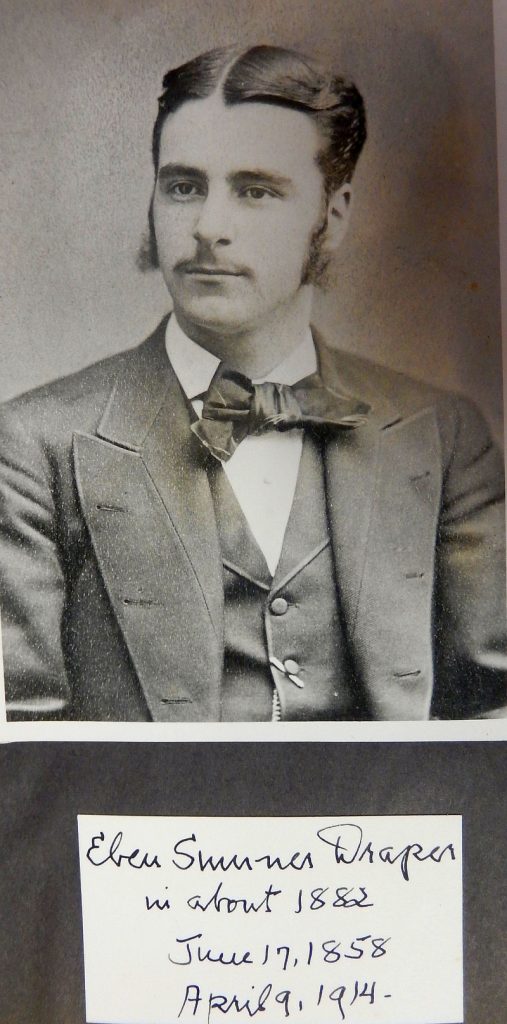
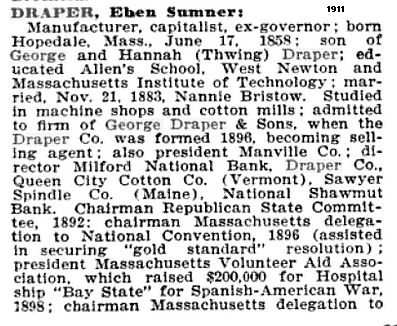
The junior partner in this great industry, after a long political career, is now the Republican candidate for Governor. Eben Sumner Draper was born in Milford (Hopedale) June 17th, 1858. He began his school training in the public schools of his native town, and was prepared for business life in the Allen School, West Newton, one of the best secondary schools in Massachusetts. He then completed a course in the department of engineering, Massachusetts Institute of Technology, and later began work in the Hopedale machine shops, where he was thoroughly trained in the various details of the business. He obtained a practical knowledge of the working of cotton machinery in the cotton mills of Lowell, Manchester and other New England manufacturing cities. Three years of such training were an admirable preparation for his business career. He became interested in politics and achieved his first notable success in 1892, when he was elected Chairman of the Republican State Committee. In 1896, he was the Chairman of the Massachusetts delegation to the Republican National Convention, and he had charge of the canvass of the convention, which secured the adoption of the “gold standard” resolution.
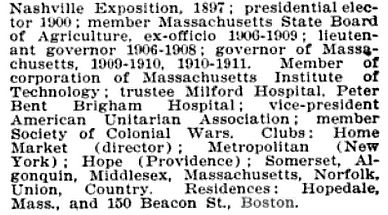
He headed the Massachusetts delegation to the Nashville Exposition in 1897, and was the Republican Elector for the Eleventh Massachusetts district in 1900. During the Spanish war he was President of the Massachusetts Volunteer Aid Association and had a leading part in the purchase and equipment of the hospital ship, Bay State, at an expense of $200,000, and in raising an equal sum for the care of Massachusetts soldiers and sailors. He served as President of the Republican Club of Massachusetts in 1903 and 1904.
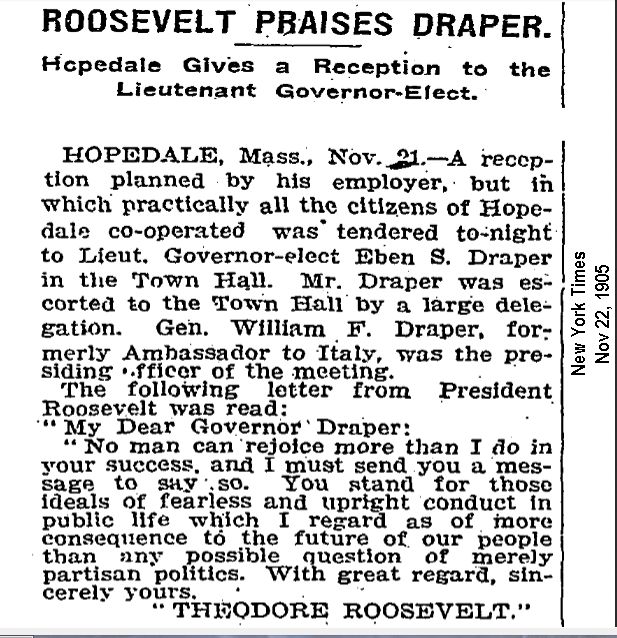
In 1905 Mr. Draper became the candidate of the Republican party for Lieutenant Governor of Massachusetts. The workingmen of Hopedale, when he was nominated, presented him with a signed address, which read:
“A few words from the employees of the Draper Company about Hon. Eben S. Draper and the town of Hopedale.
“Hon. Eben S. Draper is:
“A man of large business ability; “
“A man of sterling honesty and integrity;
“A man interested in philanthropy, and charity, and all measures which tend to improvement and advancement.”
“He is agent of the Draper Company of Hopedale, Mass., a company which is conspicuous among the employers of laboring men on account of the care and attention given to conditions which prevail at their works, among which are ample and commodious shops and workrooms for the employees, up-to-date appliances for the used and safety of the men; steady and regular work so far as business conditions will permit; fair and honest treatment to all, which conditions make Hopedale a desirable place in which to work.”
He was elected in November, and was re-elected in 1906 and again in 1907. During the spring of 1908, owing to the enforced absence of Governor Guild from his official duties at the State House on account of sickness, Lieutenant-Governor Draper was Acting-Governor of the State for many weeks, and brought to the office the administrative ability and judgement of men and affairs that had placed him at the head of a great corporation. Governor Guild could not have delegated his authority and the direction of
his administration to safer hands.
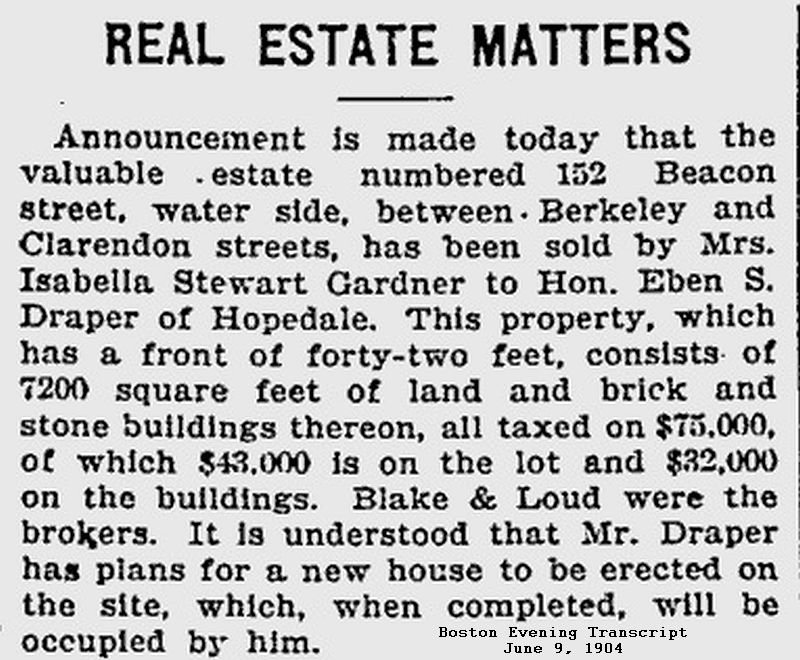
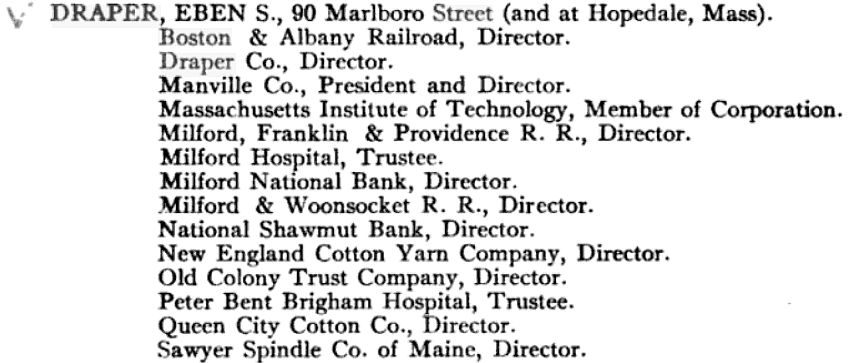
Apart from his busy political life, he has a living interest in a multitude of affairs. He is a member of the Corporation of the Institute of Technology, a member of the Board of Managers of the Milford Hospital, (a gift from his wife and himself tot the town), and a trustee of the Peter Bent Brigham Hospital, and Vice President of the American Unitarian Association. He served as Chairman of the Massachusetts Association for the relief of California.
He is a Director of the National Shawmut Bank, the Boston and Albany Railroad, the Old Colony Trust Co., the Milford National Bank, and various cotton mills and other industrial corporations. The Society of Colonial Wars, the Somerset, Middlesex, Massachusetts, Norfolk, Union, Algonquin, Exchange and Country Clubs of New York, include his name on their enrollments.
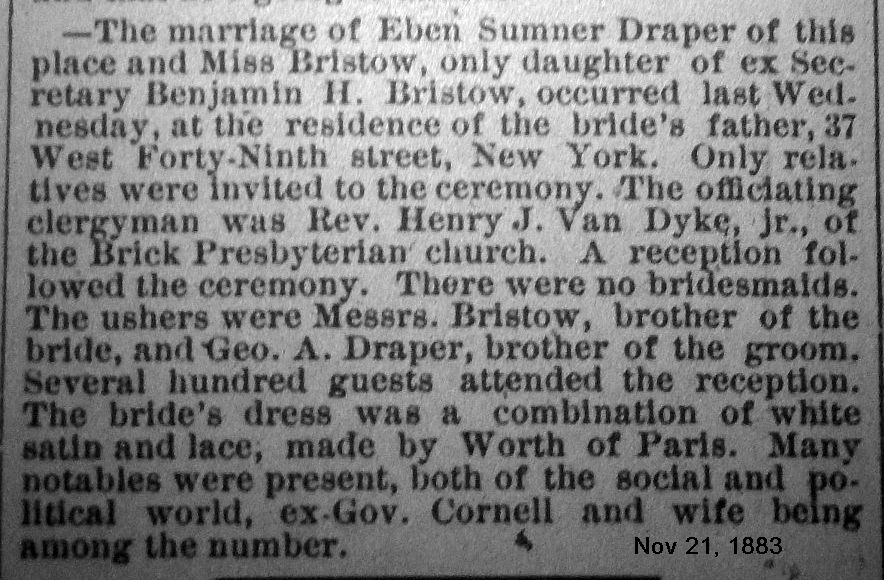
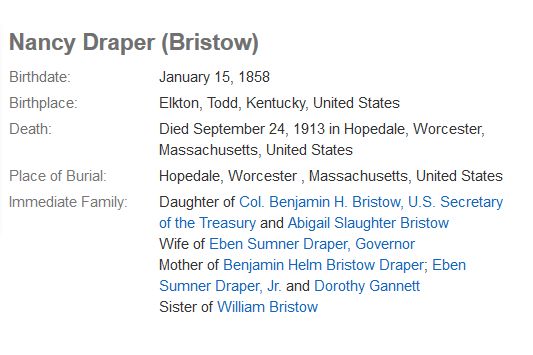
Notwithstanding this multiplicity of club memberships, and his diverse business and political affiliations, Lieutenant Governor Draper is preeminently a lover of his family and his home. He married, November 21, 1883, Nancy Bristow, daughter of the late General Benjamin Helm Bristow, of New York, who was Secretary of the Treasury in Grant’s administration and candidate for the Presidency in 1876.
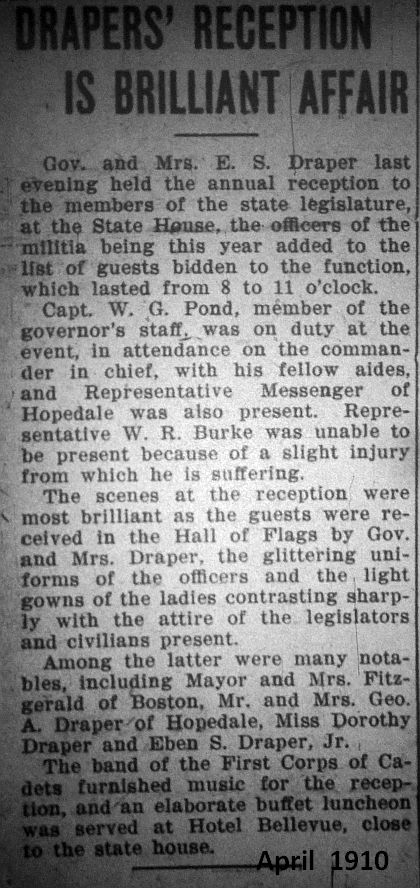
Their children are: Benjamin Helm Bristow, born Feb. 28, 1885; Dorothy, born Nov. 22, 1890, and Eben Sumner, Jr., born Aug. 30, 1893. Mr. and Mrs. Draper are social and cheery, and the evening caller, dropping in, is likely to find the family group engaged in games, in which the children share. He enjoys lawn tennis, but golf is the sport in which he finds particular delight. All the commonplace interests of the community are shared by him, and when Sunday comes, if his is not in his pew in the Unitarian Church, the congregation knows that he is away from home.
The legion of workmen in the Draper employ are his enthusiastic friends. During the recent commercial depression, the Draper Company, in common with so many other corporations, was obliged to put many men on shorter hours, but the burden of a decreased wage was made lighter by the voluntary reduction of rents by one-half, while those whose hours of labor were still further reduced, found their weekly rent bill entirely cancelled. No wonder the workmen say, “The Drapers are good people to work for.”
Those who know the Lieutenant Governor best, admire him for the straightforward honesty of his character, his good judgement, and for his kindly, genial nature. His business associates recognize his skill in administration, and his high sense of honor. The citizens of the Commonwealth have tried him and proved him, and will continue to trust him, whatever his political future may prove to be. The Massachusetts Magazine
*********************************
Second Story Visits
To The Homes of the Great
Eben S. Draper
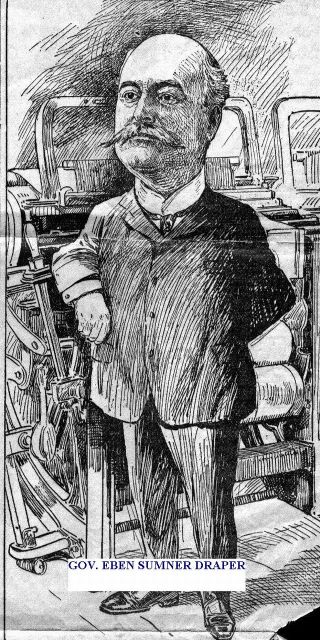
Eben S. Draper of Hopedale is Lieutenant Governor of the old Bay State and understudy for Curtis Guild and all the other Drapers. He is the burden-bearer of his family, and the sins of all the stand-patters are visited on his head. When he runs for office, he is supposed to be the wicked partner, and everything comes his way except the great big majorities. Inasmuch as Eben is no spell-binder and this is his first offense some political clairvoyants have advertised him as an easy mark. Nevertheless he manages to land on his feet every time. In spite of the handicaps of his family and political running mate, the Lieutenant Governor is a corking good fellow, who is well worth cultivating and who is popular with everybody who knows him. He wants to be Governor; so do a lot of other fellows who measure more around the head than around the chest, and the latter are of opinion that Eben would be a weak candidate. There is a suspicious smell about this opinion, but the strength of a candidate must not be measured by the odor of the other fellow’s opinion. If a Republican must be elected to warm the Governor’s chair, we would rather see Eben get it than the other, for he is a modest, kindly, generous gentleman who is democratic without being demagogic and who does not want any place bad enough to sacrifice his self-respect for it. His brothers keep the tariff chained up in a cellar out in Hopedale, and they are worried for fear it will break loose and bite Eben, while his rivals are afraid it won’t break loose. No man need imagine that because the Lieutenant Governor is not an orator he is weak-chested and inclined to tuberculosis; he is kind and sound, can stand without hitching and you need not watch your jewelry when he’s around. The Boston Traveler, March 28, 1907.
********************
Governors of Massachusetts
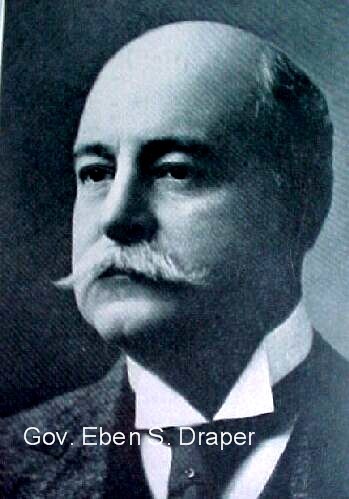
Eben Sumner Draper (1858-1914)
Governor of the Commonwealth of Massachusetts
1909-1911
Like Curtis Guild, Eben Draper was forged by his family’s business. His father, George Draper had been part of a Christian Socialist community, which ended in bankruptcy in 1856. George Draper and his brother took over the community’s assets and began several businesses including manufacturing house goods and commercial printing. They soon discovered they could profitably manufacture and sell textile machinery. Over the next seventy years, the Drapers would develop their textile machinery business while building Hopedale into a secular community based on industrial paternalism.
Eben Draper attended the Massachusetts Institute of Technology, graduating in 1878 and returning to his family’s company as a junior partner. He served as a director of several companies involved in textile and equipment manufacturing. In 1892, Draper became active in the State Republic Party. By this time the family’s company was the largest textile equipment manufacturer in the United States. In 1903, the company would sell a spectacular 78,000 looms worldwide.
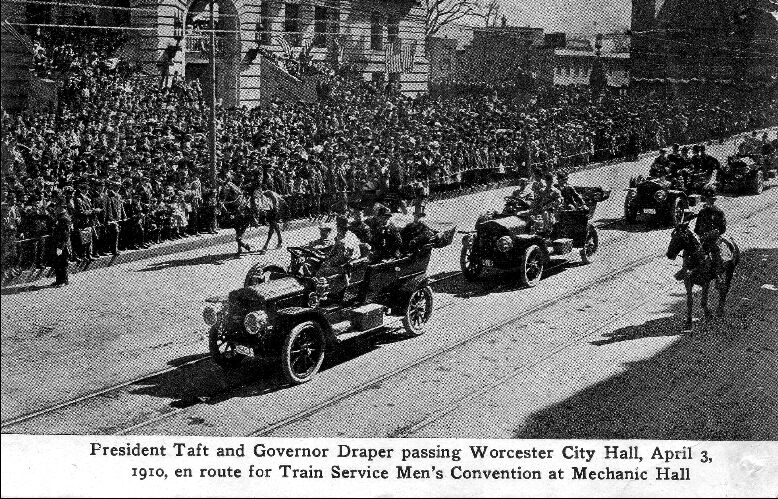
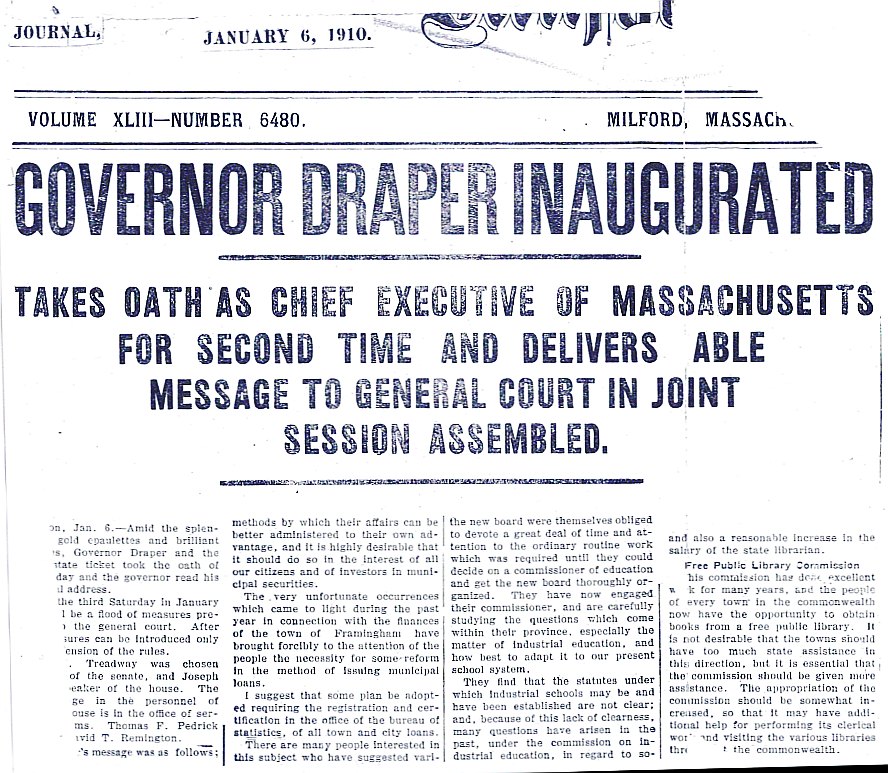
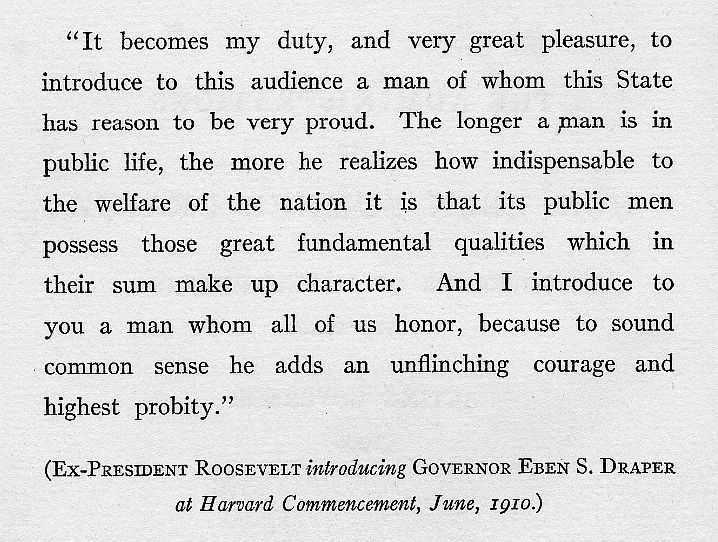
Eben Draper was elected Lieutenant Governor in 1906 and served in the post until his election as Governor in 1908. Governor Draper depoliticized a variety of harbor development issues by creating a commission of experts to manage and recommend its policies. However the dominant issues of the times involved labor. As Governor, Draper vetoed a bill restricting public employees to eight-hour days. Though labor fiercely opposed Draper because he was the owner and manager of a large non-union factory, he won a second term of office. Governor Draper was defeated in his second reelection bid. He retired to a life a private business and philanthropy. Draper’s company enjoyed remarkably good labor relations, surviving one of the most tumultuous eras with only a brief strike in 1913. From the Interactive State House website.
Several years ago I requested a change to the state house biography of Draper above. In it, he was referred to as Ebenezer Draper. Since that was the only place I’ve ever seen that, I was very doubtful that his name was Ebenezer. I went to the Milford town clerk’s office and obtained the birth certificate below, which shows that he was named Eben and not Ebenezer. I put in a request through Senator Dick Moore to have the correction made, which was done within a day or two after I spoke with them.
The state site seems to suggest that the strike of 1913 was something of a minor annoyance. I think most who have read about it would disagree. Click here for more on the strike.
Eben Draper served as governor of Massachusetts from January 7, 1909 until January 5, 1911. In 1914, he died suddenly in South Carolina at the age of 56 while returning home from a trip to Cuba.
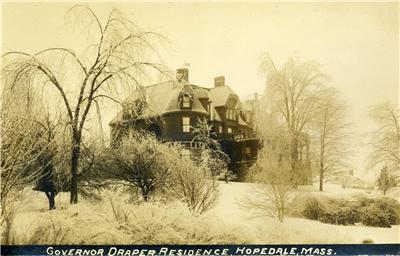
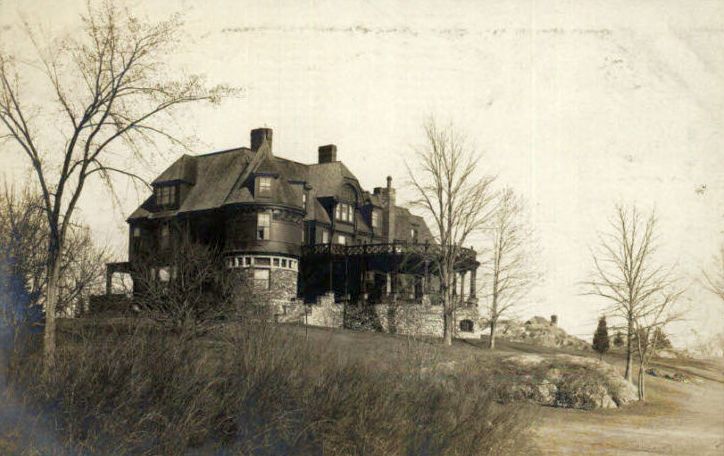
For those of you who arrived at this page from the question page, the answer is no, the Larches on Williams Street wasn’t Eben Draper’s home. His estate was the Ledges on Adin Street. The Larches was the home first of George Otis Draper, and later of Hannah Thwing Draper Osgood.