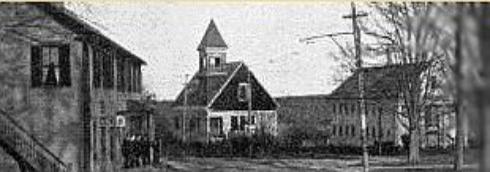
Mendon’s Golden Age
an era of economic prosperity, high social and professional status, and architectural grandeur. A triangular parcel that included Maple Street, Main Street, and Hastings Street was a center of culture and affluence that was rarely found in a small rural neighborhood. It was Mendon’s golden age. The town’s economic well-being was influenced by many factors. One factor was geography. Blackstone and Millville were part of Mendon then (South Parish), and the tax dollars generated from their industrial mills along the Blackstone River greatly benefited the town’s finances. Another factor was the nearness of the Blackstone Canal. For Mendon farmers, it essentially made Plummer’s Landing on Church Street in Whitinsville an inland seaport. The town’s agricultural products were loaded onto canal boats and sold to markets from Worcester to Providence and beyond. Also, many of the people in the village center were personally wealthy due to their occupational advantages. Mendon’s town treasury was very healthy. The people of the village center were multi-talented, highly educated and professionally elite. Seth Hastings, for example, was the chief justice of Worcester Superior Court, a congressman, lawyer, bank president, state senator, town official, Harvard graduate, and bakery owner. Both of his sons, William and Charles, were lawyers and Harvard graduates. William was also a state senator, state representative, and Mendon’s postmaster. His son-in-law, Caleb Hayward, was an attorney and bank director. Jonathan Russell had been ambassador to England, France, Norway and Sweden before moving to Mendon. He signed the Treaty of Ghent for the United States after the War of 1812. He served in Congress as a Mendon resident in the 1820s. Dr. John Metcalf was a surgeon, state senator, president of Massachusetts Medical Society, and author of Annals of Mendon. He was a graduate of Brown University and Harvard Medical School. Reverend Adin Ballou was the founder of the religious utopian community of Hopedale and a newspaper editor. Attorney Richard George was a graduate of Brown University and he was town counsel for thirty years. Silas Dudley was a well-to-do gentleman farmer. Alexander Allen was an attorney and town official. These talented people were all neighbors in the 1820s to 1830s. Many of the buildings that were constructed during this time period were symbols of the affluence of the people who built them. Several homes were either federal style or Greek-revival. Perhaps the most distinctive were at 24 Main Street, 38 Maple Street, 1 North Avenue, and 7 Hastings Street. Some buildings were constructed of brick, such as Seth Hastings’ bank, law office, and residence. The most majestic structure of the era was the Unitarian Church. The last significant building was the town hall. Mendon center was a beautiful New England hilltop village surrounded by farms, pastures, and stone walls. Two events of the 1840s left a drastic impact on the town. Blackstone (including Millville) broke away to form an independent town, and the Blackstone Canal closed down. The canal was replaced by the Providence and Worcester Railroad. The robust economy of the previous twenty-five years was brought to a slower pace. The golden age was over. Today, if the telephone poles and wires were removed, and if the tarred roads were replaced with gravel, the village would look much like it did in the 1840s. The buildings are a reminder of the people of that time period. They are a testimonial to an era of professional elegance and grace. It was a special time in Mendon’s proud history. Richard Grady Mendon, MA Mendon Menu . |