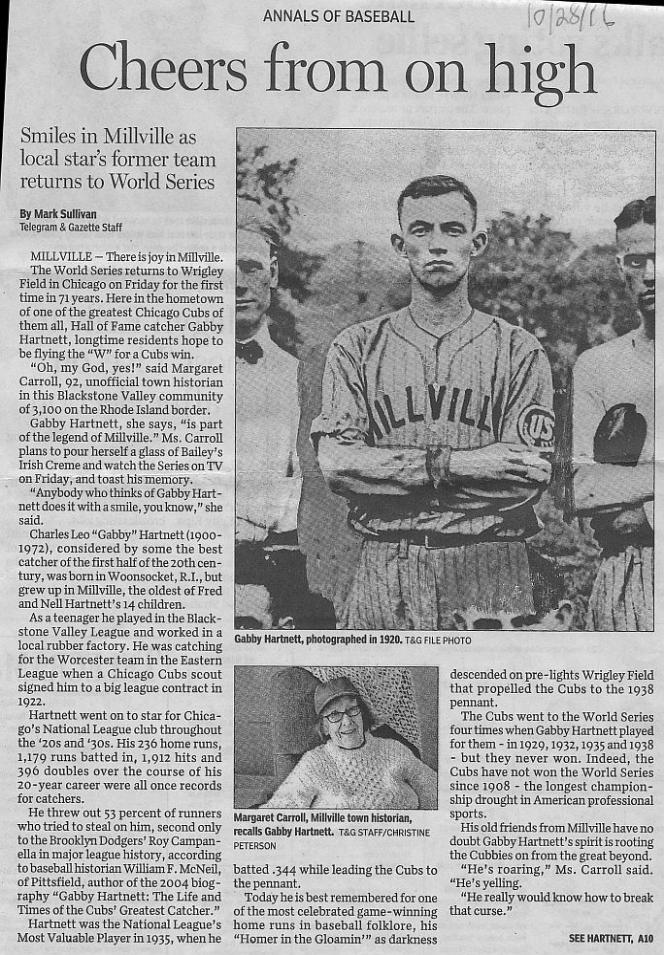
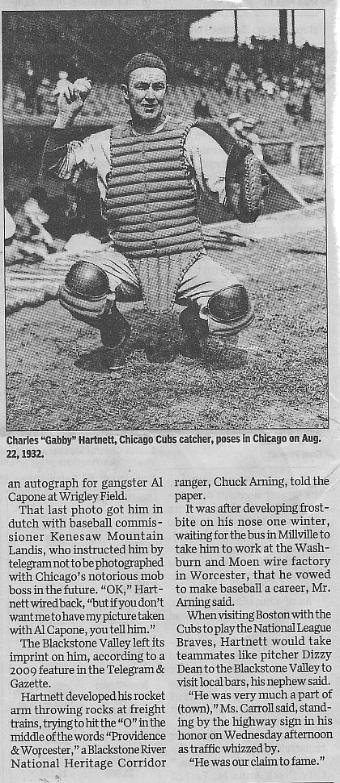
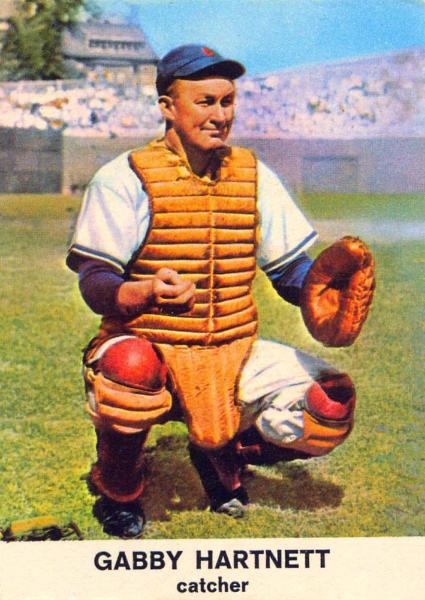
Charles Leo "Gabby" Hartnett
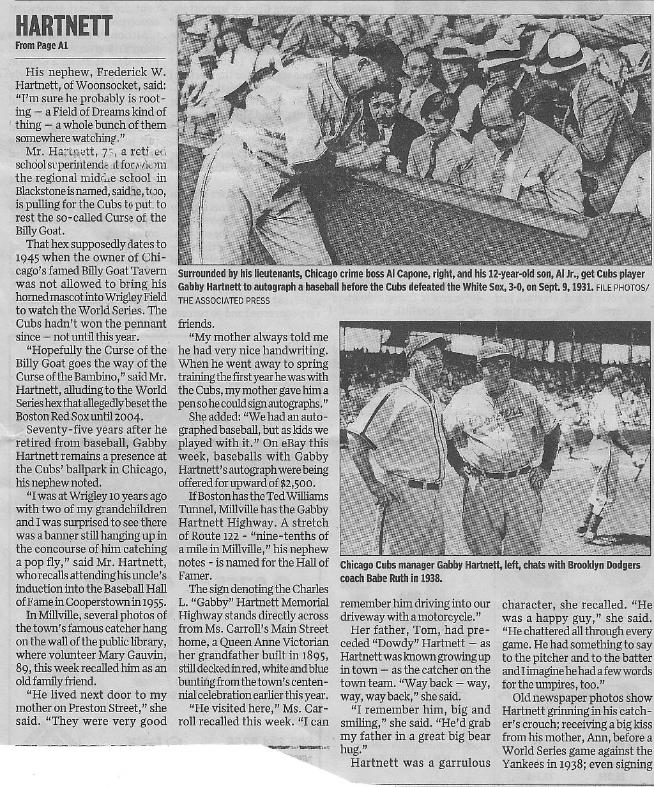
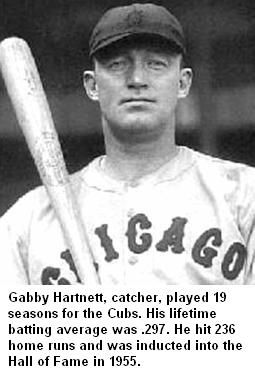
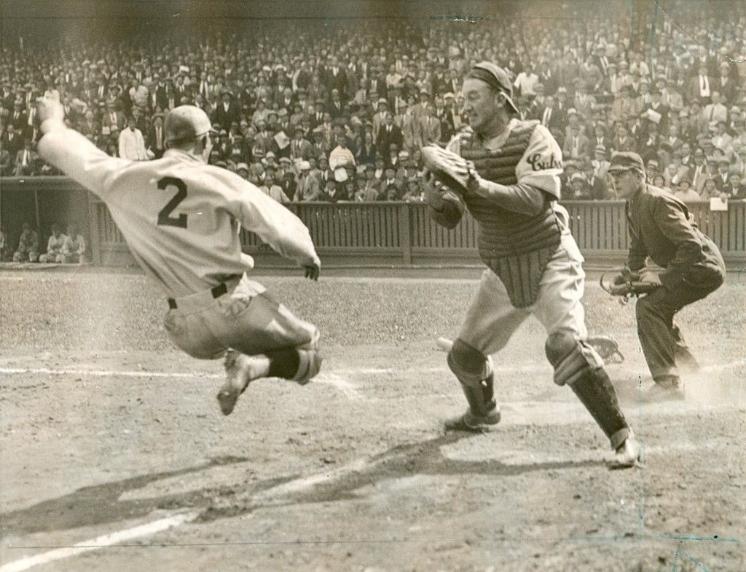
article below was published in the Milford Sunday News on January 31, 2016. It was written by Bob Tremblay. (Mr. Know-it-All, or Mr K.) A colleague recently informed Mr. K that baseball legend Gabby Hartnett went to school in Franklin. His curiosity piqued, Mr. K scoured numerous sources, including the Baseball Almanac, Baseball Reference.com, the Encyclopedia of Baseball Catchers Hall of Fame and the Society of Baseball Research (SABR) to learn more about one of the greatest catchers to ever play the game. Charles Leo “Gabby” Hartnett was born in Woonsocket, Rhode Island, on Dec. 20, 1900, the eldest of 14 children born to Fred and Ellen “Nell” (Tucker) Hartnett. Fred, a laborer, moved his family to the Bay State in nearby Millville to work at Banigan’s Millville Rubber Shop, according to Bill Johnson writing for SABR. “Fred played semipro baseball in his younger years and managed the Millville town team for a period, and was considered to have a tremendous throwing arm,” writes Johnson. “It was a genetic legacy he passed to his son, Leo.” The boy still had an obstacle to overcome. “Gabby broke his arm as a child,” according to the Encyclopedia of Baseball Catchers Hall of Fame. “It didn't knit properly, and his mother insisted he carry a pail of stones or sand wherever he went to exercise it. ’’ Many of Hartnett’s brothers and sisters also played baseball. After finishing the eighth grade at Longfellow Grammar School, the 14-year-old Hartnett worked as laborer, like his dad, at the rubber shop. He also joined the town’s baseball team, along with another future professional, Tim McNamara, who went to Fordham University and pitched for the Boston Braves and New York Giants from 1922 through 1926. Hartnett later left the rubber shop to attend Dean Academy in nearby Franklin, now the site of Dean College. One can assume Hartnett played baseball at Dean Academy. A future report may shed light on this subject. Anyway, when he did play, Hartnett demonstrated such a strong throwing arm that in 1920 the American Steel and Wire Co. in Worcester offered him a job in its shipping department just so he could play on the company baseball team. “There is a story, impossible to prove but widely recounted and intriguing, that the New York Giants’ (manager) John McGraw heard of Hartnett and sent scout Jesse Burkett to have a look at the prospect,” writes Johnson. “Evidently Burkett felt the catcher’s hands were too small for major league baseball, so the Giants passed.” Oops. Burkett wasn’t the only baseball mind to underestimate Hartnett, however. His high school coach made this assessment of the future star: “No judgment, no instinct; he will never make a catcher.” Double oops. But we’re getting ahead of ourselves. Hartnett signed his first professional baseball contract with the Worcester Boosters of the Class A Eastern League in 1921. Hartnett played well enough for Worcester in 100 games that Cubs scout Jack Doyle offered him $2,500 to sign with Chicago. Unfortunately, Hartnett did not immediately impress Cubs manager Bill Killefer as the team already had a fine catcher in Bob O'Farrell. Intervention from Doyle and a compliment from the team’s ace, Grover Cleveland Alexander, a future Hall of Famer himself, helped keep Hartnett on the Chicago roster. “Backing up starting catcher O’Farrell in 1922, Hartnett barely spoke to anyone, especially not to newspaper reporters,” writes Johnson. “In view of his awkward shyness, teammates and the press dubbed him Gabby, an ironic moniker at the time, but one that he actually grew into as he aged, developing a reputation as something of a chatterbox crouched behind home plate.” We should point out that perhaps Gabby was only following orders. Before the catcher left for spring training, his mother advised him, “Keep your mouth shut until you see what’s going on.” Hartnett made his major-league debut on April 12, 1922, and the more he played the more he excelled. After O’Farrell was injured in 1924, the Millville marvel took over catching duties and began setting records. For example, his record of 37 home runs hit by a catcher set in 1930 would stand for 23 years until Roy Campanella hit 40 for the Brooklyn Dodgers in 1953. In addition to setting records, Gabby garnered another nickname. “As he grew older and added weight, the big catcher developed a ruddy complexion, resulting in the nickname ‘Old Tomato Face,’” a biographer wrote. “According to one sportswriter, ‘There were three distinguishing characteristics associated with the likable Irish-American – a red face, a big cigar and a laugh in which he simply wound up and let go, laughing all over. His frame shook like a dilapidated jalopy.’” Off the field, Hartnett married the former Martha Henrietta Marshall on Jan. 28, 1929. Son Charles Leo Jr. (known as Bud) was born in December 1931 and daughter Sheila was born in June 1935. Apparently fatherhood agreed with Hartnett. “In 1929, his arm went mysteriously dead in spring training, where he had reported with his new bride, Martha,” the catchers website states. “Nothing helped the arm, and during a Cubs' series in Boston, he went to see his mother... after the games. She predicted that his arm would be better as soon as his pregnant wife delivered their child. Hartnett caught just one game that season. Junior was born Dec. 4, and within two weeks, Gabby's arm soreness was gone.” In addition to being a memorable catcher, Hartnett displayed a habit of playing in memorable games. For example, he was behind the plate during Game Three of the 1932 World Series against the New York Yankees when Babe Ruth hit his “called shot” home run off Charlie Root. According to Hartnett biographer William McNeil, Gabby later said, “I don’t want to take anything from the Babe because he’s the reason we made good money, but he didn’t call the shot. He held up the index finger of his left hand … and said, ‘It only takes one to hit.’” Hartnett enjoyed a very good year in 1935, hitting .344, leading the Cubs to the World Series against the Detroit Tigers. The team lost but Hartnett won the National League MVP award. Hartnett secured his immortality in Cubs lore on Sept. 28, 1938. As darkness descended on Wrigley Field, Hartnett, now the team's player-manager, hit a home run with two outs and two strikes in the bottom of the ninth inning to break a 5-5 tie and launch the Cubs into first place. The team, which seemed to be out of the pennant race, would later clinch the National League title. "Most fans were unable to follow the flight of the ball in the darkness, but when it settled into the left field seats for a walk-off home run, Wrigley Field erupted with a deafening roar that could be heard for blocks," Johnson relates. "Thousands of spectators came spilling out of the stands screaming and racing toward the diamond.” Recalled Hartnett, “I swung with everything I had, and then I got that feeling, the kind of feeling you get when the blood rushes out of your head and you get dizzy. A lot of people have told me they didn’t know the ball was in the bleachers. Well, I did. Maybe I was the only one in the park who did. I knew the moment I hit it. … I don’t think I saw third base … and I don’t think I walked a step to the plate – I was carried in.” The clutch hit became known as the “Homer in the Gloamin’” and remains one of the signature walk-off home runs of all time. After the 1940 season, Hartnett was fired as Cubs manager. He ended his career in 1941 as the player-coach with the New York Giants, hitting .300 in 64 games at the age of 40. Hartnett managed in the minors from 1942 through 1946. After retiring from baseball, Hartnett opened Gabby Hartnett’s Recreation Center in a Chicago suburb. In 1955, Hartnett was elected to the Baseball Hall of Fame along with such other greats as Joe DiMaggio. After selling the center in 1964, Hartnett served as a coach and scout for the Kansas City Athletics for two years. He died on his 72nd birthday, Dec. 20, 1972, in Park Ridge, Illinois, from cirrhosis of the liver and is buried in All Saints Cemetery in Des Plaines, Illinois. Writes Johnson, "Hartnett’s obituaries conveyed a portrait of a genuinely good man: ‘(It) was his winning personality that set him apart on the field – a friendly wave to the men in the press box, a hundred handshakes with friends he had made in every city in the circuit, and autographs for everyone, young and old, who asked him to sign.”’ One of those autographs went to the notorious Chicago gangster (and baseball fan) Al Capone. A photograph captured the signing. After the photo was published in newspapers across the United States, Hartnett received a telegram from Baseball Commissioner Kenesaw Mountain Landis instructing him not to have his picture taken with Capone in the future. Hartnett replied with a telegram to the commissioner stating, “OK, but if you don't want me to have my picture taken with Al Capone, you tell him.” Hall of Fame manager Joe McCarthy called Hartnett the "perfect catcher." A section of Rte. 122 running from Millville to Blackstone is dedicated to Charles Leo "Gabby" Hartnett. Red Sox and Yankees Play in Douglas (Yes, really.) Boston Celtics Play at the Draper Gym (Yes, really.) |


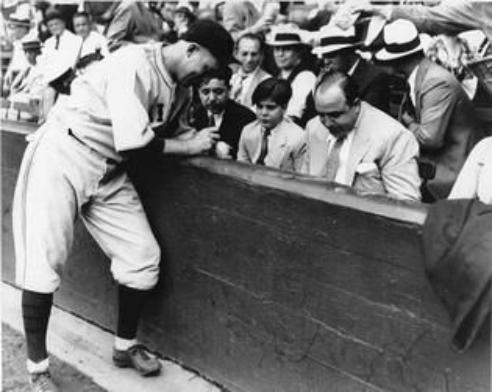
Gabby signing an autograph for Al Capone. |