A New School for the Second School District and Harrison Hall : 1840
and meaningful. It helped to remodel and modernize the interior of the building and to restore the exterior to its original architectural design. He was a professor of mathematics at MIT, and he was a summer resident of the town. He was from a family of prominent lawyers, educators, and businessmen who were from the village center, 28 Main Street and 14 Maple Street. His contribution to the restoration of the historic building was quiet and low key. This was in complete contrast to the building's early history, which was divisive, contentious, and controversial. In 1840, Mendon was divided into several autonomous school districts. Voters in the second district voted unanimously at a January meeting to build a new school house. It was voted at a meeting on February 1 to form a building committee of Silas Dudley, David Davenport, and B.D. Williams. The committee was to propose a plan, estimate a cost, and to recommend a site location. Voters approved a plan by local builder, William T. Metcalf, on March 12, for a bid of $1,550. The proposal was accompanied by a plan designed by his brother, Dr. John Metcalf, town physician and amateur architect. The meeting was adjourned to May 27. However, not everyone was in agreement with the plan, because only two days later, on March 14, several residents petitioned the school district's prudential committee to call a meeting for a different plan. Silas Dudley stepped down from the building committee so that he could submit an alternative proposal that included a school house with a hall above it. It was a partnership offering, where Mr. Dudley would own the hall on the second floor and the land on which it was built. The town would own the school on the first floor. The district would be able to use the hall free of charge for lectures, meetings, and other educational purposes. Mr. Dudley's plan was accepted after he agreed to lower his proposal from $1,700 to $1,550. The meeting was adjourned to April 4. Construction began, and the building was finished by the contracted date of October 4, 1840. Mr. Dudley named his upper floor Harrison Hall after President William Henry Harrison, who died after serving only one month in office. Supporters of the opposing plans were not pleased with the proceedings. There was much bickering and controversy. Questions were raised about the legal rights of the school districts in comparison with the financial responsibilities of the entire town. One voter expressed his displeasure by refusing to pay the school construction part of his tax bill. This act of civil disobedience created further controversy, because the town took the gentleman to court. The case was not settled until there was a final ruling by the state supreme court. The man who refused to pay a segment of his bill argued that several legal procedures were not followed. He said that meeting warrants were not properly posted, that adjournments overlapped, that illegal reconsiderations negated previously voted articles, and that the sandwich layers of ownership for the building was not a good idea. He claimed that if the school had an issue with the roof, it would have to trespass in order to go up there to fix it. He also pointed out that one of the assessors resigned in 1841, making the legality of the assessments questionable. After much litigation, Chief Justice Shaw sided with the town, stating that, in his opinion, the intent of the voters was clear to construct the school under the Silas Dudley plan. It is assumed that the tax withholder paid off his bill soon after. The first town meeting was held in Harrison Hall in 1844, and in 1849, voters authorized the selectmen to begin the process of purchasing the building from Mr. Dudley. The town owned it in 1850 and renamed it Mendon Town Hall. The town's first high school opened in the upper floor in 1868 and operated in conjunction with the lower floor elementary school until January 1904. The donation by Nathan R. George Jr. in 1929 helped to pay for the removal of the front outside staircase and have it brought inside. Issues with the back staircase were corrected, and the interior was improved and modernized. It is likely that he felt gratified in knowing that he was instrumental in upgrading the historic building that endured so much controversy in the early 1840's. Perhaps, in his own way, he made up for, to some degree, the turmoil created by the rebellious tax delinquent, who fought to prevent the existence of the building, his grandfather, Attorney Nathan George. (Information for this article was obtained from "Mendon Town Hall," a narrative by Paul Williams read to the Mendon Historical Society in 1932.) Richard Grady June 14, 2013 Mendon Town Hall Mendon Menu . |

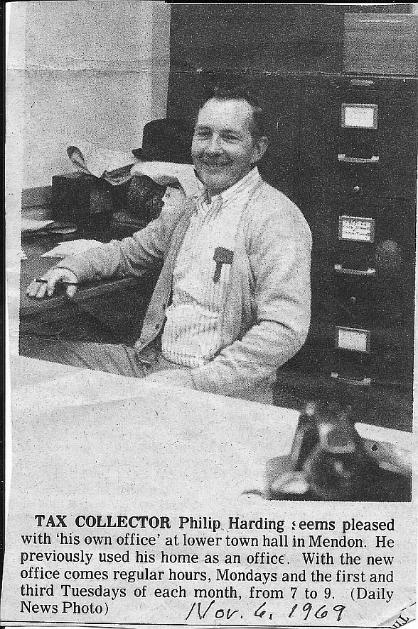
Thank you to Beverly Harding for donating these articles. Previously, the selectmen held meetings in the Record Room at 13 Main Street. Town meetings were held in the upper Town Hall. Town Clerk Emily Coleman’s office was at her house on Providence Road. Tax Collector Phil Harding’s office was at his house on George Street. |