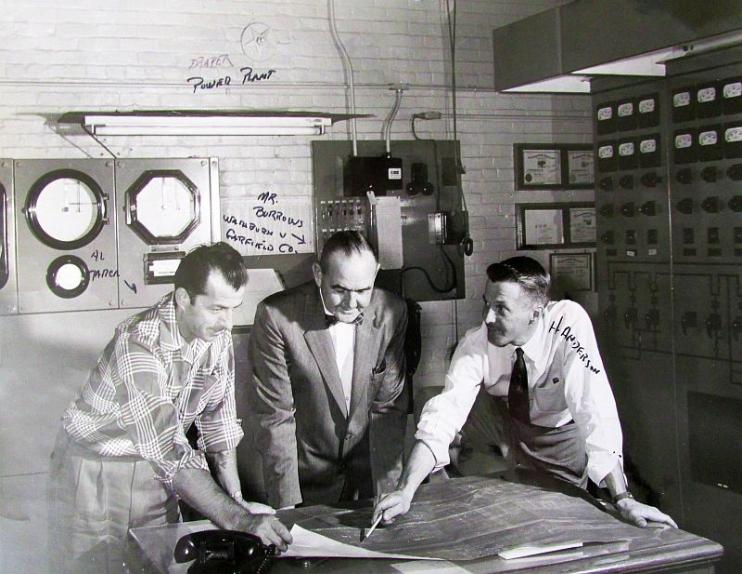
Al, on left, outside his office in the Draper power plant. |
Memories of Al Tarca I grew up on Hayward Street in the Plains in Milford. I lived across the street from the "six chimney house." It was a rental property. It's still there. There was a hill on East Walnut Street where we would slide in the winter. In the summer we'd go swimming and we'd pick blueberries. We didn't swim in the lakes. We'd swim in the quarries. The ones off of Route 16. We'd often go to Dodd's Quarry. We called it the BA beach. No girls, no clothes. We learned how to swim there. I learned to swim in an area of the quarry called the bathtub. It was very shallow and only as large as this table we're sitting at. I lost my balance there once, and fell into the deep part. I did the dog paddle to shore, and ever since then I've been able to swim. In time I learned how to do all the other common strokes. Another quarry we'd sometimes go to was Quirk's. It's right near where the Stop & Shop is now. The places we'd dive from had names. The low couch, the high couch, the chair, the peak, and the running jump. It was a feather in you cap if you could make that jump. We'd do our blueberrying wherever there were high tension wires. Later on we'd go to Rosenfeld's sandpit in Hopedale. There was a swamp back there where we'd get them. We'd pick them and sell them. During the summers, my father would work at B.H. Bristow Draper's estate as a gardener. The cook's name was Delia. I don't know her last name. She asked my father if I'd pick blueberries for her so that she could surprise Mr. Draper with them. I walked over there from the Plains to deliver them. I had a paper route, starting when I was eight years old. When I was ten, I had two routes and I hired kids to help me. I had the routes until I graduated from high school. Kids used to play marbles a lot in those days. I came up with an idea of my own. I had a board that I'd set upright. It had grooves at the bottom with numbers over them. If a kid tossed his marble and it went through the opening, he'd win as many marbles as the number was. If it didn't go through, I'd keep his marble. I won a lot of marbles with that game. It was like my little casino. After high school, before I went into the service, I used to hang around at a place they called the Hearts of Ben. It's on East Main Street in the Plains. During the week we'd play cards for peanuts and soda. On weekends they'd play poker there. I'd watch them. They'd play five card stud. The house would get a take on every pot. At the end of the night, the house would have all the money. That's when I learned not to go to the casino. I went to work at Porter Shoe in Milford. Drapers wasn't hiring at that time, but eventually I got a job there. I worked at the sewer plant. The town didn't own it. It belonged to Drapers. In 1984, Rockwell turned the sewer facility over to the town. When owned by Rockwell, they weren't eligible for any state aid to improve the plant, but the town would be, so it was turned over to the town. After some time working in the sewer plant, I went to the shop and worked in the drill room. During the time when I was in the drill room, I went to Wentworth nights where I took a steam course. Then the war broke out, and in 1942 I joined the Navy. The first ship I was onI was on a tin can. (destroyer) On one trip we escorted a merchant ship convoy bringing supplies to Murmansk, Russia. We were at the invasion of Oran and Casablanca in North Africa, and also Sicily and other places in Italy. We were part of the invasion of southern France. We came back to the States and I was transferred to another ship the Achenar. It had been a merchant ship but it had been converted for amphibious work. It could carry LCMs (landing craft, machinery) and LCVPs. (landing craft, vehicle, personnel). Seventy years ago today (June 4) we were in England, getting ready to invade Normandy. On D-Day, we lay off with a mother ship, near other ships, maybe 100 yards or so offshore. We dropped these boats into the water. We had troops aboard along with half-tracks, and armored cars also. We'd load them onto the boats, and off they'd go to shore. D-Day was seventy years ago this week. June 6, 1944. The fellows that I give credit to on D-Day, were not so much the ones that masterminded the greatest invasion that ever took place, but those soldiers who were in those small boats. They'd have to leave the boats, carrying packs, with rifles overhead, and walk ashore through the water. At the same time, the Germans were firing at them just like they were little targets you might say. They had guts. We made a few trips back and forth that week. I had the best job in the world on the ship. I was in the fire room on the engineering force. I learned how to fire a boiler. The boiler made steam which turned the turbines which turned the propeller. We made our own water from salt water. There wasn't any water company around. Of course we made our electricity also. After the D-Day invasion, we went to the Pacific. At Okinawa, our ship was hit by both a kamikaze plane and a boat. There was a landing craft tied up at the side of our ship and the kamikaze boat hit it. If that hadn't been there, it might have sunk us. After I got out of the Navy, I went back to Drapers. Due to my wartime experience, I got a job in the boiler room there, and worked my way up to chief engineer in the power plant. When Rockwell closed the plant, I got a job as chief engineer at Dennison Manufacturing. One of the big events at Drapers in the 1950s, was the 1955 flood. However, I have very little in the way of memories of that. I was on vacation in California. We were reading about it in the papers, but they weren't covering it the way they would today. I couldn't visualize what was happening here. I got back about a week later. One thing that I remember is the air compressors. A lot of the tools ran off of compressed air. They used it to hold jigs and fixtures that held the castings while they were being machined. As I recall, the smallest compressor was 225 horsepower, and there were two 500-horsepower compressors. That's a pretty good sized machine. They had been flooded. When I got back, the work of restoring them was underway. They had welding machines tied into the wires to dry them out. We saved every one of them. While we were in California, we went to Disneyland. It had just opened. I thought it was just going to be a glorified carnival. Was I wrong! I served on the Hopedale Water and Sewer board for many years. The best years of my life were when I helped out with Scouting, with George Daniels, Bob Barrows, Leigh Allen, Fred Loeper, you, and the kids. I went to Camp Resolute a few summers. I always felt the kids were the cream of the crop of all kids, and they had the best parents in the world. In order to be a Scout, the parents usually participated. We used to camp up at the Lookout once a month. There was a kid there one time who wasn't a Scout. He was harassing a Scout, calling him a sissy. The Scout said, "If you think I'm such a sissy, here's my pack. Put it on and see how far you can walk with it." The kid couldn't do it. We had lots of fun at the Lookout on those weekends. We had church services there on Sundays. My son became an Eagle Scout. He always puts that on his resume. When he got married and moved out, he took his merit badge sash with him. I won the Silver Beaver award that's given to Scout leaders. My advice to people as they get older and retire is to keep moving. Don't stay home. Go out someplace every single day. Take a walk. Go to the mall. You don't have to spend any money, but if the weather is bad, you can walk there. I get here to the exercise class at the Community House three times a week. Be active. It's the best thing you can do. Also, keep reading. Read about the history of this great country. Al Tarca, June 2014 War Veterans' Menu Memories Menu HOME
Okinawa. You can read about that below in the "Factual History of the Achenar." |


Above and below - Al's second ship, the Achenar. |


