A History of Lake Nipmuc
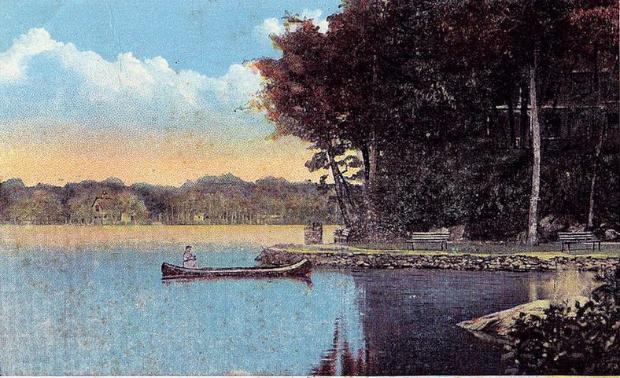
Nipmuc Indians. They lived at seasonal villages not far from the shoreline. Included were villages located at Pond Hill (northwest of Rte. 16), the Phipps property (off Park Street), and Wigwam Hill (off Millville Street). The Nipmucs, fresh water Indians, used the lake and the land surrounding it for hunting, fishing, and farming. Nipmugg Great Pond, as the natives called it, was mentioned as a point of reference in the Indian Deed of 1662. The deed authorized the sale of an eight mile square parcel called Squinshepauge to be sold as a new frontier settlement. The incorporation of the town of Mendon on May 15, 1667, and the King Philip War, 1675 – 1676, marked the end of the common use of the lake by the great Nipmuc people. After the King Philip War, Lake Nipmuc was used for agricultural purposes by new families who moved into town during its resettlement. Robert and Sarah Taft built a new farmhouse about two hundred feet from the eastern shore in 1679. It was from this site that eventually evolved generations of farmers, town officials, philanthropists, and national leaders. The lake was known as Taft’s Pond, and a shoreline road leading to the residence was named Taft Avenue. The lake’s uses remained low key until after the Civil War. It was in the late 1860’s that there was a new appreciation of the scenic natural beauty of the lake. It became popular for wealthy out-of-towners to board for the summer at Homer Darling’s home at 73 North Avenue, or the Adams House at 10 Hastings Street, or the Russell House at 1 Emerson Street.. Later, Sky Farm at 21 North Avenue became a summer residence. Lake Nipmuc had become known as a resort, with its healthy, cool air, its clear, pristine water, and its tree-lined shore. The 1880’s were the beginning of the establishment of the lake as an extremely popular regional resort. John C. Wood was granted a license to operate a bowling alley at his building at Nipmuc Grove, and Charles E. Guild was granted permission to operate a steamboat for as many as twenty-five passengers at a time. Nipmuc Hall and Grove opened on July 4, 1882. It featured a clam dinner, lemonade, ice cream, and soda. It offered boat rides, swings, and hammocks. An orchestra played throughout the day, and there was a fireworks display at night. The new recreation site attracted hundreds of people every weekend throughout the summer. The Milford-Uxbridge Electric Railway, also known as the Mendon trolley, began operation in December 1901. It purchased Nipmuc Park and provided easy transportation for visitors. A new theater was built that featured famous vaudeville stars (including Fred Allen). Electricity was installed, and more rides were offered. A restaurant and a new dancing pavilion were built. Nipmuc Park was the most popular resort in the area. World War I and the growing popularity of automobiles changed the necessity of a trolley system and the operation of a lakeside amusement park. By the late 1950’s and early 1960’ s, only the ballroom remained as the most popular feature. Bill Green offered Friday night record hops to area teenagers and a hall for wedding receptions and special occasions at Lakeview Ballroom. (Aerosmith) He also operated the Flame and Sword Restaurant. The Rouleau family purchased the property, renovated it, and changed the name to the Myriad Ballroom. It continues to serve as a popular hall for dining and dancing overlooking the scenic lake. The town of Mendon purchased White’s Beach in 1964 for the purpose of a swimming facility for town residents. Allan Byrne was appointed as the recreation director. The Town Beach has served as a popular place for family summer entertainment ever since. Lake Nipmuc has served generations of people in many ways over the centuries. It is more than an eighty-five acre spring-fed kettle hole. It is one of our natural resource treasures! Richard Grady Mendon, MA |
Lake Nipmuc: Late 1940’s - Late 1950’s. Judith Hattersley Oldfield, daughter of Stenson and Marjorie Hattersley, spent her summers there on Taft Avenue at her family’s cottage. The cottage was once owned by Marjorie Arnold Hattersley’s family. George Murphy and his wife, who were both in vaudeville, used to spend their summers on Taft Avenue. They stayed in the green house to the right of White’s Beach (when facing beach). Sally Rand spent a few summers on Taft Avenue when she was performing in burlesques at Lake Nipmuc Park. She stayed in the home later owned by the Newton’s. This was next to the home of Police Chief Larson. A prominent judge from Providence would sometimes visit her. 31 Taft Avenue which is now (December 2012) for sale was once owned by the Cahill family. Jack Cahill was the police chief in Dedham, MA. He and his family spent many summers on Lake Nipmuc. White’s Beach was owned at one time by Al and Marguerite White. They eventually sold it to the Boucher family, and Al and Marguerite bought a place on Old Taft Avenue close to Rte. 16. One summer there was a group of gypsies living on the Rte. 16 side of the lake. |
.