The Underground Railroad in Hopedale
Were homes in the Hopedale Community used as stations on the Underground Railroad? There is no doubt that the members were abolitionists. Many of Community founder Adin Ballou‘s sermons and speeches give evidence for that. The Community newspaper, The Practical Christian, is filled with articles on the horrors of slavery, and Hopedale was the site of annual anti-slavery meetings that attracted as many as a thousand participants and featured prominent speakers such as Frederick Douglass, Sojourner Truth, Wendell Phillips, Abby Kelly Foster, Charles Burleigh, “Box” Brown, William and Ellen Crafts and William Lloyd Garrison.
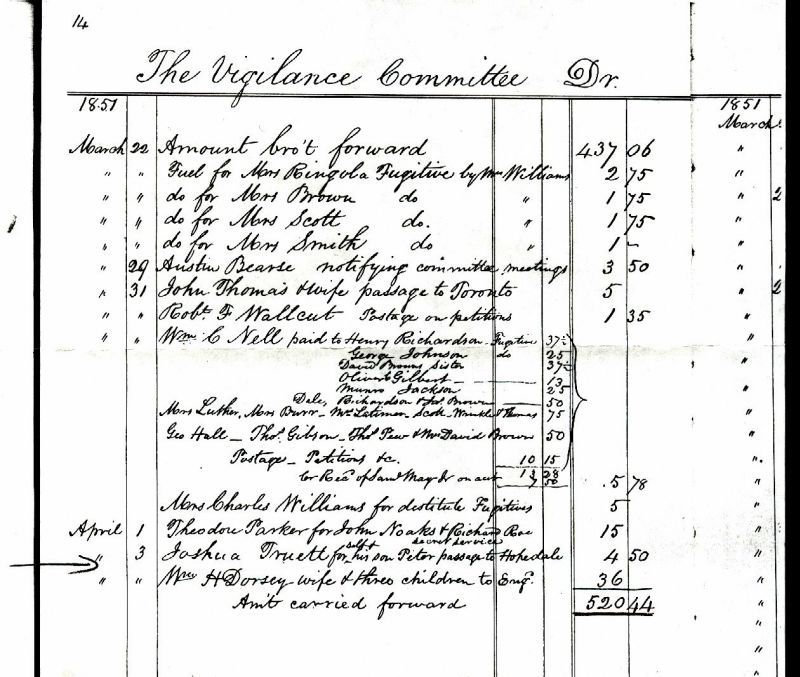
However, we have only a few cases mentioned in writing that escaped slaves were housed in Hopedale on their way to freedom. One of these is in the paper shown above. Since this is a copy of a copy that is now on your screen it might not be clear so I’ll reprint here the line of interest. April 3 [1851] Joshua Truett for self & his son Peter passage to Hopedale 4.50 (This is indicated by the arrow near the bottom left of the copied page.) This page was in a book of accounts from an abolitionist group called The Vigilance Committee as you can see at the top of the page. The committee was based in Boston. A copy of the page was sent to us by Sheila Sibley at The Jackson Homestead in Newton. The Homestead has been accepted for inclusion in the National Underground Railroad Network to Freedom. Providing convincing documentation to receive this honor is difficult and while many homes are rumored to have been part of the network, very few have been recognized as such by the National Park Service.
So we are left with some questions about Joshua and Peter Truett that we may never be able to answer. Were they escaped slaves on their way to Canada or were they being sent to Hopedale for another reason; as speakers, perhaps? Were they being sent from Boston to Hopedale or might the payment from the Boston committee be for bringing them to Hopedale from somewhere else? On the same page we see that $5.00 was spent for passage to Toronto for John Thomas and wife so $4.50 from Boston to Hopedale seems a bit much. If they were coming from the Boston area, why would they come to Hopedale? That doesn’t seem to make sense. Some slaves, after escaping, were able to get to boats that sometimes took them to New Bedford. If they were going from New Bedford to Worcester on the way to Canada, then Hopedale could have been along the route. Also, anyone coming through Connecticut and heading to Boston might have stopped here.
At about the same time that the Truetts came to Hopedale, an article in the Practical Christian, the newspaper of the Hopedale Community, tells of a meeting at the Methodist Church in Milford concerning a family of escaped slaves. That was a family of four, however, and no names were given. Could it be that they were the Truetts and for some reason the accounts book only mentioned Joshua and Peter? I think it’s quite likely that they were, but that’s just a guess. To read the Practical Christian article, click here.
Another account of Underground Railroad activities is found in a little book titled Hopedale Reminiscences, printed in 1910. In that year The Hopedale Ladies Sewing Society and Branch Alliance asked about a dozen people, who had been children living in Hopedale in the early Community days, to write their memories of those times. Here’s a paragraph from what Anna Thwing Field recalled.
“Many escaped slaves lived in the families of Hopedale. My father had a colored man called John who did some work about the place, but never went alone from the house. At night he was there, in the morning gone. I was too young to be entrusted with important secrets. In the opposite house a man, woman and two children, all black, dwelt one winter in the cellar kitchen and one summer in the attic. The oldest girl went to school and learned to read and write, Another neighbor had as a guest Lizzie Hall, a handsome mulatto young woman with a history somewhat like Eliza of Uncle Tom’s Cabin, though Lizzie Hall was her master’s daughter. She stayed till after her little child was born, then she too, had gone away. Several others there were who lived among us for weeks or months. They were fed, clothed and sheltered. We knew them and saw them moving in and out, one day here, the next, gone. Sometimes we heard they had reached Worcester, Boston, New York, or the Mecca of their wanderings, Canada.”
Click here to read Anna’s entire story of the abolitionists and other reformers who visited the Hopedale Community .Click here for Rosetta (Lizzie?) Hall.
Community founder, Rev. Adin Ballou did a very large amount of writing in his lifetime, but so far I’ve found mention of only one case of taking in an escaped slave. In this situation, it didn’t sound as though Hopedale was a regular stop on the Railroad. Rather, it was an individual case in which Frederick Douglass brought a woman named Rosetta Hall here to live for a while. It has been suggested that, since this sort of thing would have been illegal after the passage of the Fugitive Slave Act in 1850, it shouldn’t be surprising that participants wouldn’t be writing about it. However, I haven’t found anything about it in Ballou’s autobiography or his History of the Hopedale Community written decades after the Civil War. [It seems that Lizzie Hall, mentioned in the paragraph above, and Rosetta Hall, must have been the same person.]
Why would Ballou have so little to say on the matter, while Anna Thwing Field remembered a few situations from her childhood that say that escaped slaves spent some time here? One possibility is that aiding fugitive slaves would be such a normal activity for an abolitionist community it didn’t seem worth mentioning. Also, if the Railroad existed in Hopedale, it may have operated in a way different from how we assume it normally did. We tend to think of a few recently escaped slaves being delivered to their next station after dark, being taken to a secret room and then moving on to the next stop within a day or so. I suppose this was how it worked in the South and perhaps in northern locations where the Fugitive Slave law was being enforced, but that was evidently not the case in Hopedale. Since they were able to hold a public meeting with escaped slaves present in Milford and write about it in the Practical Christian, they must not have been concerned with the law being enforced around here. From what Field says, the escaped slaves who arrived here stayed around for a while.
Did the fugitives in Hopedale have to remain hidden or not? Field‘s memories don’t give us a clear answer. John “never went alone from the house,” but in the case of the family living nearby, “The oldest girl went to school and learned to read and write.” The family “dwelt one winter in the kitchen cellar and one summer in the attic.” Was that to remain hidden, or just because that was where they had room for them? It doesn’t seem to make sense that they’d be kept carefully hidden, while the girl was openly going to school.
I think that what may have happened is that Hopedale wasn’t on a regular Underground Railroad route, but it was known as a safe place for escaped slaves to stay, so sometimes arrangements were made, as in the case of Rosetta Hall, for one or more to come here. If I find more on this matter, I’ll add it here.
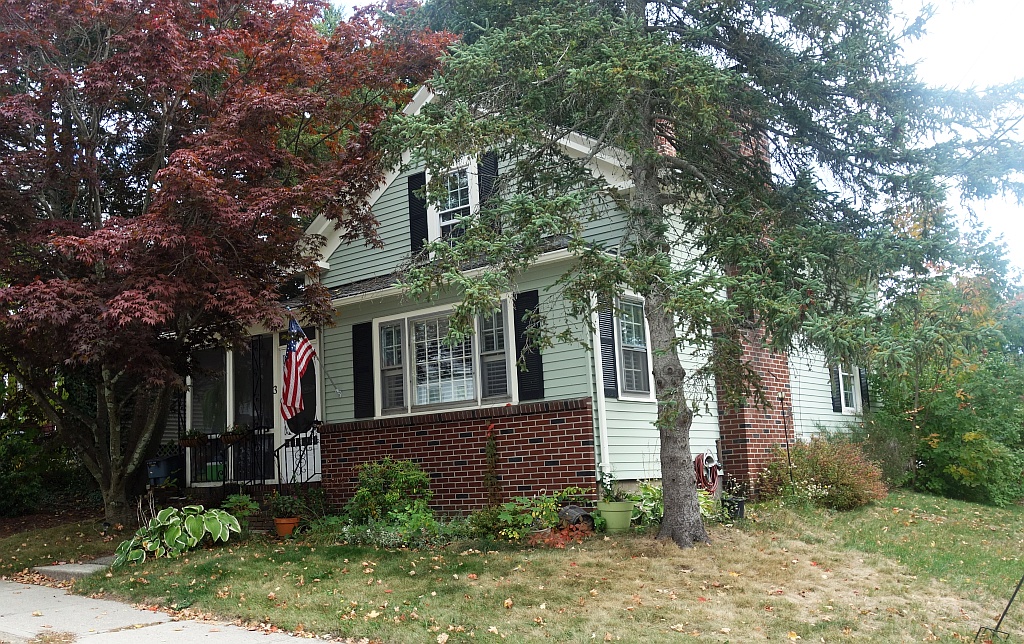
Underground Railroad House in Hopedale
Prominent visitors to the Community The Branded Hand
Abolition Activities in Hopedale, Milford and Mendon
Abolitionism in the Hopedale Community by Ernest Dalton
Meeting at Milford Methodist Church