Hopedale History
July 2025
No 441
Augustus’s Hopedale
Hopedale in July
<><><><><><><><><><>
Twenty-five years ago – July 2000 – The draft assembly of Human Genome Project is announced at the White House by President Bill Clinton, Francis Collins, and Craig Venter.
A summit meeting takes place at Camp David between President Bill Clinton, Israeli prime minister Ehud Barak and Palestinian Authority chairman Yasser Arafat, ending without an agreement.
Fifty years ago – July 1975 – Cape Verde gains independence after 500 years of Portuguese rule.
A crewed American Appolo spacecraft and the crewed Soviet Soyuz spacecraft for the Soyuz 19 mission dock in orbit, marking the first such link-up between spacecraft from the two nations.
One hundred years ago – July 1925 – In a staged test case (the “Monkey Trial”) in Dayton, Tennessee, John T. Scopes, a young high school science teacher is accused of assigning a reading from a state-mandated textbook on Darwinian evolution in violation of a Tennessee state law, the “Butler Act“. He is found guilty and fined $100, though the verdict is later overturned on a technicality.
Meher Baba begins his 44-year silence.
Adolf Hitler publishes Volume 1 of his personal manifesto Mein Kampf in Germany.
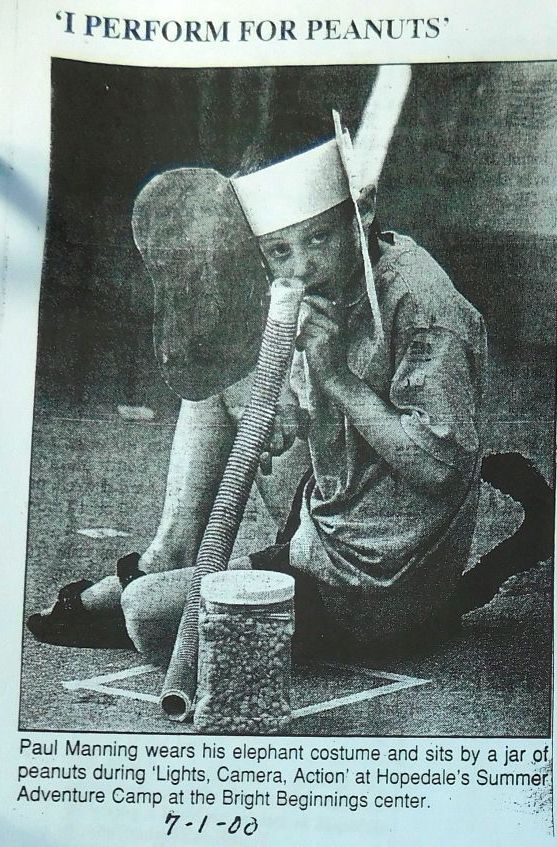
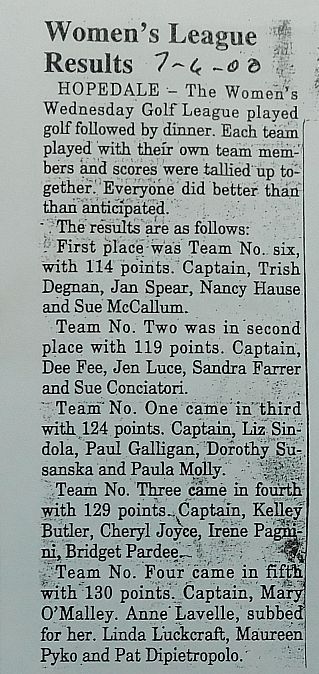
News items above are from Wikipedia. For Hopedale news from 25, 50 and 100 years ago see below this text box.
<><><><><><><><><><>
Augustus’s Hopedale
Adin Augustus Ballou, son of Adin and Lucy Ballou, as a teenager, worked in his father’s print shop, which was attached to their home at the corner of Hopedale and Peace streets. Probably the biggest job at the print shop was turning out the Practical Christian, the twice monthly newspaper of the Community. Around 1845, Augustus started a paper of his own. The first issues were on very small paper; I think about four by six inches. He decided to give it the humorous name, The Mammoth. Eventually he enlarged it and each issue had four pages measuring seven by ten inches. Thanks for Jane Lowell for 16 issues of the paper. Below is a column Augustus wrote for the July 28, 1847 issue. At that time Community members were thinking of Hopedale as only the beginning. They were hoping to spread their ideals throughout the country.
Hopedale
Our readers may wish to know something about Hopedale, and we will therefore give them a short sketch. Accounts of various places, and of the improvements in this improving age, would doubtless be interesting. Such accounts we may give from time to time. We have not the talent for a tourist but must write in a plain blunt way, selecting a few prominent features of remark.
Hopedale is not so large as Boston or many other towns; nor does it boast of wealth, learning or beauty. Neither the Ohio nor the Mississippi river runs through here, carrying a thousand steamboats to market. Henry Clay, Daniel Webster, and James K. Polk, neither of them live here. But a hundred other folks do, including the editors of The Mammoth. Here is a small territory dotted with several neat white dwellings, each having a garden and fruit trees belonging to it. A small river passes through, turning various Yankee machinery, and employing several mechanics. Farmers are engaged on meadow lands and hills, having in prospect the products of cornfields and apple orchards to reward their toil. The people believe in working for a living, and strange as it may appear, they say it isn’t honest to live in any other way. They advocate the doctrine that all should have a chance to be comfortable, educated, and happy, and that by the exercise of love one toward another they may prevent all crime and misery. Therefore, you will not find in their dominion a single poor-house, or jail, or prison, or gallows, or grog-shop—no lawyer, or constable, or soldier, nor even a sword nor a gun stowed away as a memento of their brave grandfathers.
But as the sun shines and the water runs downhill here as elsewhere, the above wonderful facts might not appear so apparent to a casual visitor. Yet they are facts, and if they are not fully grown, the seeds are planted, and some day they will command the notice of every enlightened traveler. When there shall be a population of thousands, who live without hunching, or biting, or snarling among themselves—in whose streets are no beggars, nor loafers, nor dirty, ignorant or quarrelsome boys, it will be worthy of record in the London Chronicle.
The Mammoth, 1 – 8
Ezine Menu HOME