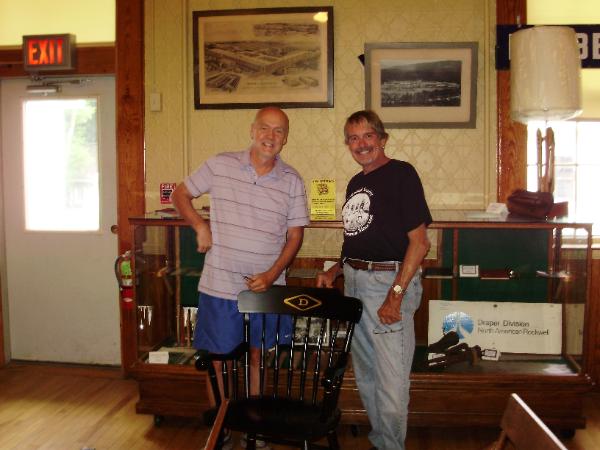
Dave Meade (left) and Bill Wright at Campton Historical Society Museum. |
Finishing mill - Beebe River |
Village at Beebe River |
October 15, 2012 No. 214 Beebe River Hopedale in October G&U locomotive in Hopedale – YouTube Trains now arrive daily. Here's one that came in on October 11. One more time - October 12.
Draper Corporation open house at its plant in East Spartanburg, SC in 1953. The Parklands, October 6. Hopedale Pond, October 1 and October 11.
Naughty, Naughty Nipmuc.
on the wall in a closet by the stage in the town hall. A few years ago I took pictures of some of the names and put them on my website. This week I was able to get them all - 24 pictures. Lots of names that are familiar to those of you who grew up in mid-20th century Hopedale. Here they are.
<><><><><><><><><><> Twenty-five years ago – October 1987 – Draper Complex Sale Expected Next Month First Girl Scout Event in Hopedale – Hayride Through Sutton, Picnic at Purgatory Chasm World population is estimated to have reached five billion people. The United States is caught up in a drama that unfolds on television as a young child, Jessica McClure, falls down a well in Midland, Texas, and is later rescued Fifty years ago – October 1962 – Hopedale Pharmacy Displays Prescriptions Going Back to 1847 VFW Auxiliary Will Hold Pantry Party Cuban Missile Crisis begins: A U-2 flight over Cuba takes photos on Oct. 14 of Soviet nuclear weapons being installed. A stand-off then ensues for another 12 days. <><><><><><><><><><> For several decades, Draper Corporation had a plant in Beebe River, New Hampshire. Here’s Bill Wright’s account of a recent trip he made there, to see what he could learn about the facility. To read the article on a page with more pictures connected to the story, click here. Beebe River Dave Meade and I met in Lincoln, NH and headed south to the Campton Historical Society in Campton, New Hampshire. We were greeted by Sandra Decarie the curator and Bob Mardin the librarian. The introductions were heartfelt and happy as we immediately commenced discussing Draper. Bob excused himself to call his brother Richard who had worked at the Draper Beebe River Bobbin Plant for 24 years. Beebe River had a history of logging and sawmills. At one point much of the lumber was used in the manufacture of pianos. Parker-Young established a sawmill in 1917, over seven years creating 160,000,000 board feet of lumber, depleting the supply of spruce trees. Though hard times clouded the horizon, Draper was looking for a site to manufacture bobbins. The requirements were a saw mill, a huge supply of hardwood, a railroad and a labor force. Whereas Beebe River met those criteria, negotiations for the purchase occurred in Boston during April of 1924. The deal was consummated with “as much as fuss as purchasing a pair of shoes from a merchant.” The transaction netted Draper 25,000 acres of land, 28 miles of railroad track, five locomotives, 500 boxcars, the post office, theater and community center. ( It may be noteworthy here to state that the relationship of Beebe River to Campton is the same as Spindleville to Hopedale.) Draper built a finishing mill, roughing mill, box shop, dry kilns maintenance garage and generator building. Across the (now removed) railroad tracks was a pond, immediately beyond which is a village with houses, and a community hall built and/or maintained by Draper for its employees. (Writers note: We found a wonderful nugget as we walked the grounds. The village park had the identical playground equipment; slide, swings, monkey bars, etc. as were at the Hopedale Town Park. Same style and manufacturers). At its peak, Beebe River employed 350, produced 100,000 bobbins per day and manufactured the shipping crates for looms. Raw materials from Guilford, ME, Woodford, VT and Tupper Lake, NY were transported to Beebe River to supplement the hardwood harvested locally to satisfy the enormous hunger for bobbins. These were shipped to Hopedale via rail. As with Hopedale, Draper was a major presence. In addition to the scores of jobs and a livable community, it paid 40% of Campton’s town taxes. In 1967, Draper stockholders voted to merge with Rockwell-Standard. At that time, there was no indication of what the future held for the plant. (Significant of the above data was found in the,“Campton Bicentennial 1767-1967 Commemorative Booklet, Reprinted and Updated 2002). Richard Mardin was able to recall many elements of his 24 years at Beebe River. His family did own and operate a local sawmill but the bobbin factory offered better opportunities. He began his career in 1959 as a machinist and ended as Manager of Industrial Engineering. The plant made and maintained most of its own cutting tools. His recollections include that Draper “took good care of its people,” and enlisted Gus Burg to erect about 20 houses. Logs were brought in by rail and dumped into a pond to rinse dirt and stones from them. They were then brought to the sawmill to be cut and ultimately shaped into blanks which were then kiln dried. From the blanks, bobbins of different configurations (to match various diameters of thread) were manufactured. The bobbins were all made of rock maple because that hardwood would always “run true”. Beebe River continued operations until the mid 1980s. The demand for wooden bobbins had diminished. Although alternative products such as hand saw handles were produced, the end had come. Richard noted with a wry smile “… if a suit from Hopedale showed up on Thursday, salaried employees were going to be let go. If the suit arrived on Friday, hourly employees were on the dismissal list.” Bill Wright, September 2012. Here are three links sent by Peter Metzke to three sites about Beebe River. Campton Historical Society flyer about a program on the Draper plant at Beebe River. Campton Historical Society page on the village of Beebe River. A page on logging in the Beebe River area. Ezine Menu HOME |