July 14, 1675: Mendon Attack
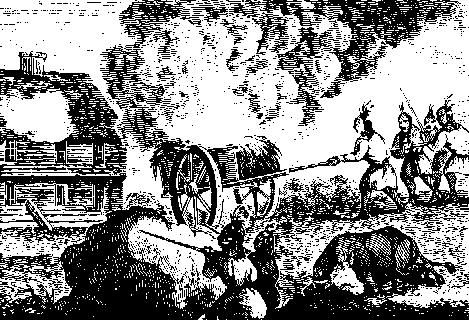
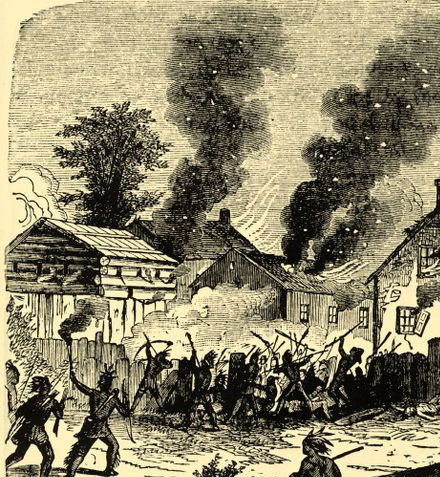
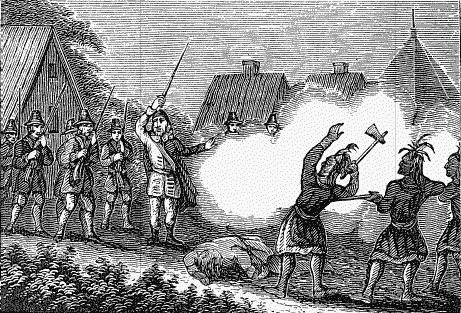
The destruction of Mendon during the King Philip War was brought about by a conflict of cultures. By 1675, the peaceful co-existence that was demonstrated at the first Thanksgiving in Plymouth had long ended. Lack of agreement in regards to land, religion, and way of life led to such intense conflict that the Indians thought it was necessary to banish the English settlers from Southern New England and send them back to Europe. The first attack was in Swansea in June by Wampanoags. King Philip was their chief. Three weeks later, the attack on Mendon on July 14, 1675 sent shock waves of terror throughout Massachusetts Bay Colony. The attack was by Nipmucs, and it meant that King Philip’s attempts at lobbying neighboring tribes had succeeded. The Wampanoags had been joined by Nipmucs and Narragansetts. The attack on Mendon was the first outside of Plymouth Colony. The Swansea fight had not been just a local skirmish. It was the beginning of an all-out war to see which culture would prevail.
One of the most significant conflicts between cultures was in regards to use of land. Indians believed that land was a gift from the Creator for everyone to use, regardless of who actually owned it. It was essentially for communal use. The English, on the other hand, believed that when land was purchased, the previous owner should vacate it. The new owner would have exclusive rights to it. The English were puzzled and angered when they saw Wampanoags continuing to hunt and fish on land that they had just sold. As more and more land was purchased to accommodate the influx of new settlers, Indians realized that they were being boxed in and not welcome on land that they assumed they could still use. Over a period of time, it became evident that Wampanoags were on a trend of being pushed out of their own land.
Religion was another source of disagreement that led to the conflict of cultures. The English were Puritans. They believed it was God’s will and their moral duty to convert the Indians to Christianity. Several ministers and sachems met in Concord in 1646 to create a list (The Clear Sunshine of the Gospel) of what the Indians needed to do to change their ways to become Christians. The list imposed fines in English money and other punishments on natives who would not cooperate. Some villages accepted the new religion. They were known as “Praying Indians.” Many others did not. Wampanoags were being arrested and brought to trial in Plymouth for farming and fishing on Sunday. An Indian who told a lie had to pay five shillings, and the theft of a canoe would be five shillings. Massasoit is alleged to have remarked that Christianity sounded like a wonderful religion, but he asked of the English, “When are you going to start practicing it?”
How people lived their daily lives was another source of cultural conflict. Though both the English and Indians relied on farming, fishing, and hunting for survival, there were many differences in their clothing, hair styles, manners, technology, tools, and weapons. The English regarded their way of life as superior to the more simple culture of the Indians. As with religion, they felt it was imperative to impose their way of life on the Indians. Some natives who chose to work for the English as servants or maids were required to dress, comb their hair, and speak like their employers. Wampanoags were fascinated with firearms and alcohol. The English readily traded them in exchange for furs and pelts, knowing full well that the natives’ limited experience with both could get them into trouble with laws that were limiting and confining their lives. King Philip became painfully aware that since he became chief in 1662, the culture of his tribe was being eroded and assimilated and soon would be gone if he and his people did not take action.
The clash of cultures brought devastation to both the settlers and the Indians. Mendon was attacked again in February 1676. This time the entire town was burned to the ground. Philip’s death in August 1676 took away native leadership. The out-manned and out-gunned Indians were not able to continue the war for their homeland. They had suffered a crushing defeat. Mendon and other towns gradually recovered from the charred ruins. It re-settled in 1680, built its second meeting house (Founders’ Park), and re-established itself as a farming, frontier community. The Nipmucs, Wampanoags, and Narragansetts were not able to recover. Some fled to other tribes. Some were sold into slavery. Many died of disease and starvation. Some were executed on Boston Common. Many Indians adopted the culture of the English and lived quietly amongst them. The King Philip War brought an end to the proud and noble Indian civilization as it had once existed in Southeastern New England. Sadly, it began, or at least escalated, here!
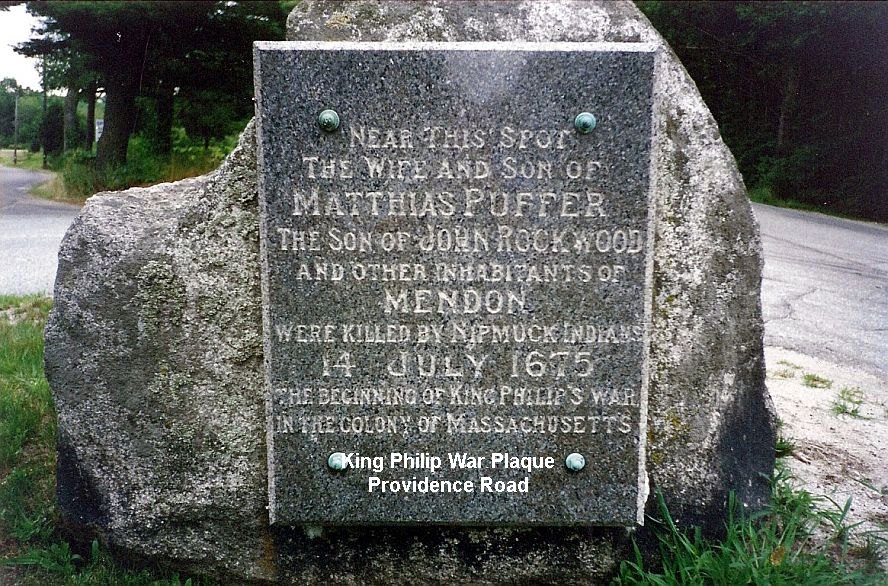
A stone marker (see above this textbox) is located at the corner of Providence Road and Hartford Avenue East to designate the area of the July 14, 1675 attack.
Richard Grady
John Trainor
Mendon, MA
Mendon Residents Defy Legislative Mandate:
Threatened with Loss of Homes
Mendon residents have a long history of being independent thinkers. They have been known to make decisions on their own without giving in to outside pressures. This has been true in regards to voting for political candidates, taxes, and town spending. There have also been times when the state and federal governments have imposed laws that were not to the liking of voters. Perhaps today’s town citizens inherited this tendency because of a situation that their ancestors experienced long ago.
Mendon was a pioneer town of thirty-eight families when it came under attack by Nipmuc Indians on July 14, 1675. The attack was a surprise to the residents of the eight-year-old town, because as far as they knew, relations had been peaceful. The Indian deed of 1662 allowed Nipmucs to continue to hunt and fish within the town boundaries. They were well aware of skirmishes that had taken place in Plymouth and Swansea between Wampanoags and English settlers. These were due to injustices directed at the Indians, but no such problems had been voiced by the Nipmucs.
King Philip, chief of the Wampanoags since his father’s death in 1662, was outraged at the loss of his people’s land, religion, and way of life. He lobbied the Nipmucs and Narragansetts to join him before they suffered a similar fate. The Mendon attack was the first outside of Plymouth Colony. It meant all-out war. It was the intent of the three tribes to force the settlers back to Europe in order to preserve their native homeland and culture. The peaceful co-existence with the Nipmucs was over. The attack, led by Matoonas, left five people dead and the town in terror.
People of Mendon lived in daily fear of a second attack. Some families moved back to Braintree and Weymouth, and others prepared for military conflict by building a fort. The nearest town was Medfield, separated by fifteen miles of forest. By October, only nineteen families remained. They had defective guns and inadequate ammunition. It was clear that if they remained in the vulnerable, isolated town, their survival would be doubtful.
In light of the desperate situation that they were in, the remaining residents hoped to get help from the General Court in moving back to fortified Braintree and Weymouth. Instead, a letter was delivered on November 3, ordering that all residents who had left were to return, and that all remaining residents were forbidden to leave. The order further stated that all residents who did not comply with this directive would forfeit their homes and property. The residents were stunned and horrified, and they let Boston know that they would be defying the order. Shortly thereafter, they abandoned the unprotected town.
The decision proved to be a wise one, because in February 1676, the warriors returned and burned down every building in town. The war ended in August with King Philip’s death. Families returned over the next three years and reclaimed their charred properties. Their homes were rebuilt, and by 1680, a new meeting house was constructed at what is now Founders’ Park.
The King Philip War was devastating to both the Indians and the settlers. The towns in Southeastern New England gradually recovered and were rebuilt, but the Nipmucs, Wampanoags, and Narragansetts were never the same.
The strong-willed pioneers of the fledgling town of Mendon stood up to the General Court and defied a mandate that would have put them in mortal danger. They exercised their right to democracy, where people have input in how their government makes decisions. Their ancestral lineage to today’s Mendon residents would have been different had they succumbed to the pressures of the 1675 legislature. Our founding fathers rest in peace in Old Cemetery, knowing that they helped to set the framework of how we govern ourselves today.
Richard Grady
John Trainor
February 2012

