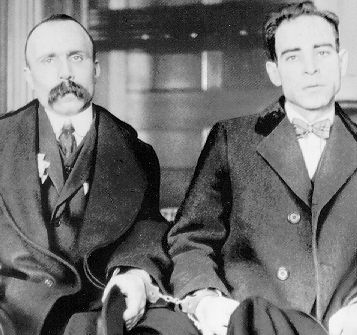
Nicola Sacco
Ferdinando Sacco (later known as Nicola Sacco) was one of many thousands of Italians who left their homes near the turn of the century to come to America. Like so many others, he formed a link in a “chain migration,” moving to a place where friends, paisanos, and relatives had already established a community. In Sacco’s case, the community was in Milford, Massachusetts, a town of some fifteen thousand about thirty miles southwest of Boston. The Plains section of Milford was home to dozens of families from several towns in the north of the Italian province of Foggia, including Casalvecchio, and Torremaggiore, where Sacco was born. His father’s friend, Antonio Calzone, who worked at the Draper Company, had urged the elder Sacco to send his sons to America, and when Ferdinando and his older brother arrived in April 1908, they were taken in by Calzone.
Fernando worked as a manual laborer in several different jobs during his first months in Milford before Calzone helped him obtain employment at Draper, where he had worked for a year. Then another Casalvecchio neighbor helped the young man enter a training program to learn edge trimming, a skilled craft in the shoe-making process. Sacco’s first job as an edge trimmer was in the town of Webster, but he soon returned to Milford, where he obtained steady employment at the Milford Shoe Company (where he had trained.) He remained at this job from 1910 until 1917, when he left the United States for a period of exile in Mexico. “To this day, Sacco is remembered with affection by the older residents of the town, for whom he was a hardworking young man and a credit to the community, incapable of committing the crimes of which he was charged,” writes his biographer. 1
In Milford, Sacco was exposed to a vibrant radical community of Italian anarchists and socialists. He began to read I Proletario, an IWW weekly edited by Arturo Giovannitti, and he soon subscribed to Cronaca Sovversiva, an “Anarchist Weekly of Revolutionary Propaganda” published by Luigi Galleani in Lynn. When the textile workers of Lawrence went on strike in 1912, Sacco was among their Milford supporters who worked to collect money both for the strikers and for the defense fund of Giovannitti and Joseph Ettor when they were arrested in connection with their activities in the strike. 2
In 1913 Sacco began attending meetings of the Milford anarchist group Circolo di Studi Sociali, joining a number of his neighbors who were also immigrants from Foggia. “Sacco found these men, all of them about his own age, more sympathetic than other radicals he had met: more militant, more eager to learn, more willing to dedicate their energies to the cause of their fellow He soon “threw himself body and soul into the anarchist cause.” 3
When Draper’s workers went on strike in the spring of 1913, Sacco and the other anarchists of the Circolo were quick to come to their support. “He was not an orator,” the strike leader Joseph Coldwell later said of Sacco, “or even a fluent speaker, but he was a mighty good worker in detail matters and never hesitated to do his share of the appointed work…Never in the limelight during the strike…he was one of the silent, active, sincere workers, giving of his time and money to help his fellow men.” 4
Saccos’ first contribution to the Cronaca Sovversiva was in August 1913, when the journal published a brief account that he wrote of the Draper strike and the campaign to raise money for the defense of strikers who had been jailed. Over the next few years Sacco became a frequent contributor to the journal, documenting the fabric of anarchist social and political life in Milford. His contributions described, “attending picnics and conferences, acting in social dramas, continually raising money to aid political prisoners and jailed strikers, always collecting money for “the propaganda.” 5 He later told a biographer that while in Milford, he and his wife, Rosina, “used to arrange for dramatic performances and to raise money for all sorts of causes.” 6
A friend and fellow Foggian immigrant anarchist described some of these activities: “We put on plays in Milford, like Rasputin and Tempeste Sociali, and organized picnics to raise money for the movement…There were two radical circles in Milford, an IWW group on East Main Street and an anarchist group on Plain Street. Each had about twenty-five members, all Italians…Some of its members had been involved in the 1913 strike in Hopedale, when the IWW tried to organize the workers and a striker…was killed. Sacco also took part in it. In 1916 Sacco, my brother Saverio, and Luigi Paradiso were speaking at a meeting and were arrested by the Milford police chief.” 7
Sacco’s 1916 arrest occurred when Milford’s anarchists mobilized in support of striking IWW iron workers in the Mesabi Range in Minnesota. They faced the usual obstacle: in December the Milford police banned all open-air meetings. When the group defied the order and met on December 3, Ferdinando Sacco was one of the three arrested and sentenced to three months in jail. (The charges were later dismissed.) 8
When the U.S. Congress passed its military conscription act in May 1917, shortly after the U.S. entrance into World War I, the Cronaca Sovversiva urged its readers to refuse to register. (The act required non-citizens to register even though in theory they were not liable for military service.) Many of its readers went underground or fled the country. Sacco, along with Bartolomeo Vanzetti and some sixty others from around the country, decided to leave for Mexico. 9
When Sacco returned to the United States several months later his family had moved to Cambridge, and he joined them there. He obtained a job in Stoughton through a former superintendent from the Milford Shoe Company, Michael Kelley, who had since opened his own business there, and remained there until his arrest in May 1920. 10
Kelley’s grandson later recalled, “Grandmother was extremely fond of him. She always stood up for him and couldn’t believe that he could do those nefarious things…They were aware of his radicalism but didn’t know what to make of it. They saw him as a good worker, a family man, a kind person. Grandmother asked him to kill a chicken now and then and he was very squeamish about it. He didn’t like killing chickens. It was an odd relationship between an Irish business family and an Italian worker. ‘Give up the radical crap. Be an American,’ Grandfather would tell him. Dad said that, apart from everything else that was said against them, Italian immigrants were regarded as bomb-throwers.” 11
The end of the story of Ferdinando Sacco’s life (he took the name Nicola when he returned from exile in Mexico, to avoid being discovered as a draft registration evader) is far better known than the story of his Milford years. He was arrested along with Vanzetti, with whom he had shared his Mexico exile, for a robbery and murder in South Braintree, Massachusetts, in spring of 1920; the two were convicted on flimsy evidence and sentenced to death. The case became a national and international cause célèbre, and the two were executed in the electric chair in August 1927. On the fiftieth anniversary of their deaths, Massachusetts Governor Michael Dukakis proclaimed August 23, 1977, Nicola Sacco and Bartolomeo Vanzetti Day.” Linked Labor Histories, pp. 44-47, Aviva Chomsky, Duke University Press, 2008.
Separate from the paragraphs above, Chomsky tells more of Sacco’s arrival in the U.S.
When Fernando (later Nicola) Sacco left Italy in 1908 at age 17, he sailed with his brother from Naples to Boston. They continued directly on to Milford, where they stayed with a friend of their fathers who had settled there, “amid a colony of Foggian immigrants, including a barber, a baker and an undertaker, in addition to shoe workers, laborers, and mill hands.” 12 He first found work as a water boy working for a Draper contractor, then in the Draper foundry itself. Sacco left Draper after a year to train in a small shoe factory in Milford, and after brief hiatus when he worked in a shoe factory in Webster, he returned to Milford to the Milford Shoe Company, where he worked from 1910 to 1917. 13
As in many Italian and other immigrant communities, radical newspapers, ideas, and organizations formed a strong component of working-class life in Milford. Two radical newspapers, Il Proletario, edited by the IWW activist Arturo Giovannitti, and Cronaca Sovversiva, edited in Lynn, Massachusetts, by the anarchist Luigi Galleani, circulated in the community. Many workers joined or attended events sponsored by the anarchist Circolo di Studi Sociali or Milford Socialist Club, founded by the Rhode Island Socialist Party activist Joseph M. Coldwell. 14 A Milford resident recalled, “The radicals–mostly socialists and IWWs–had a club on East Main Street, directly across from our house. All the radicals met there and called themselves socialists.” A member of an anarchist group in nearby Franklin explained, “We went to Milford quite often for picnics and plays.” 15 Chomsky, pp. 23 – 24.
1. Avrich, Paul, Sacco and Vanzetti, The Anarchist Background, Princeton University Press, 1991, 21 – 23, 25.
2. Ibid, 26 – 27.
3. Ibid, 27.
4. Coldwell to Eugene Lyons, in Lyons, The Life and Death of Sacco and Vanzetti, 33, cited in Avrich, Sacco and Vanzetti, 29.
5. Robert D’Attillio, “La Salute e in Voi: The Anarchist Dimension (Historical Context of the Sacco-Vanzetti Case),” The Sacco-Vanzetti Project,
6. Avrich, Sacco and Vanzetti, 55.
7. Ralph Piesco, in Avrich, Anarchist Voices, 98.
8. Avrich, Sacco and Vanzetti, 29 – 30.
9. Ibid, 58 – 60.
10. Ibid. 66 – 67.
11. George T. Kelly in Avrich, Anarchist Voices, 100.
13. According to his trial testimony. For a detailed description of Sacco’ voyage to Milford and its context, see Avrich, Sacco and Vanzetti.
14. Avrich, Sacco and Vanzetti, 27.
15 Jennie Paglia in Avrich, Anarchist Voices, 97.
There’s another Hopedale connection to the Sacco-Vanzetti case in addition to the fact that Sacco had worked at Drapers for a while. Draper executive Hamilton “Ham” Thayer was the son of the judge in the case.
Milford News article on Bacchiocchi’s Death
Milford Gazette articles on the strike
Milford News 55th Anniversary of Strike Article
The Hopedale Strike of 1913: The Unmaking of an Industrial Utopia