


HOPEDALE — A Superior Court judge has ruled invalid a deal the Select Board had signed with the Grafton & Upton Railroad to split protected forestland on West Street because the proposal didn’t go to Town Meeting first.
At the same time, Judge Karen Goodwin on Nov. 10 ruled that the Select Board alone has the authority to exercise the right of first refusal to buy land that has been deemed forest and therefore taxed at a lower rate.
Goodwin also entered a preliminary injunction preventing the railroad from carrying out further work on that forestland for 60 days of the ruling, or until Jan. 9.
More:Residents file lawsuit against Hopedale, Grafton & Upton Railroad for ‘illegal’ deal
Attorney David Lurie, who represents 11 Hopedale residents who filed suit back in March, said his clients are happy with the judge’s final decision and are now urging the Select Board to take back that land.
“The board would be violating its duties to the public if it did not proceed to acquire the entire property,” said Lurie, of Boston-based Lurie Friedman LLP.
In October 2020, residents at Town Meeting voted unanimously to acquire all 130 acres of the property off West Street. The Select Board also agreed to set aside the land for conservation.
More: Hopedale STM draws hundreds
“The will of the people to acquire and protect all 130 acres as parklands, for posterity, must be respected,” said Lurie. “If the board has the utter audacity to continue to ignore the people’s will after this decision and cast its lot with the railroad, the board should step down from their official positions, as they cannot be trusted to act in the best interests of the people they supposedly represent.”
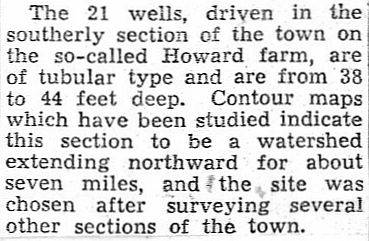
Residents say the land is important to protecting Hopedale’s current and future drinking water sources.
Earlier this year, selectmen signed an agreement with the railroad — after the two had their own court battles and subsequent mediation — that would split the land between the railroad and the town. The town agreed to pay the railroad $587,000 for about 84 acres, because a railroad-owned trust owns the land.
The 11 residents then filed a lawsuit, arguing the town should have acquired all of the land, per the earlier Town Meeting vote. In April, the residents secured an injunction to stop the town from paying for, and therefore acquiring, the 84 acres, while the case played out in court. The April injunction did not stop the railroad from proceeding with construction.
“The court did not look kindly on both the railroad’s ‘attempt to circumvent’ the town’s rights to protect the forestland, and its clearing of the land while the town was deciding whether to exercise its rights and while the Appeals Court’s injunction against transfer of the town’s rights under the settlement agreement remained in effect,” said Lurie.
More: Hopedale West Street land dispute case back in court
Acquiring that land would preserve it as conservation land for open space and passive recreation, and there’s no risk of losing 25 acres of wetlands as a potential water supply, wrote Lurie in a letter to attorney Brian Riley, who represents the town in the lawsuit, following the court’s decision.
There is no downside for the board to pursue enforcement, Lurie said, and any attempt to obtain approval of the settlement agreement at a Special Town Meeting would be defeated.
Above and below sent by a member of the plaintiffs listed below.
WORCESTER, ss. SUPERIOR COURT DEPARTMENT OF THE TRIAL COURT
Civil Action No. 2185CV0238
ELIZABETH REILLY, CAROL J. HALL, DONALD HALL, HILARY SMITH, DAVID SMITH, MEGAN FLEMING, STEPHANIE A. MCCALLUM, JASON A. BEARD, AMY BEARD, SHANNON W. FLEMING, and JANICE DOYLE, Plaintiffs, v. TOWN OF HOPEDALE, LOUIS J. ARCUDI, III, BRIAN R. KEYES, GRAFTON & UPTON RAILROAD ) COMPANY, JON DELLI PRISCOLI, MICHAEL MILANOSKI, and ONE HUNDRED FORTY REALTY TRUST, Defendants.
PLAINTIFFS’ OPPOSITION TO BOARD’S MOTION FOR CLARIFICATION OF JUDGMENT
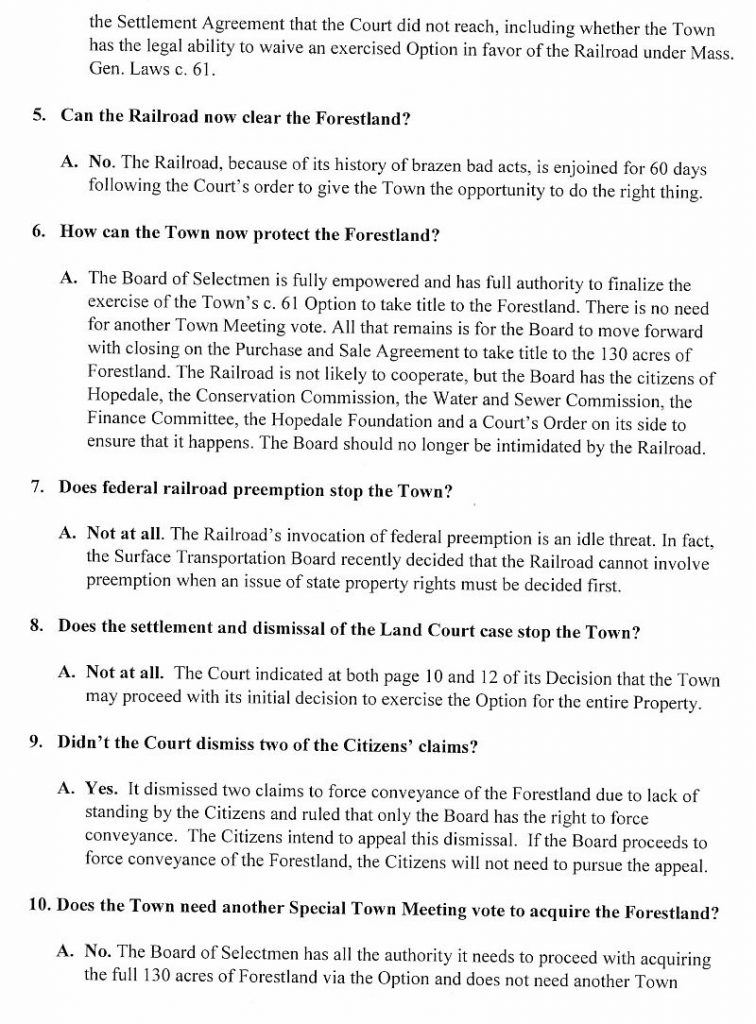
The Court’s Order is clear. Because the Board was and remains unauthorized to agree to the key material term in the Settlement Agreement, the Agreement is void ab initio. All of the Agreement’s terms are void, including the Board’s purported waiver of the Town’s c. 61 Option rights. Those rights remain in full despite the Railroad Defendants’ attempts to skirt c. 61, steal away the Town’s Forestland and destroy it. This Court astutely saw through the Railroad Defendants’ malfeasances and appropriately gave the Board the opportunity and time to fulfill its duties to the Town. Unfortunately, this Motion is yet another example of the impotence of this Board (or further evidence that it remains beholden to the Railroad) and further justifies the Citizen Plaintiffs’ action.
It is not the Court’s job to hold the Board’s hand and walk them through how to complete what it and the citizens of the Town started. The citizens of Hopedale have resoundingly insisted and recently reaffirmed what the Board must do – enforce the Option and acquire all of the Forestland from the Trust.
The Town unanimously provided the Board the authority at the Special Town Meeting, c.61 provides the Board with the process and this Court provided the Board the time to act. The Motion should be denied for the reasons set forth below, but ultimately because this Court’s Order is clear.
Plaintiffs respectfully request that the Court deny the Town’s Motion and extend the Injunction against the Railroad Defendants from any work in the Forestland for an additional 60 days following entry of the Court’s order on the Town’s Motion. 1.
1 – No Clarification of the Court’s Order is Needed
The Court’s Order is clear, written advisedly and there is no ambiguity. The Court notes early in the Order that “it is undisputed that the Town attempted to carry out the steps necessary to exercise its Option with respect to the 130.18 acres of forest land pursuant to Chapter 61.” Order at 5. The Court took a closer look than the Land Court did when it denied the Town’s Motion for preliminary injunction, setting the stage for the void Settlement Agreement. In this Court’s Order at n. 6, the Court found that there was no uncertainty with respect to the c. 61 Forestland at issue, neither as to area nor as to cost. The Court also explains that the “option referenced in Article 3 can only be exercised according to the terms of the triggering purchase and sale agreement between the Trust and G&U” and “the Town may not materially alter those terms by exercising the Option only as to part of the land.” Order at 8. To make the point abundantly clear, the Court held “[o]nce the Board elected exercise the Option and obtained a precisely worded authorization to acquire specific land pursuant to specific rights, it was bound by the terms of that authorization.” The Board is so bound, and the Board has a duty to act. 1 The Court then, twice, recognized that the Board has the authority to move forward with the exercise of the Option. The Court advised that the Board could “determine whether to seek Town Meeting approval for the Settlement Agreement, renew its attempts to enforce the Option, or to do neither.” Order at 10 (emphasis added). Later, the Court went further and enjoined the Railroad from any land clearing activity or work in the Forestland for 60 days to give the Board the time to decide and to act. The injunction would not be necessary or make any sense if enforcement of the Option in full was not available. In entering the injunction, the Court hit the Board over the head with the reason for the injunction: “to allow the Town to decide whether to seek the Town Meeting authorization necessary to validate the Settlement Agreement or to take the necessary steps to proceed with its initial decision to exercise the Option for the entire Property.” Id. at 12 (emphasis added). The Court could not be clearer, and the Court should not be asked by the Board to teach it how to bake bread. The Board has two experienced attorneys from two reputable law firms who should know how to read, interpret and act on the clear Order of the Court.
The Court’s Order is appropriate. The unauthorized agreement is void and unenforceable, in its entirety. Town of Brimfield v. Caron, 2010 WL 94280, *10-11 (Mass. Land Ct. Jan. 12, 2010) (Town’s right of first refusal pursuant to G.L. c. 61, §8 not yet ripe due to failure to strictly
1. The Board’s lack of backbone is exactly what caused the Citizen Plaintiffs to bring this action and include the request for mandamus to force the Board to finalize its obligations to the citizens of Hopedale and preserve the Forestland from wholesale industrial destruction by a notorious bad actor
comply with notice requirements, all subsequent acts were “a nullity”); after trial, 2015 WL 5008125 (2015) (ruling that Town had right to purchase forest lot for $186,500); Daly v. McCarthy, 2003 WL 25332929 (Mass. Land Ct. Aug. 04, 2003) (in ten taxpayer suit, court invalidates purported release of agricultural preservation restriction (“APR”) in a settlement agreement entered into by board of selectmen without town meeting approval), affirmed, Daly v. McCarthy, 63 Mass. App. Ct. 1103 (2005); Bowers v. Board of Appeals of Marshfield, 16 Mass. App. Ct. 29, 32 (1983), (reversing an agreement for judgment entered by the selectmen that included agreeing to encumber six lots owned by the Town because “[t]he power to alienate and dispose of real estate lies with the inhabitants of the town acting at town meeting”, citing c. 40, § 3). The unauthorized payment was the only provision of the Settlement Agreement requiring the Town to pay any funds or take actions. Without it, nothing remains. As the Court noted in the Order, the sum and substance of the Settlement Agreement is that the Railroad Defendants agreed to sell 40 acres of the Forestland and all of the wetlands for $587,500; the Railroad Defendants would donate a separate parcel, subject to Town Meeting approval and “[i]n return the Town agreed to waive its Option with respect to the remaining 90 acres of forest land.” Order at 4 (emphasis added). Because the key consideration was unauthorized under c. 61, § 8 or c. 40, § 14, the Agreement is void.
Accordingly, the Town certainly can enforce the rights purportedly waived under the Settlement Agreement. The necessary consequence of the lack of authority to execute the unauthorized Settlement Agreement is that it is void, a nullity, does not exist. That is why Judgment on the Pleadings on Count I was entered and that is exactly the relief requested by Plaintiffs. The necessary consequence of being back at square one is that the Board now has the choice, again, to seek approval to give away two-thirds of the Forestland to the Railroad or to seek to enforce the Town’s Option. The Railroad Defendants as “party who enters into a contract with a public entity without ensuring that proper authority exists for that contract does so at its own risk.” Colantonio, Inc. v. Fitchburg Hous. Auth., 2008 WL 3311892, at *2 (Mass. Super. July 23, 2008) (denying summary judgment to contractor seeking recovery from housing authority that was not authorized to expend the funds under the contract) quoting, Potter & McArthur, Inc. v. Boston, 15 Mass.App.Ct. 454, 459 (1983).
The Railroad Defendants cannot now enforce the unauthorized Settlement Agreement. Any “reading” of the Decision as saying there is nothing illegal or invalid about the Settlement Agreement is wishful thinking.2 It is certainly illegal in the sense that c. 40, §14 has not been complied with for acquisition of municipal property. Plaintiffs assert it is similarly illegal for transfer of municipal property rights – an exercised and recorded option in real property – without Town Meeting approval under G.L. c. 40, §3 and in violation of the anti-assignment provisions of G.L. c. 61 § 8. See Memorandum in Support of Plaintiffs’ Motion for Judgment on the Pleadings at 14-16; Plaintiffs’ Memorandum in Opposition to the Board’s Motion for Judgment on the Pleadings at 7-9. In any event, without Town Meeting approval, the Court’s decision made clear the Settlement Agreement is indeed unenforceable.
2. The Railroad Defendants have indicated that they intend to submit a response or opposition to the Town’s Motion to Clarify. The Court should reject, disregard and strike any submission from the Railroad Defendants. The Railroad Defendants were not a named party to Count I, the only claim for which the Town seeks clarification, and the Railroad Defendants lack standing to be heard on the Town’s Motion. Daigle v. Daigle, 85 Mass. App. Ct. 1105 (2014)
2 -The Board Seeks “Clarification” Because it is Paralyzed.
The real reason the Board seeks clarification, at the last possible day of Rule 59’s ten-day deadline, is that it is frozen. As referenced by the Board in its Memorandum in Support of itsMotion (at 6), the people of Hopedale made clear immediately following the Order by campaign, including a petition signed by over 500 residents, that they want Board to proceed to enforce the Option. See Petition, Signatures and Public Comments, attached hereto as Exhibit 1; November 19, 2021 Milford Daily News Article, Judge Rules Hopedale Select Board Has Final Say in Protecting Forestland, attached as Exhibit 2. The Board must finish what it started.
Despite the Court’s clear 60-day Order, the Board has not scheduled a Town Meeting because it knows that approval of the ill-conceived Settlement Agreement, which would require a 2/3 vote, would surely be defeated. Undersigned counsel and counsel for Railroad have submitted their respective views on the choice now before the Board, with undersigned counsel strongly urging that the Board pursue enforcement of the Option, as an option clearly stated by this Court. See November 12, 2021 Lurie Letter , attached as Exhibit 3; November 15, 2021
The Board is using this Motion as way to avoid responding to the citizen petition and comments and to refuse to allow public discussion in an open Board meeting. See November 22, 2021 Board of Selectmen video, beginning at timestamps 1:27:18 and 1:37:08
https://townhallstreams.com/stream.php?location_id=56&id=41404, where Board Chair Brian Keyes claimed that he was not trying to shut down the issue by blocking public discussion, but
3 The Railroad Defendants’ repeated assertions that that the Settlement Agreement remains fully enforceable and that the Town’s c. 61 rights remain unenforceable due to the waiver in the Settlement Agreement and dismissal of the Land Court action based on that Settlement Agreement are simply wrong in light of the Court’s decision. Ex. 4 at 2. Those claims are at odds with the Court’s decision. If the Town intends to comply with the decision rather than appeal it, then plainly the c. 61 rights have not been validly waived and enforcement of the Option remains available to the Town.
plainly he is. Contrast this with Chair Keyes’ penchant for using his position for bombastic soliloquy regarding this litigation. See October 25, 2021 Board of Selectmen meeting beginning at timestamp 46:05, https://townhallstreams.co/stream.php?location_id=56&id=40754.
Though the Board’s spine needs stiffening, that is not the Court’s job. However, if the Court is inclined allow the Motion, “clarification” that enforcement of the Option is indeed available to the Town – that the Court meant what it said – may help the Board understand that such option is not only available but is indeed viable on the facts of this case. Moreover, it may help the Board realize, again, that it need not be coerced by the Railroad Defendants’ bluster that it would be violating the non-existent Settlement Agreement if it continues its initial efforts to enforce the Option.
3 – The Motion should be denied in any event as served without consultation required under
Rule 9C.
The Motion should be denied because the Board failed to consult as required under Sup. Ct. R. 9C. As the Board is aware, time is of the essence as the Court’s 60-day injunction ticks by. On the tenth day following the Court’s Decision, the Board served its Motion, without having previously consulted with Plaintiffs’ counsel or even mentioning the possibility of such a motion. Following the entry of the Court’s Order, counsel for Plaintiffs reached out to counsel for the Board to discuss the clear implications of the Order immediately on November 10, by leaving voicemails on his office and cell phones and two days later by the aforementioned letter attached as Ex. 3. Despite this, counsel for the Board never responded or reached out to confer about this Motion, which may have narrowed the issue considerably given that the Court’s Order is not ambiguous or inconsistent to undersigned counsel.
CONCLUSION
For the reasons stated above, Plaintiffs respectfully request that this Court deny the Town’s Motion for Clarification and, in any event, continue the injunction for 60 days from the entry of an order on the Motion.
ELIZABETH REILLY, CAROL J. HALL, HILARY SMITH, DAVID SMITH, DONALD HALL, MEGAN FLEMING, STEPHANIE A. MCCALLUM, JASON A. BEARD, AMY BEARD, SHANNON W. FLEMING, and JANICE DOYLE
By their attorneys,
__/s/ David E. LurieDavid E. Lurie, BBO# 542030 Harley C. Racer, BBO# 688425 Lurie Friedman LLP
One McKinley Square
Boston, MA 02109
Tel: 617-367-1970
Fax: 617-367-1971
[email protected]
[email protected]
HOPEDALE — The Select Board is requesting a judge to provide it with more time to decide its next step in regards to a disputed land deal it made with Grafton and Upton Railroad — a deal the judge ruled is invalid.
In addition, the board is seeking further clarification from the judge in terms of what its options are going forward.
“Quite frankly, attorney (Brian) Riley and myself saw too many difficulties for the town and Board of Selectmen to go forward on one of those three options without further clarification from the court, particularly given the litigious nature of this matter and the competing interests of the parties that have already brought actions against the Board of Selectman on this issue,” said attorney Peter Durning during Monday’s Select Board meeting.
On Nov. 10, Judge Karen Goodwin ruled that a deal made between the Select Board and Grafton and Upton Railroad to split 155 acres of protected forestland on West Street was invalid because the proposal didn’t first go to Town Meeting.
At the same time, she ruled that only the board has the authority to exercise the right of first refusal to buy land that has been deemed forest, and therefore taxed at a lower rate.
Goodwin then gave the board three choices:
- Decide whether to seek the Town Meeting authorization necessary to validate the settlement agreement it signed with the railroad
- Take the necessary steps to proceed with its initial decision to purchase the entire the property
- Neither of the above. This would allow the railroad to acquire all of the land.
The judge gave the Select Board 60 days to make a decision, and also initiated a preliminary injunction preventing the railroad from carrying out further work on the forestland until Jan. 9.
Riley, who serves as the town’s ligation counsel, filed a motion Monday in Worcester Superior Court seeking additional clarification on the ruling before making a decision on the matter, according to Durning.
After that motion is filed, Durning said the matter will return before Goodwin to give her an opportunity to clarify her ruling, to which the board can then proceed “in greater confidence” about which steps to take moving forward.
“We’re in a little bit of a holding pattern,” said Durning about holding further discussion on the matter until the town gets additional guidance from Goodwin.
‘We wanna get it right’
The lawsuit centers on a dispute over 155 acres of forest and wetlands off West Street, through which Grafton and Upton Railroad tracks run. The railroad has been trying to expand its operations over the past year or so, and leadership says developing the tracks and the area around them is key to the strategy.
In the motion filed Monday in Superior Court, Riley wrote that it was always the town’s — and the railroad’s — position that the settlement agreement was valid, and it’s not clear why the town retains the legal right to enforce the right of first refusal because the agreement waives the town’s ability to exercise that right.
The town and railroad’s view is that the agreement is the only viable option to obtain any of the property at 364 Main St., Riley said.
“We wanna get it right,” said Select Board Chair Brian Keyes during Monday’s board meeting about seeking clarification from the court. Based on the nature of the litigation, he said they’re hoping for a quick turnaround on the matter.
An executive session held last Friday about a lawsuit brought against the town by 11 residents who oppose the land split resulted in “a robust discussion,” Keyes added, but he said there’s still too much “inconsistency” that needs to be defined.
“It’s quite sad that the board feels that it needs further guidance from the court,” he said. “In fact, there is nothing in the court’s decision that needs clarification. It’s there in black and white: Because the settlement agreement was not authorized by Town Meeting, the board now has the option to continue the steps it initially took to acquire all of the forestland.
LURIE FRIEDMAN LLP
M E M O R A N D U M
TO: Brian Riley, Peter Durning, Town of Hopedale
FROM: David E. Lurie, Harley C. Racer
RE: Strategy to Enforce Town of Hopedale’s Right of First Refusal Option to c. 61 Forestland and Likelihood of Success
DATE: December 20, 2021
Following the Superior Court’s decision on the Town of Hopedale’s Motion for Clarification, the Board of Selectmen should move forward, quickly, to enforce the Town’s Option to acquire all of the 130 acres of c. 61 Forestland at 364 West St. To enforce the properly exercised Option, the Board should return to Land Court, move to vacate the judgment entered in the form of a stipulation of dismissal and seek a preliminary injunction against any work or disturbance by the Railroad of the c. 61 Forestland during the pendency of the Land Court action. The Superior Court has made it abundantly clear through four decisions now that the Town is highly likely to succeed in its renewed effort to enforce the Town’s Option.
- The Town Can Vacate the Stipulation of Dismissal Entered in the Land Court.
It is black letter law under Mass. R. Civ. P. 60(b)(6) that the Court, at the trial judge’s discretion, may relieve a party from a final judgment upon motion or by independent action made within a “reasonable time.” The Court has power “to vacate judgments whenever such action is appropriate to accomplish justice.” Klapprott v. United States, 335 U.S. 601, 615 (1949); see also Parrell v. Keenan, 389 Mass. 809, 813-16 (1983) (judgment for damages properly vacated pursuant to Rule 60(b)(6) because settlement agreement was signed by counsel without proper authority); Abrams v. Bd. of Selectman of Sudbury, 76 Mass. App. Ct. 1128 (2010) (finding unenforceable settlement agreement entered into without authorization of planning board would warrant relief from judgment in an independent action under Rule 60(b)(6)). In Bowers v. Bd. of Appeals of Marshfield, 16 Mass. App. Ct. 29, 35 (1983), where the Board of Selectmen exceeded its authority by entering an agreement without approval of the Town Meeting, the appropriate relief was to vacate the judgment under Mass. R. Civ. P. 60(b)(6).
Where, as here, a settlement agreement is entered into without proper authority, it is unenforceable. In City of Lawrence v. Stratton, 312 Mass. 517, 519-20 (1942), after the city acquired a property by tax foreclosure, the city council agreed by unanimous vote to sell the property to a private party on the condition that he spend $50,000 to improve the property and authorized the mayor to execute and deliver the deed. Instead, the mayor entered the city into an agreement to sell the property for $1. The Court determined the mayor had no authority to bind the city by such an agreement, found the deed null and void, and ordered the reconveyance of the land to the city. Id. at 520. See also Rossi v. School Committee of Everett, 354 Mass. 461, 464 (1968) (Civil Service Commission decision based on unauthorized compromise agreement by city solicitor changing order voted upon by school committee “cannot stand”); Parrell v. Keenan, 389 Mass. 809, 813-16 (1983) (judgment for damages properly vacated pursuant to Rule 60(b)(6) because settlement agreement was signed by counsel without proper authority).
Judge Goodwin’s decisions make it clear that the Settlement Agreement is ineffective and void due to lack of municipal authority and that the Town may file a timely Rule 60(b) motion in the Land Court to vacate the stipulation and enforce the Town’s c. 61 rights. See Reilly v. Town of Hopedale, No. 2185-cv-00238, Mem. of Decision and Order at 8 (Mass. Super. Ct. Nov. 10, 2021) (“[T]he Board exceeded its authority when it entered into the Settlement Agreement without Town Meeting authorization.”); Reilly v. Town of Hopedale, Mem. of Decision on Mot. for Clarif., No. 2185-cv-00238 at 2, n. 3 (Mass. Super. Ct. Dec. 16, 2021) (“[T]he Town could seek recission of the Settlement Agreement” and “[has] the right to continue attempting to enforce the Option”). As demonstrated through Parrell, Bowers, and Abrams among other cases, a vehicle by which the Town may seek relief from the unenforceable agreement is a motion to vacate the voluntary dismissal under Rule 60(b)(6) in the Land Court.
- The Town is Highly Likely to Succeed in Enforcing its Exercised Option and Obtaining the Entire 130 Acres of Forestland.
The Superior Court, the first to give the Railroad’s illegal acts proper scrutiny, indicated at least four times that the Town would win if it pursued enforcement of the Option against the Railroad. The Court first, on September 9, 2021, “temporarily restrained [the Railroad] from any further alteration or destruction of the Chapter 61 land”. See Dkt. No. 34. Next, on September 24, 2021, after full briefing on the issues, the Court entered a preliminary injunction against the Railroad because “[b]y clearing the Forestland, the Railway, in essence, is treating the Forestland as though it were released from Chapter 61 constraints, a result the appeals court injunction sought to prevent.” Dkt. 38 at 4. The Court further noted, “[i]f the plaintiffs are successful in this lawsuit, the Forestland would remain in its natural state.” Id. The plaintiffs were ultimately successful. On November 10, 2021, the Court entered judgment for the citizen plaintiffs on Count I. In that Decision, the Court held that the Town did what was necessary to exercise its Option to the c. 61 Forestland, including obtaining authorization from Town Meeting for the purchase of the Forestland pursuant to the Option. Dkt. No. 45 at 5, 8. Because the Board is not authorized for any other purchase or acquisition, the Court informed the Board that it could “seek Town Meeting approval for the Settlement Agreement, [] renew its attempts to enforce the Option, or [] do neither.” Id. at 10. The Court also extended the injunction against the Railroad, sua sponte, because the Railroad’s bad acts were not lost on the Court – “the court is mindful of the Railroad Defendants’ attempt to circumvent the Chapter 61, § 8 process by purporting to acquire only the ‘beneficial interest’ in the forest land while undertaking the same commercial operations that Chapter 61 allows municipalities to preclude” and “the court cannot ignore (1) the Railroad Defendants’ initiation of clearing operations after the Town issued a notice of intent but before it could hold a Town Meeting . . . and (2) its resumption of clearing operations while the Appeals Court injunction remained in place.” Id. at 11.
Lest any doubt remained, the Court put it to bed in its December 14, 2021 Decision on the Town’s Motion for Clarification. The Court ruled that “the Settlement Agreement is not effective.” Dkt. No. 50. Moreover, the Court held that if the Board does not obtain Town Meeting authorization of the Settlement Agreement (either because it chooses not to hold the Town Meeting or because the vote fails) “the Settlement Agreement would fail to take effect, meaning the Railroad would retain the land and the Town would retain its money and the right to continue attempting to enforce the Option.” Id. at 2 (emphasis added). The Court again neutralized the Railroad’s threats, noting that the Railroad’s position – if a vote failed, the Town gets nothing and the Railroad gets everything – “would be unjust, to say the least.” Id. at n. 3 (emphasis added). In note 3, the Court further explained why the Railroad’s arguments of severability and claim preclusion are meritless. Id. (“the Railroad’s claim preclusion argument misses the mark”); see also Salem Highland Dev. Corp., v. City of Salem, 27 Mass. App. Ct. 1423 (1989) (where City Solicitor entered into agreement to convey property to a developer without authorization by the City Council or Mayor, Court vacated the agreement under Rule 60(b)(6) resulting in reconveyance of the locus to the city), discussed in Eastern Sav. Bank v. City of Salem, 33 Mass. App. Ct. 140, 142 (1992).
- Federal Railroad Preemption is Not Available to the Railroad and Any Surface Transportation Board Petition Would Fail.
Finally, the Railroad’s preemption threat is toothless. Any petition that the Railroad may file with the Surface Transportation Board (“STB”) or any other attempt to claim preemption will fail. The Railroad’s acquisition of the Forestland and its title to the same is in violation of a state statute that establishes property rights held by a municipality. When ownership of the property implicated state property rights, those issues must be resolved in state court before the STB can or will consider preemption. See STB Decision in Docket No. FD 265518 dated November 3, 2021 (holding that “a court is typically the more appropriate forum for interpreting contracts and resolving state property law disputes”); First American Realty, Inc., et al. v. Grafton & Upton Railroad Company, et al. No. 2185-cv-00784, docket entry dated November 5, 2021 (concurring with the STB that the state court is the proper forum). Here, none of the Forestland (or Wetland) is properly held by the Railroad and no rail transportation issue is presented. Massachusetts State Court is the only forum that can adjudicate the issue of the Town’s c. 61 Option and the Railroad’s violations of that statute.
The Town can and should move to vacate the Stipulation of Dismissal of the Land Court action because the settlement agreement upon which the Stipulation was based is null, void, and without effect. At the same time, the Town should seek a new preliminary injunction to enjoin the Railroad from further clearing the Forestland, because the current preliminary injunction expires on January 31, 2022. The Railroad is not looking out for the Town’s best interests and consequently, has led the Town down the path of illegalities as recognized by Judge Goodwin in her most recent decisions. The Board now has the opportunity to get it right by enforcing the Option to which it was bound following a “precisely worded authorization to acquire specific land pursuant to specific rights” following Town Meeting approval. Dkt. No. 45 at 8. Because a vote to obtain a retroactive authorization of the Board’s bad deal will surely fail – especially in light of the recent citizen petitions signed by well over 500 voters – vacating the judgment and enforcing the Option is the path the Board should take to preserve the Forestland. As stated, this path, in our view, is highly likely to be successful.

Judge clarifies why Hopedale land deal is invalid
Says Town Meeting must approve any revision from original vote
Lauren Young The Milford Daily News USA TODAY NETWORK
HOPEDALE — A Superior Court judge has said the town’s deal with the Grafton and Upton Railroad over land on West Street is invalid until it receives Town Meeting approval.
If the town doesn’t act, the railroad could take over 155 acres of disputed land that’s been under debate in court for over a year.
The town has until Jan. 31 to make its decision.
Residents at Town Meeting in October 2020 voted to acquire about 130 acres of the 155-acre property off West Street, and the Select Board agreed to set aside the land for conservation.
Earlier this year, selectmen signed an agreement with the railroad — after the two had their own court battles and subsequent mediation — that would split the land between the railroad and the town. The town agreed to pay the railroad $587,000 for about 84 acres, because a railroad-owned trust owns the land.
Eleven residents then filed a lawsuit, arguing the town should have acquired all of the land, per the earlier Town Meeting vote. In April, the residents secured an injunction to stop the town from paying for, and therefore acquiring, the 84 acres, while the case played out in court.
But the April injunction did not stop the railroad from proceeding with construction on the West Street land.
‘Procedurally defective’ On Dec. 16, Judge Karen Goodwin ruled the execution of the land deal as “procedurally defective” because the Select Board failed to obtain Town Meeting approval for acquiring the smaller amount of land. Thus, the town cannot use the money appropriated at the October 2020 Town Meeting to acquire only part of the disputed land until it gets such approval for a revised deal.
The Select Board had filed a motion for clarification of Goodwin’s Nov. 10 decision in which she ruled that the deal between the board and railroad to split the land on West Street needed to go to Town Meeting first for it to carry any weight. She also ruled that only the board has the authority to exercise the right of first refusal to buy that land.
She gave the Select Board three choices:
Seek Town Meeting authorization to move forward with the revised agreement
Take the steps to proceed with its initial decision to buy the entire property
Neither of the above. This would allow the railroad to take all of the land The town asked the judge to amend or clarify her Nov. 10 decision to state that the town had lost its statutory option to buy the entire parcel, but that wasn’t what the court decided, stated Goodwin in her ruling.
Although terms of the agreement are legal (including the board’s agreement to waive its right of first refusal), the board exceeded its authority when it entered into that agreement without Town Meeting approval, Goodwin found in her Dec. 16 ruling.
If the board doesn’t hold a Town Meeting or fails to gather the votes it needs, then the agreement would fail to take effect, said Goodwin, meaning the railroad would keep the land and the town would retain its money and the right to continue attempting to enforce its right to buy the land first under state law Chapter 61.
“The judge’s decision, once again, could not be clearer: The town can proceed to enforce its (Chapter 61) option to acquire all 130 acres of the forestland, right now,” said David Lurie, of Lurie Friedman LLP, who is representing 10 taxpayers in their lawsuit filed in Worcester County Superior Court. “The Select Board should proceed post haste to do just that.”
The Select Board discussed the update in Executive Session during a meeting on Monday. Its next meeting will be held tonight.
Town rejects representation from citizens’ lawyer
During a Dec. 13 Select Board meeting, the board voted to stick with its current attorneys in the West Street lawsuit, rejecting an offer from the attorney representing the opposing side to do it for free.
Lurie offered his services to the town “free of charge,” to replace Brian Reilly of KP Law and Peter Durning of Mackie, Shea and Durning, in the case against the railroad.
Lurie told the Daily News that his firm is willing to help the town enforce its Chapter 61 right of first refusal option in any capacity — free of charge — to help Hopedale get that forestland.
But on Dec. 13, Select Board Chair Brian Keyes and member Louis Arcudi III voted against replacing the town’s current legal team. The third board member, Glenda Hazard, abstained because she felt it wasn’t the right time to vote on the matter.
The topic was added to the Dec. 13 agenda after Keyes commented during a previous board meeting, on Nov. 22, about his comfort in using the town’s current lawyers. Hazard then said the board hadn’t discussed the issue, and that Keyes was only speaking for himself. And with Lurie’s firm offering its services for no fee, Hazard said it was something the board should consider.
The most recent citizen petition sent to the board included 402 people with more than 300 comments asking for Lurie to replace the town’s current lawyers, said Arcudi.
Two counts appealed by citizens
On Dec. 6, the residents filed a motion to appeal Counts II and III citizens’ lawyers. Both those counts were previously dismissed in the judgment entered on Nov. 10, which confirmed that only the Select Board has the authority to exercise a Chapter 61 right of first refusal option and that the forestland in the settlement agreement isn’t protected parkland.
Lurie told the Daily News that the appeal was made in case the board does not enforce its right of first refusal on its own.
During the Dec. 13 Select Board meeting, Elizabeth Reilly, lead plaintiff in the citizens lawsuit, said the notice of appeal was filed because the injunction against the railroad continuing work at the West Street site ends Jan. 31 and the town still hasn’t made a decision after the judge’s Nov. 10 ruling.
Railroad: Agreement remains ‘fully enforceable’
“Contrary to a lot of what I heard (during the Select Board’s Dec. 13 meeting), the (land deal) remains intact and fully enforceable,” said attorney Don Keavany, representing the Grafton and Upton Railroad and One Hundred Forty Realty Trust in the lawsuit. Within that agreement between the Select Board and the railroad is a clause, which says that if any provision of the agreement is not enforceable, the rest of it remains fully enforceable.
That means the agreement survives with or without a transfer of the land, he said.
The railroad has been complying with the agreement since February, he said, and hopes that a new Special Town Meeting is scheduled within the next month to appropriate a new sum of money for the town to acquire 130 acres of the West Street property.
While taxes gained from the railroad building on that West Street land will benefit Hopedale, Keyes said during the Dec. 13 meeting that it’s not his top priority — protecting natural resources like water supply and adding forestland to town parklands is.
“The silver lining behind the railroad getting all 155 acres is they’re still going to develop the property, and we’re still going to get all that tax revenue if they do that,” said Keyes during the meeting. But if the town chooses to not move forward with the settlement agreement or fight to obtain all that land, it would come at an immense cost, he said.
“There’s no way of forecasting the amount,” he said, “but we’re talking about hundreds of thousands of dollars.”
Lauren Young writes about business and pop culture. Reach her at 774-8041499 or [email protected]. Follow her on Twitter @laurenwhy__.
HOPEDALE — The Select Board has reversed field and now wants to reopen the Land Court case it filed to acquire 130 acres of forestland the Grafton & Upton Railroad was on track to take.
On Dec. 30, the town filed a motion to reopen the case against the railroad to proceed with its original decision to buy the 364 West St. property under state law Chapter 61, for which Special Town Meeting gave its approval in October 2020.
That property on West Street consists of 155 acres, with 130 of them classified as forestland.
In January 2021, after at least a year and a half of lawsuits, legal mediation, local and state hearings, and resident petitions and advocacy, the town and the railroad reached accord on splitting up the West Street property. Under that settlement, Hopedale was to acquire about 85 acres in the area, as well as a commitment from the railroad that it wouldn’t develop another, small section for five years. The town would pay $587,500 for 64 of those acres.
Now the town has changed its mind on the deal, citing “compelling and extraordinary circumstances,” according to its Dec. 30 motion.
More:Hopedale board’s deal with railroad is ‘procedurally defective.’ Judge explains why
On Tuesday, the town also filed an emergency motion to extend the injunction against the railroad from clearing that property further until the court acts on the motion.
Coming to you with an update and, yes, another petition request. Petition Link:


- We are of the strong opinion that the Land courts denial of the Town’s Motion to Vacate contains clear errors of law and is HIGHLY LIKELY TO BE REVERSED ON APPEAL
- There is no harm to filing and pursuing a Notice of Appeal but there would be a great loss of the Town’s rights if an appeal is not filed
- The Land Court does not address the injustice that occurs by ceding the Ch 61 Forestland to the RR, who holds title to the Forestland ONLY through its BLATANT VIOLATIONS of Ch 61
- The Town should not be presented with a devil’s choice between a bad deal that is the product of a series of illegal actions by the RR, or getting nothing.
- The Land Court order creates inconsistent court rulings which MUST BE RESOLVED BY THE APPEALS COURT
- The Land Court’s decision is starkly inconsistent with Judge Goodwin’s unambiguous finding that the Board exceeded its authority when it entered into the Settlement Agreement without Town Meeting approval of the reduced acquisition, and therefore, the Settlement agreement is not effective. If the Settlement Agreement is not effective, neither is the Stipulation of Dismissal.
- The Land Court’s commentary regarding the consideration issue is also inconsistent with Judge Goodwin’s finding that enforcing only part of the Settlement Agreement – the part that benefited the RR, i.e. the Town’s release of the Ch 61 Option – “would be unjust, to say the least”.
- These inconsistencies between the decisions of the Land court and the Superior Court must be reconciled by an appellate court. For this reason alone, the Town must file a Notice of Appeal of the Land Court decision.
- The RR’s latest letter threatening a lawsuit for breach of contract (included in the attachment) makes it crystal clear that there is a real dispute as to the effectiveness of the Settlement Agreement. The Superior Court has ruled that it is not effective, but the RR nevertheless maintains that it is. This is an issue that can only resolved by the Courts.
- The next step to resolution is an appeal of the Land Court’s Order to reopen the litigation to enforce the Town’s Ch 61 rights.
- The Appeals Court is where this dispute will ultimately be resolved and the appellate process is the course to correct errors and injustices that have occurred in the lower courts.
- The Select Board should not simply give up now, especially with an option that supports the will of the residents. The Select Board should appeal this unjust decision and join the Hopedale Citizens to protect the public’s rights with this forestland.
- The Select Board will not be faulted for unsuccessfully trying to preserve the forestland, but will be faulted for giving only a half-hearted effort.

HOPEDALE — What town officials called “extraordinary circumstances” with respect to their desire to reopen a lawsuit against the Grafton and Upton Railroad over 155 acres of disputed land weren’t extraordinary enough, at least in the eyes of a Land Court judge.
Now a Superior Court injunction forbidding the railroad from clearing more of the 155 acres of disputed land ends Monday — a decision the town plans to appeal, according to Peter Durning, who has represented the town in its Land Court proceedings.
What the town does after that will be voted on by residents, said Select Board Chair Brian Keyes during a meeting on Thursday night.
“A robust element of the (board’s) discussion was a sincere interest in bringing this matter to the residents in a Special Town Meeting,” Durning said. While that meeting hasn’t been scheduled, Keyes said officials plan to hold it safely in-person.
The issue stretches back to October 2020, when Special Town Meeting approved the town to purchase the 155 acres of land at 364 West St., which was also sought by the railroad for development. One hundred and thirty acres are classified as forest land, with the remaining 25 acres being wetlands.
The town filed a lawsuit and preliminary injunction against the railroad shortly after the October 2020 Special Town Meeting but later agreed to mediation, resulting in an agreement to split the disputed land. The town agreed to getting about 85 acres, plus a 20-acre expansion of its Parklands, and the railroad vowed to provide environmental protections and possible cost-sharing opportunities when it came to land-surveying and pinpointing new water sources.
Feb 22, 2022
Good Morning,
Good Afternoon,
https://www.zoomgov.com/j/1613026429?pwd=ZkpBVjVyUzc1QmtuZ1RPOHNRRjNmUT09
Meeting ID: 161 302 6429

Good Afternoon,
May 2, 2022


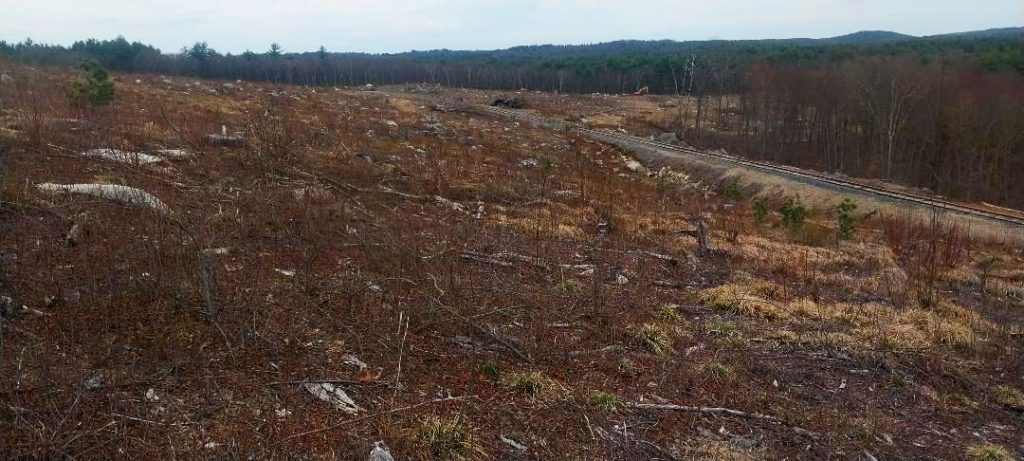
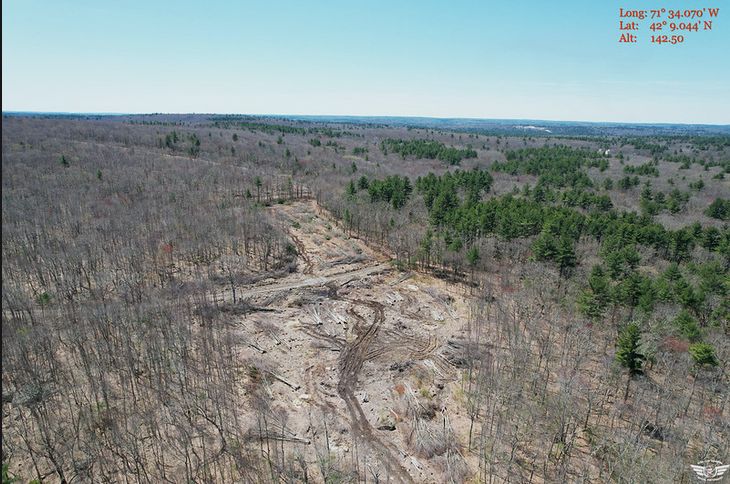
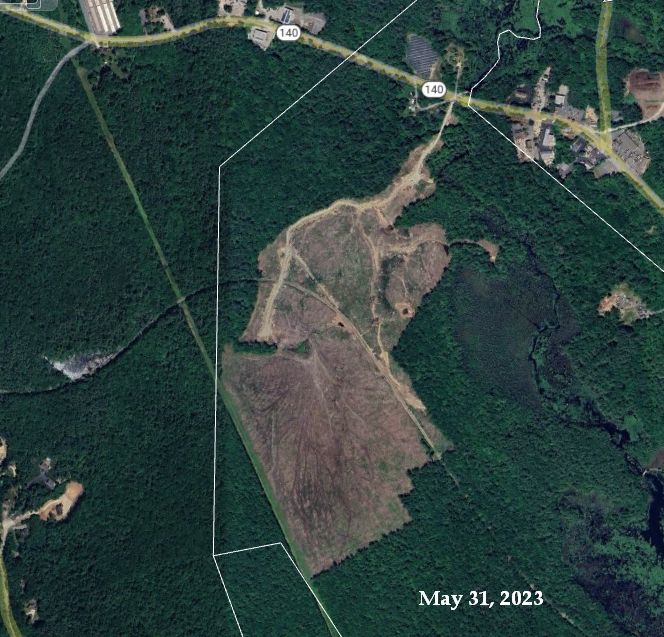
This picture of the West Street land being cleared by the G&U Railroad was taken from Rosebud Lane in Milford. You can also get a glimpse of it from Route 140 near Dairy Queen. Thanks for pointing that out, DJ.


Railroad company bulldozes thousands of trees, enraging residents worried about the impact on water supply
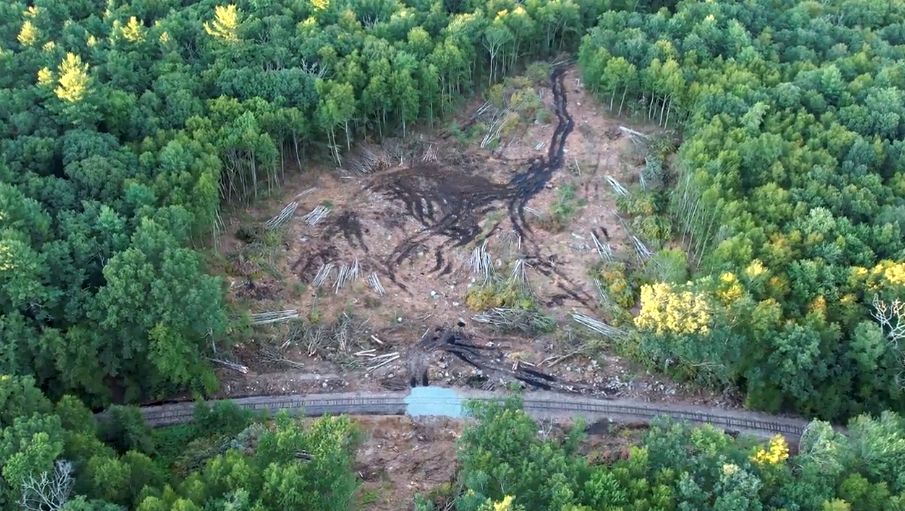
HOPEDALE — Last spring, as legal wrangling mounted and town officials sought control over forestlands critical to the local water supply, the new property owner spurned their pleas and cleared 100 acres above the sole aquifer, bulldozing thousands of mature trees to make way for new development.
Residents were aghast to learn the owner, a local railroad company, asserted its right under an arcane federal law that allowed it to ignore local and state environmental rules.
The dense woods where they had long walked their dogs and went snowshoeing, a forest vital to filtering and recharging the town’s water as well as absorbing the carbon emissions that cause climate change, looked like a moonscape.
“It’s devastating to see what they’ve done,” said David Sarkisian, 64, whose property abuts the cleared land. “This is an environmental nightmare for our town.”
The woods were bought from a land trust two years ago by the Grafton and Upton Railroad Co., which operates a 149-year-old freight line between Grafton and Franklin that runs through the property.
With the shipping industry booming, company executives say they need more room to maintain locomotives, store rail cars, and unload and warehouse commodities they transport, which include chemicals, propane, lumber, gravel, and wax.
The railroad bought nearly 200 acres of forested land in this town southwest of Boston near Rhode Island and plans to build 1.5 million square feet of warehouses — more than 20 buildings — and a network of roads and other paved surfaces. The track-side location is ideal for the company, near two interstate highways.
“With double-digit growth year over year, and 20 percent growth in rail car volume, our customers have needs,” said Michael Milanoski, president of the company, known as GURR.
But it’s unclear whether the company can develop the land, which it hopes to complete next year.
Local residents and Hopedale officials, enraged about the environmental threats and what they consider bullying by the company, have filed multiple lawsuits. They claim the company violated state and federal laws and that the town should have had the option to buy the land first.
“They’ve trampled the town’s rights and are jeopardizing the town’s future by endangering its water supply,” said Ed Burt, chairman of the Hopedale Water and Sewer Commission. “This may be something we never recover from.”
Meanwhile, newly elected selectmen have taken a less-accommodating position than their predecessors, who had approved a settlement with the company that allowed it to develop a smaller portion of the land. The agreement required the company to sell the remaining undeveloped land to the town.
Last year, after residents sued the town to block the settlement and Hopedale’s Town Meeting rejected it, a state superior court judge effectively nullified the agreement.
Over the summer, the new Select Board approved using the town’s eminent domain powers to take nearly two-thirds of the land, claiming Hopedale is the rightful owner.
Around the same time, the town’s Conservation Commission accused the company of violating the state’s Wetlands Protection Act, arguing its development would worsen existing water-supply problems, lead to significantly higher treatment costs, and impede access to new water sources.
“When these types of mature forests are razed and later replaced with impervious surfaces from development, the water is not held as long,” said Becca Solomon, chair of the Conservation Commission, in a sworn statement in yet another lawsuit filed this summer. “It causes higher risk of flooding during large rain storms, and because the water is not held by the vegetation, it is followed by higher risks of drought.”
The company has challenged the town’s authority to assert eminent domain over the property and insists it shouldn’t be subject to state environmental laws. In asking a federal judge in Boston this summer to block such action, GURR argued the federal Interstate Commerce Act has long allowed railroad companies to operate “free of unreasonable local interference and regulation.”
The company, which has been sued for asserting similar privileges in other communities, called the land “irreplaceable real estate” and “a once in a lifetime railroad development opportunity.”
No compensation from the town would be enough to make up for the loss of the land, it added.
“GURR could not simply take the proceeds from a taking and purchase replacement property similarly sized, zoned, situated, and suited to development as a railroad transloading operation,” the company argued in a complaint to the court.
Milanoski insisted the company is doing everything it can to protect the environment.
“This is one of the most benign locations from a community impact that one could find,” he said in a telephone interview.
He also said the company is abiding by federal environmental laws and plans to filter storm water, build drainage basins, and take other steps to protect the local water supply.
“It’s bogus to say that we’re going to contaminate the watershed,” Milanoski said. “The town is trying to deflect its own problems.”
In fact, he argued, the project would ultimately be good for the environment.
Allowing for more freight to be delivered by rail, rather than on trucks, would make a significant difference in reducing emissions, he said.
“Our project is going to offset the need for any more trucks on the road,” Milanoski said.
He cited a 2018 report by the state Department of Transportation that called for the development of more freight rail to accommodate millions of additional tons of cargo the state projects will enter Massachusetts in coming years.
The report asserts that transporting commodities by rail is four times more fuel efficient than sending the same amount of goods by truck, reducing overall emissions by about 75 percent.
“When feasible, MassDOT encourages the use of rail to move freight and recognizes that the growth of freight rail volumes will be necessary to meet the future supply chain requirements,” said Kristen Pennucci, a spokeswoman for the state Department of Transportation. “MassDOT also encourages all transportation systems to be developed according to the environmental regulations of the commonwealth.”
Other studies have been less definitive about the benefits of rail. As trucks are electrified and become more fuel efficient in the coming years, the equation is likely to change, especially if freight trains continue to be powered by diesel locomotives.
A report two years ago by the California Air Resources Board found that the state’s pollution controls for trucks will result in fewer emissions of harmful particulate matter than trains as soon as 2023. But the report found it will take years before trucks produce fewer greenhouse gases, because of the time it will take for most tractor-trailers to run on electricity.
When asked why it was necessary to remove so many trees, Milanoski said: “You can’t develop industrial areas if you can’t cut down trees. What about solar farms?”
He added: “We’re a business that has the right to develop its property.”
State environmental officials declined to comment.
Officials at the US Environmental Protection Agency said they’re monitoring the project and noted that developed land typically reduces groundwater by hundreds of thousands of gallons per acre annually compared with natural land.
“If the proposed buildout proceeds, EPA would … ensure compliance with federal environmental laws and prevent impacts to water quality,” said Dave Deegan, a spokesman for the EPA in New England.
In Hopedale, residents said much of the damage is already done, as the hills on the property have been denuded.
Their only hope is that a court will rule in their favor, allowing the town to reclaim the property and rebuild the forest.
“What GURR did is a punch to the gut,” said Carole Mullen, 66, a resident who has lived in Hopedale for decades. “It’s a monstrosity.”
David Abel can be reached at [email protected]. Follow him on Twitter @davabel.

November 15, 2022
Good Evening,
Just wanted to give you a brief update on today’s court hearings.
The Panel of Appeals judges adjusted the docket to move our cases to the end to allow for any added time needed (and they used it!). I was able to watch the Panel in action all day on a range of cases and was impressed with how thorough, logical, and fair they were.
When it was our turn, it was obvious from the questions the judges were asking that they were well informed about our cases by the briefs submitted. The Citizens and Town attorneys did a fantastic job handling the pressure of the time limits and the intense questioning. It was clear that both the Citizens and the Town are looking to get to the bottom of the settlement agreement and our Ch 61 rights. The Panel judges did spend a fair amount of time stating that Judge Goodwin’s Motion for Clarification ruling was clear. The Settlement Agreement required town meeting approval for the appropriation of funds to become valid.
There was no time frame given as to when they will make a final decision. They asked the RR for some further information and gave them a deadline of one week, so we know it will be at least a few weeks.
We are feeling optimistic that this Panel will give us the clarification that we’ve been looking for, and that the rulings from these hearings will be helpful to the Town as it presses forward in acquiring and protecting our West St Watershed property.
As an aside (but not a small matter), I wanted to congratulate our own Christopher Hodgens on being nominated by Governor Baker to become an Associate Justice of the MA Appeals Court. Having spent the day watching a panel of his new peers, I can honestly say that I am so humbled to call him a neighbor and a friend. While it is a giant loss for our own Zoning Board of Appeals, it is a huge gain for us all. The cases he will be ruling on will affect real change.
Here is a link to his Governor’s Council review. It’s a wonderful tribute to his amazing career and well worth the watch: https://www.youtube.com/watch?v=NUR37EM-OVU
Congratulations, Chris!! We look forward to watching you do great things!!
Today was a very good day. 🙂
Loz


March 8, 2023
Good Morning,
After almost 4 months, the Superior Court Appeals panel of judges have made their ruling. While it wasn’t a win from top to bottom, on the most important aspects, the Appeals Court has ruled in favor of the citizens.
They affirmed the Superior Court judgement that declared the Settlement Agreement between the Town & the RR to be INVALID which opens the door for the Town to pursue our Ch 61 Right of First Refusal. There are no longer any lingering questions – there IS NO SETTLEMENT AGREEMENT.
They also vacated the related Land Court’s denial of the Citizens’ motion to intervene in the Town’s Land Court action and they provided a lot of guidance for the court when the case is heard. This ruling provides another opportunity to protect the previous Superior Court judgement and move the case forward towards enforcing the Town’s Ch 61 rights to the property.
The Town attorneys have been notified and all of the attorneys will be working hard to use these rulings to the Town’s advantage. I will send out updates as they come in.
For those that like the legalese, the ruling can be read HERE.
In related news, some of you are aware that there is trouble within GURR. Michael Milanoski and the owner Jon Delli Priscolli are suing each other. In a nutshell, JDP made an agreement to sell GURR to MM, which MM wants to enforce. Yet GURR/JDP appears to have a previous Right of First Refusal for the sale to a Dana Rail Corporation, which MM claims to be invalid.
This all sounds so familiar… Anyway, the courts have enjoined JDP from making any sales until the cases have been heard, and MM no longer works for GURR. The court dates are set for April & May.
Other related topics – we have all heard by now that the town is doing some serious work balancing the budget and we are likely facing an override. Claims are being made that the West St Watershed property action is costing the town money. I want to state yet again that it has not. All legal bills continue to be paid for by our donor and we continue to move forward in all avenues to acquire this land for the original purchase price that is also one hundred percent covered by donations. With yesterday’s ruling, the original 1.2m price tag is now still possible.
Lastly, papers are being pulled for town elections in May. We are thrilled to hear that Tim Watson has thrown his hat in the ring for the Select Board, and Carole Mullen has taken out papers for the Planning Board. Both would be great additions to our town government as they both have been intimately involved with the inner workings of our Town for years. They are well respected go getters, they are committed to responsible development, and have a vested interest in the fiscal success of Hopedale. We’re looking forward to their campaigns.
As always, thank you all for staying in the loop.
Today is a good day!!!
April 4, 2023
Good afternoon.
I have a West St Watershed update – Judge Burroughs ruled on the Federal Court case (RR looking to enjoin the Town from taking the land by eminent domain). In short, we’d expected this issue to eventually be settled by the Surface Transportation board, which is where the Federal court sent the case. What was not expected is that it appears that the RR will be allowed to continue to develop the site while the case proceeds. Disappointing to say the least. The Town never actually filed for a stop work injunction from the Federal Court, so maybe this is something that can be quickly addressed.
The ruling can be read HERE.
Most important to keep in mind, this is a temporary setback for the eminent domain taking, but the Town’s ch 61 rights remain unaffected by it. The railroad’s claim to title to the property remains in dispute and that issue is not federally preempted. The citizens won the appeal and the railroad’s attempts for reconsideration and further appellate review will be rejected. You can read their court filings HERE. I suspect the Citizens and the Town will be renewing our ch 61 rights shortly in state court where we expect to prevail given the strong rulings and statements in our favor by the Appeals Court.
In the meantime, heading to the STB is not a bad thing. The question to be answered by the STB is whether the RR truly has preemptive rights in this matter. Although the preemptive rights are broad, they are limited, per the specific situation. We are still confident that the Town’s State law rights to this property, especially for public water supply measures will negate the RR’s ‘interstate commerce’ preemption.
The injunction battles for the Town’s cases are challenging and complex made so much more difficult by the actions of the previous Select Board. If they had only brought their ‘settlement’ to Town Meeting in the first place, we probably would have landed at the STB 2 years ago, without all the legal costs (which continue to be covered by donations).
The attorneys are currently working on strategies and the Select Board will decide on the next steps here. I would expect that they will provide an update at the next Select Board meeting.
As this rollercoaster continues and as we are facing our current budget challenges, it is important to remember that the value of this property as our watershed has not changed. Development by the RR (or anyone) at West St brings with it a set of negative repercussions to the Town of Hopedale.
The Water Commission, Conservation Commission, and Finance Committee have given their opinions over and over. The Blackstone Valley Watershed Association and the EPA have as well. Reviewing the Finance Committee’s 2020 report is worth the time. Their overall conclusion: “we do not believe that such increased activity would result in a net benefit to Hopedale over the long-term.”
Increased tax revenue may appear enticing, especially during difficult budget times, but railroad revenue is also very hard to quantify. The timing of the proposed buildings, and even the feasibility of the RR’s West Street plans are completely unknown. What isn’t in question is that many of the negative impacts will precede any tax revenue from new buildings. The hit to our aquifer has already started. Per Mass Audubon, at 100 acres of lost watershed forestry since last June, we’ve already lost the natural filtration of close to 50 million gallons of water.
https://www.massaudubon.org/our-conservation-work/policy-advocacy/shaping-climate-resilient-communities/our-projects/the-value-of-nature (Forest Fact sheet)
So, legally speaking, all is far from lost. We will continue to forge ahead, and I will send out any updates I hear. Hopefully soon.
Lastly, in other Town news:
Please save the date for
VOTING FOR LOCAL ELECTIONS – May 9 (Tues) – Draper Gym
ANNUAL TOWN MEETING – May 16 (Tues, 7pm at the HS)
OVERRIDE VOTE – May 23 (Tues) – Draper Gym
Wanted to share the official mission statements for two candidates running for the Select Board and Planning Board. Tim Watson and Carole Mullen are fully up to speed on the importance of and the fight for the West St Watershed property. As you’ll read in their mission statements, they would work hard to move our Town forward towards better financial health and the residents’ vision – and in a positive way.
You can read Tim Watson’s HERE. You can read Carole Mullen’s HERE.
I encourage everyone to talk to all of the candidates, read their updates on the Hopedale Bulletin Board on Facebook, attend their meet and greets, and take an active role in choosing your candidate. We are fortunate to have so many wonderful candidates and I am so looking forward to a bright future for our Town.

May 7, 2023
Good Afternoon,
Just wanted to give an update on where things stand regarding the court cases. There are now two arenas that the Town is currently involved in. The Surface and Transportation Board (STB) and Land Court.
First Matter: The RR/Town’s STB case to determine if the RR has Federal Preemption status in the matter of the Eminent Domain taking of West St is underway. The RR has filed its initial motions with the STB and the Town is in the process of responding. The Town’s Attorneys are now working with a Washington DC firm who have previously been successful in winning against GURR at STB in the case regarding the easements at the downtown railyard. It is our expectation that as we pursue our State Ch 61 Right of First Refusal (RoFR) cases, that the Town will end up back at the STB in that matter as well. We remain confident that the Town’s State RoFR will NOT be Federally Preempted by the RR.
Second Matter: The RR was denied its initial appeal of the Citizen’s important win at the Superior Court Appeals Panel and have filed for further appellate review of the decision and that is currently pending. We remain confident that this too will be denied. To summarize why this decision is so important to us, the Town, and the RR, the Panel Appeals decision officially kills the Settlement Agreement that gave away the Town’s Ch 61 rights and opens the door for the Town to pursue our Right of First Refusal to purchase the property at the 1.175 million dollar price (which has been fully covered by donations). This has been the goal of the Citizen’s lawsuits all along and we are looking forward to working along side the Town in finally securing this important property for the Town.
Both the Citizen’s and the Town have filed in Land Court to pursue vacating the stipulation of dismissal that the previous Select Board gave up on. Both parties are basically looking to renew the Town’s case for the RoFR for the West St property. Both parties are also looking to transfer the cases from Land Court to Superior Court. This was recommended by the Panel Appeals judges and both the Town and the Citizens agree it belongs there. Land Court has requested written status reports by May 10th and there will be a status meeting on the 16th. I will keep you updated as we go.
3rd Matter: GURR’s internal litigation continues. Milanoski’s case against Delli Priscoli (owner) was heard in Worcester Superior Court. Milanoski is looking for a ruling that would allow him to continue with the purchase of GURR. Delli Priscoli’s response (& his case in Boston Superior Court) is looking for a ruling on a previous Right of First Refusal to a Dana RailCorp before he can sell to Milanoski. GURR had it’s own attorney there and they were looking for expedition of the cases regardless because they are claiming to be hamstrung and not able to perform daily operations or borrow money. This likely explains why the RR and the Town were able to come to a work stop agreement without further litigation. You can read the Work Stop Agreement HERE. The RR will continue to do work towards storm water protection, but the scope is very limited.
So, these are good days for the Town and the West St Watershed Property. There is an agreement in place to protect the property from further development and the Town is moving forward to pursue our RoFR at the original price that is covered by donations. As always, it may not be a straight shot to victory, but as we continue to hang in there, we will get to our goal.
For those who like the legalese:
Citizen’s Motion to Land Court to Vacate the Stipulation of Dismissal can be read HERE.
Citizen’s Motion to Land Court to Transfer to Superior Court can be read HERE.
Citizen’s Motion to Land Court for Leave to Intervene can be read HERE.
Town’s Renewed Motion to Land Court to Vacate the Stipulation of Dismissal can be read HERE.
Town’s Motion to Land Court to Transfer to Superior Court can be read HERE.
——————————————————————————————————-
Just to remind everyone, the Annual Town Meeting is coming up and by now everyone knows that this is an especially vital meeting for our Town.
The first important date is this Tuesday, May 9th. This is the ballot vote for candidates running for all Boards & Commissions. We have great candidates running for the Select Board, but in regards to the West St property, we are supporting Tim Watson for his in depth knowledge of the importance of keeping this property for the Town and the steps that have been taken to fight for that. For the Planning Board, in regards to the West St property, we are supporting Carole Mullen. She has been involved in protecting this land from the very beginning and is the only candidate running who supports the preservation of this land for the Town.
The second important date is next Tuesday, May 16 at 7pm in the HS. This is the annual in person Town Meeting and in order to vote, you must be in attendance.
The warrant for the meeting can be read here:
https://www.hopedale-ma.gov/sites/g/files/vyhlif711/f/uploads/2023_annual_town_meeting_warrant_1.pdf
There is a great summary document that explains the budget issues and the need for an override (which I hope the residents will support) and it can be read here:
https://www.hopedale-ma.gov/sites/g/files/vyhlif711/f/uploads/a_snapshot_of_hopedale.pdf
The last important date is Tuesday, May 23rd. If the residents vote to move forward with an override on the 16th, we still need to pass a ballot vote held the following week. A YES vote means you support an override which is needed in order to save our Library, Council on Aging, Parks Department, and to save our Schools from drastic cuts.
As always, thank you for your continued involvement and we hope to see you at the Annual Town Meeting on the 16th.
By Theresa Knapp – hopedaletownnews.com
The Attorney General has ruled on two complaints from Grafton & Upton Railroad Company which alleged the Hopedale Select Board “posted insufficiently specific notices for its May 23 and June 21 meetings” and “improperly met in executive session on June 21.”
The complaints are related to the property located at 364 West Street.
In a letter to special town counsel from Assistant Attorney General Elizabeth Carnes Flynn dated May 10, the ruling stated:
“For the reasons stated above, we find that the Board violated the Open Meeting Law by posting insufficiently specific notices for its meetings held on May 23 and June 21. We find that the Board did not otherwise violate the Open Meeting Law.”
It further stated, “We order the Board’s immediate and future compliance with the Open Meeting Law and caution that future similar violations may be considered evidence of an intent to violate the law. Because the Complainant understood that its property and the Board’s support of its IRAP grant application would be discussed during the May 23 meeting, and because, on July 11, Special Town Meeting voted in favor of the warrant discussed during the June 21 meeting, we do not order additional remedial action.”
The full decision can be found in the Select Board’s meeting packet for its May 15 meeting at www.hopedale-ma.gov.

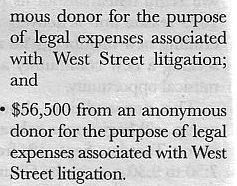
From localtownpages – Hopedale, for August 2023 report on a Select Board meeting.
August 18, 2023
Good Afternoon,
Hope everyone is having a good Summer!
Just wanted to share the Zoom link for Monday’s Status Update hearing in Land Court. All parties (Citizens, Town, and RR) will be in attendance. It will be mostly procedural in nature. Hoping the dates set for future hearings aren’t so drawn out and we can finally get the ball moving on enforcing our Ch 61 rights.
Topic: Land Court – Judge Rubin Hearings Time: Aug , 2023 9:30am EST
Link: https://www.zoomgov.com/j/1617508759?pwd=QnBnUVFnM2dVTDZDWllMT2hqQlRkdz09
Meeting ID: 161 750 8759 Passcode: 611360
Other than the venue being chosen for our hearings (Land Court), there are no major updates to share since May. The RR v Town case at the Surface and Transportation Board (STB) is still in a “behind the scenes” waiting pattern (for those following the legalese, the RR filed a response to the Town’s latest filing at STB. You can read it HERE.). The internal RR cases (Michael Milanoski vs Jon Delli Piscoli/GURR and vice versa in Boston and Worcester Superior Courts) are also in pending hearing status. We’re happy to report that the court filings for the internal RR cases have been very informative/helpful for our Town/Citizens cases in all venues. The RR continues to abide by their written agreement with the Town to hold off on any development at West St, and all parties are just ready to get on with the legal stuff…. It sure is a slow process…
All of the legal firms/experts working for the Citizens and the Town remain very confident in our position and are ready to go in all venues. We are a lucky little town to have so many good people on our side.
Hoping for the best on Monday. As always, thank you for staying in the loop and remaining committed to our vital watershed property and our Ch 61 rights. We will get there!
Best Regards,
liz
August 21, 2023
Good Afternoon,
Not too much to report from this morning’s land court hearing. The judge heard discussion from all parties on how everyone wishes to proceed. The Town & the Citizens were hoping to combine the multiple legal issues in order to expedite the timeline and save time & resources, but Judge Rubin is going to hear the issues one at a time. This whole process is just sooooo slow….
First up is the issue of standing for the Citizens. The Superior Court strongly suggested that the Citizens be given intervenor status, and the Town and the Citizens are in agreement that this would be a good way to move forward together. Judge Rubin is going to accept written arguments from all parties and the next hearing will be in person in Worcester Land Court on Monday, November 13 at 10:30am.
It was great to hear Attorney Mackey state that the Town is very committed in moving forward to exercise our legal right of first refusal. He explained that they are keeping up with the Eminent Domain proceedings in order to keep all doors open, but now that the Appeals Court declared the Settlement Agreement ineffective, the Town would obviously want to pursue our original rightful purchase of the West St watershed property under Ch 61.
One interesting exchange was the Judge’s question – If the Town prevails here and confirms Ch 61 rights to the property, will this then go to the Surface Transportation Board? The RR attorney stated – No, that decision would not be challenged by them at the STB. If you remember back when this was originally in Land Court, the RR and previous board members “warned” us many times that having to argue Ch 61 in front of the STB would surely end in failure and that’s why there was no choice but a Settlement… Too bad the advice from previous and current attorneys assuring us that Ch 61 is a State issue and we wouldn’t lose at the STB wasn’t followed, but at least we know now that the RR isn’t going to try and challenge that point at STB once our Ch 61 rights are officially reestablished.
So, that’s where we stand for now. Although, we’re frustrated with the slow pace, everyone remains confident that we will prevail.
Hope everyone has a great rest of the Summer.


October 17, 2023
Good Afternoon!
Just wanted to send a quick update now that Judge Rubin formally entered her decision. Friday was a good day!! The Citizens attorneys (with additional support of Special Town Counsel) went to Land Court on Friday looking to gain intervenors status in the Town vs RR case (where the town was looking to vacate the stipulation of dismissal in order to restart the Ch61 RoFR process). We were awarded this opportunity as a result of our win at the Panel of Justice Appeals Court.
I’m beyond happy to report that the Citizens won the right to intervene. Judge Rubin stated that the facts of the law in this case led her to this decision. She ruled pretty quickly. This is a just, expected, and critical ruling as the Town would have limited options to try to re-attempt to vacate the stipulation of dismissal and restart the Ch61 RoFR process. So, the Citizens are going to have the opportunity to do that for the Town at an in person hearing on Jan 9, 2024. We have no doubt that we will succeed as the law of the case is very clearly on our side.
I have included her full ruling at the bottom, but here is the important paragraph:
“I conclude that the Citizen intervenors claim an interest in the forest land at issue in this land court case, so as to provide the Citizens with the benefit of favorable rulings in the Superior Court case, as affirmed, and ensure those rulings are entitled to full respect and force. As for the third inquiry under Rule 24(b), and in light of the rulings in the Appeals Court Decision, I conclude that if the citizens are unable to intervene in this case, their ability to protect their interest in maintaining the forest land may be impaired or impeded because the Town and the Citizens have in the past diverged in their approach to the underlying issues and may do so again. It is also unclear if the town will be able to advance a claim to enforce a right of first refusal under Chapter 61 unless the Citizens are able to intervene and advance the motion to vacate. Likewise for the same reason, the Citizens have demonstrated that their interest in this case is not adequately represented by the Town.”
As always, thank you for continuing to stay informed and committed through the ups & downs. The Town will prevail in regaining this important watershed property with the our Ch61 Rights, and will be able to protect the Town’s current and future public water supply.
November 16, 2023
Good Evening,
The Town’s case at the Surface Transportation Board was ruled on late yesterday. This case is related to the Town’s effort to take the West St Watershed Update property by Eminent Domain.
The STB ruled in favor of the RR. The ruling can be read HERE.
While any loss is disappointing, there are a few important points to keep in mind.
The STB and Federal cases for Eminent Domain are entirely separate from the State Ch 61 Right of First Refusal cases. The STB decision has no effect on the Town’s exercise of its Right of First Refusal to acquire the 364 West St. property which is pending in the Land Court on remand from the Appeals Court.
The STB Decision says only that a Town is preempted from using eminent domain to take land properly owned and developed by a railroad. The STB Decision expressly said that resolving questions of state property law issues – like exercise of the state statutory c. 61 right and whether the Railroad is indeed the proper owner of the land– is a matter for state courts.
The Appeals Court made very clear that the Town must be given the opportunity to renew the effort to exercise its Right of First Refusal Option and the Land Court has made clear that it will abide by the Appeals Court’s ruling.
The Railroad previously lost an STB case (which can be read HERE) involving its property rights in downtown Hopedale, where the STB indicated the property rights issue must be decided by the state court.
The Town’s preferred method of claiming 364 West St has always been through Ch 61. The eminent domain case was a worthwhile undertaking because it has kept the property safe from continued destruction. While this safeguard will soon be lifted, the property is still protected in the meantime by an injunction stemming from the RR’s internal legal battles.
Bottom line, at the end of the day, the Town will prevail on its right of first refusal and own the property free and clear of the Railroad despite the Railroad’s illegal actions which have caused so many costly court proceedings over the last three years.
The next step for the Citizens and the Town is to vacate the stipulation of dismissal (this case will be heard in January), and the law is solidly on our side. Once that happens, the Town will be free to execute our original Right of First Refusal (which will very quickly be followed by the RR’s case to stop us).
We are going to try to set up a legal update with a question and answer session at a Select Board meeting soon. The Citizen’s attorneys will be available and I’m hopeful that the Town attorneys will be as well. We realize this is all very confusing and hopefully it will help to hear from the attorneys themselves.
As always, thank you for staying involved and informed. Please do not hesitate to contact me with any questions or concerns.
Hope everyone has a wonderful Thanksgiving.
Liz
March 25, 2024
Good Afternoon,
It’s been a long wait, but the hearing date finally arrived. The Citizen’s case in Land Court to Vacate the Stipulation of Dismissal was heard by Judge Rubin this afternoon in Boston.
Judge Rubin granted both the Citizen’s motion and the Town’s motion to vacate the stipulation of dismissal. So, this means that the Town is free to exercise our Ch 61 Right of First Refusal to purchase the West St Watershed property. I will send out her written ruling when it is posted.
At this point, the Citizens role appears to be complete. Our goal was to help the Town get our rights back and that goal has been achieved. The ball is now passed to the Select Board, so we will all need to stay tuned for their updates as they move forward.
The Town attorneys stated that they will be executing the RoFR and will be filing an amended complaint to include damages/reduced purchase price for the property. I don’t and won’t know any of the details from here on out, but I will watch the docket for filings & will share them when they become available.
Today is a good day. The Town is back in charge of what happens with the West St Watershed property.
As always, thank you for staying in the loop.
History since last hearing:
There have been legal filings since our last court date & I’ll summarize them & include most them here (space limitations on constant contact) for those who want to read the details.
1 – After our hearing win in the Fall, the RR tried yet again to have our case dismissed and to continue to deny the Citizen’s and Town’s right to vacate the stipulation of dismissal and pursue its RoFR that was illegally taken. This resulted in the court date being pushed back from January to March. Many complaints and responses were filed with no real new arguments made. The RR continued to purport that we don’t have standing and that the settlement agreement will keep the Town from being able to proceed. We continued to respond that the Panel Appeal’s Court decision had declared otherwise and the Town continued to agree (hence the reason Land Court is allowing us to move forward with this next hearing..). If anyone wants to read the documents, just let me know. There are a bunch – most are too big for me to load here. You can get them right from the Land Court docket (it’s a little involved and I can walk you through it). The Judge denied their motion today.
2 – Citizen’s amended Complaint – some new information/requests
We continued to seek the original goal of vacating the stipulation of dismissal to allow the Town to exercise its legal RoFR for the West St Watershed property. We added additional requests for either a reduced purchase price for the destruction of the forestland or reforestation at the RR’s expense, and protection from further development of the property until the case is resolved. The Judge granted our motion to vacate, but denied our additional requests due to lack of standing (we were anticipating this).
You can read the complaint HERE and the split up appendixes HERE, HERE, and HERE.
3 – The RR responded with their opposition to our amended complaint.
Their opposition can be read HERE.
Their memo with supporting law can be read HERE.
Their statement of facts can be read HERE.
Their appendix for their opposition can be read HERE.
4 – The Citizen’s responded to their opposition.
Our response can be read HERE.
Our response to their statement of facts can be read HERE.
The appendix to our response can be read HERE.
5 – The Town responded to the statement of facts, and it can be read HERE.
6 – And no surprise, the RR responded to our response to their opposition, and it can be read HERE.
7 – And lastly, with no surprise, our response to the RR’s response to our response to their opposition (say that 10 times fast…) can be read HERE.
March 25, 2024
Good Afternoon,
It’s been a long wait, but the hearing date finally arrived. The Citizen’s case in Land Court to Vacate the Stipulation of Dismissal was heard by Judge Rubin this afternoon in Boston.
Judge Rubin granted both the Citizen’s motion and the Town’s motion to vacate the stipulation of dismissal. So, this means that the Town is free to exercise our Ch 61 Right of First Refusal to purchase the West St Watershed property. I will send out her written ruling when it is posted.
At this point, the Citizens role appears to be complete. Our goal was to help the Town get our rights back and that goal has been achieved. The ball is now passed to the Select Board, so we will all need to stay tuned for their updates as they move forward.
The Town attorneys stated that they will be executing the RoFR and will be filing an amended complaint to include damages/reduced purchase price for the property. I don’t and won’t know any of the details from here on out, but I will watch the docket for filings & will share them when they become available.
Today is a good day. The Town is back in charge of what happens with the West St Watershed property.
As always, thank you for staying in the loop.
History since last hearing:
There have been legal filings since our last court date & I’ll summarize them & include most them here (space limitations on constant contact) for those who want to read the details.
1 – After our hearing win in the Fall, the RR tried yet again to have our case dismissed and to continue to deny the Citizen’s and Town’s right to vacate the stipulation of dismissal and pursue its RoFR that was illegally taken. This resulted in the court date being pushed back from January to March. Many complaints and responses were filed with no real new arguments made. The RR continued to purport that we don’t have standing and that the settlement agreement will keep the Town from being able to proceed. We continued to respond that the Panel Appeal’s Court decision had declared otherwise and the Town continued to agree (hence the reason Land Court is allowing us to move forward with this next hearing..). If anyone wants to read the documents, just let me know. There are a bunch – most are too big for me to load here. You can get them right from the Land Court docket (it’s a little involved and I can walk you through it). The Judge denied their motion today.
2 – Citizen’s amended Complaint – some new information/requests
We continued to seek the original goal of vacating the stipulation of dismissal to allow the Town to exercise its legal RoFR for the West St Watershed property. We added additional requests for either a reduced purchase price for the destruction of the forestland or reforestation at the RR’s expense, and protection from further development of the property until the case is resolved. The Judge granted our motion to vacate, but denied our additional requests due to lack of standing (we were anticipating this).
You can read the complaint HERE and the split up appendixes HERE, HERE, and HERE.
3 – The RR responded with their opposition to our amended complaint.
Their opposition can be read HERE.
Their memo with supporting law can be read HERE.
Their statement of facts can be read HERE.
Their appendix for their opposition can be read HERE.
4 – The Citizen’s responded to their opposition.
Our response can be read HERE.
Our response to their statement of facts can be read HERE.
The appendix to our response can be read HERE.
5 – The Town responded to the statement of facts, and it can be read HERE.
6 – And no surprise, the RR responded to our response to their opposition, and it can be read HERE.
7 – And lastly, with no surprise, our response to the RR’s response to our response to their opposition (say that 10 times fast…) can be read HERE.
April 1, 2024
Good Morning,
Just wanted to send out Judge Rubin’s ruling (see below). She ruled in both the Citizen’s & Town’s favor & the stipulation of dismissal was granted. It was posted on the docket last week, but I was out of town (family emergency). The Select Board will be giving an update on the case status this evening, and if you’re available, it would be great for you to hear what they have to say directly. There are differing opinions on the board regarding the direction to take, and it’s going to be important for residents to listen, consider, and voice their opinions on where they want the Town to go with the legal process.
The residents voted overwhelmingly 3 times over the past 4 years to obtain the entire property for the Town, and we still have two donors to fund the purchase. If you are still on board, please continue to let the Select Board know that this is what you want now that we finally won back the the ability to do it.
Here is the zoom link to tonight’s meeting:
https://us02web.zoom.us/j/87145575031?pwd=eHBzbWFwODhSWUtUandGZmIrWDZqQT09
Ruling:
Hearing on motion to vacate dismissal and motion to dismiss held in person. Attorney David Mackey and Sean Grammel appeared on behalf of the Town of Hopedale (“Town”), Attorneys Donald Keavany and Andrew DiCenzo appeared on behalf defendants, and Attorneys Harley Racer and David Lurie appeared on behalf of the intervenors, the Hopedale Citizens (the “Citizens”). In addition to the filings listed in the docket of December 12, 2023, Court is in receipt of (1) Hopedale Citizens’ Post-Remand Reply Memorandum in Support of their Motion to Vacate Stipulation of Dismissal; (2) Hopedale’s Reply in Support of its Renewed Motion to Vacate Stipulation of Dismissal; (3) Sur-Reply of Grafton & Upton Railroad Company and One Hundred Forty Realty Trust in Opposition to the Town of Hopedale’s Motion to Vacate Stipulation of Dismissal; (4) Sur Reply of Grafton & Upton Railroad Company and One Hundred Forty Realty Trust in Opposition to the Intervener-Plaintiffs’ Motion to Vacate Stipulation of Dismissal; (5) Amended Verified Complaint of Intervenor-Plaintiffs Elizabeth Reilly and Ten Citizens of Hopedale; (6) Hopedale’s Answer to the Amended Verified Complaint of Intervenor-Plaintiffs Elizabeth Reilly and Ten Citizens of Hopedale; (7) Motion of Grafton & Upton Railroad Company and One Hundred Forty Realty Trust to Dismiss Interveners’ Amended Verified Complaint pursuant to Mass. R. Civ. P 12(b)(1) and 12(b)(6) and the memorandum, appendix, and statement of facts in support thereof; (8) Hopedale Citizens’ Opposition to Motion of Grafton & Upton Railroad Company and One Hundred Realty Trust to Dismiss Intervenors’ Amended Verified Complaint and the appendix in support thereof; (9) Hopedale Citizens’ Response to Statement of Facts in Support of Motion of Grafton & Upton Railroad Company and One Hundred Realty Trust to Dismiss Intervenor’s Amended Verified Complaint; (10) Reply of Grafton & Upton Railroad Company and One Hundred Forty Realty Trust in Support of Motion to Dismiss Verified Amended Complaint; and (11) Hopedale Citizens’ Sur-Reply in Opposition to Motion of Grafton & Upton Railroad Company and One Hundred Realty Trust to Dismiss Intervenors’ Amended Complaint.
THE TOWN’S AND CITIZENS’ MOTIONS TO VACATE STIPULATION OF DISMISSAL.
Following colloquy, the Town’s and Citizen’s motions to vacate the stipulation of dismissal are ALLOWED for the reasons stated on the record and as follows:
In January 2022, this court denied a motion by the Town to vacate the Stipulation of Dismissal with prejudice (the “Stipulation”), that had been filed by the Town and the Defendants after they entered into a settlement agreement. At that time, I concluded that exceptional circumstances were not present to warrant vacatur. Since that time, circumstances have changed, and these motions are now before the court after remand from the Appeals Court, as discussed below. Both the Town and the intervenor Citizens seek to vacate the Stipulation.
After the Citizens prevailed (in part) in a related Worcester Superior Court case (Case No. 2185CV00238), the Appeals Court considered an appeal in that case, as well as the Citizens’ appeal of this court’s denial of their motion to intervene in this case and remanded this matter for further proceedings consistent with the Appeals Court Decision, including consideration of the Citizens’ motion to join the Town’s motion to vacate the Stipulation. Reilly v. Hopedale, 102 Mass App. Ct. 367, 385 (2023) (the “Appeals Court Decision”). Thereafter, with the benefit of guidance from the Appeals Court, on October 13, 2023, I allowed the Citizens’ motion to intervene and now consider motions by the Citizens and the Town to vacate the Stipulation, pursuant to Mass. R. Civ P. 60(b)(6).
Rule 60(b) states that a court may relieve a party from a final judgment, order or proceeding in certain enumerated circumstances, the last of which is a catch-all, specifically for “any other reasons justifying relief from the operation of the judgment.” Rule 60(b) further states such a motion shall be made within a reasonable time. A motion under Rules 60(b) is addressed to the trial judge’s discretion. See Reporter’s Notes – 1973, citing Farmers Cooperative Elevator Assoc. v. Strand, 382 F.2d. 228 (8th Cir. 1967). The court has the power to vacate judgment whenever such action is appropriate to accomplish justice. Id., citing Klapprott v. United States, 335 U.S. 601, 69 S. Ct. 384 (1949) and Pierra v. Bemuth, Lembueke Co., 20 F.R.D11 (S.N.D.Y 1956). In deciding a Rule 60(b)(6) motion, “the judge may consider whether the movant has a ‘meritorious claim or defense,’ ‘whether extraordinary circumstances warrant relief,’ and whether granting the motion would affect ‘the substantial rights of the parties.’” Adoption of Yvonne, 99 Mass. App. Ct. 574, 583-584 (1981), quoting Parrell v. Keenan, 289 Mass. 809, 506 (1983); see Bowers v. Board of Appeals, 16 Mass. App. Ct. 29, 33 (1983). Further, “[a]lthough the rule ‘vests power in courts adequate to enable them to vacate judgments whenever such action is appropriate to accomplish justice,’” Id., quoting Klapprott, supra, at 615, relief under rule 60(b)(6) requires a showing of “extraordinary circumstances.” Id. (citations omitted).
As discussed below, after hearing and briefing by the parties, and with the benefit of guidance from the Appeals Court, I conclude that the Appeals Court Decision, together with and affirming the Superior Court Decision constitute compelling and extraordinary circumstances that warrant vacating the Stipulation. As explained in the Appeals Court Decision, the Citizens’ right to protect the Superior Court judgment is independent of the Town, the Citizens having obtained that right through the exercise of their statutory rights as ten or more taxpayers under G. L. c. 40, § 53. “The citizens’ entitlement to enforce that favorable judgment did not depend on whether the Town had the authority to stipulate to the dismissal of its own claims in the Land Court. The stipulation of dismissal did not – and could not – extinguish the citizens’ claims or judgment under G. L. c. 40, § 53. See Jarosz v. Palmer, 436 Mass. 526, 529 (2002) (a stipulation of dismissal with prejudice is not the equivalent of a final judgment on the merits for the purpose of issue preclusion).” Reilly, 102 Mass. App. Ct. at 382.
The Appeals Court also provided further observations for the court’s consideration on remand. Specifically:
“[W]e recognize the citizens’ road to relief in the Land Court case has been made difficult by the fact that the town has not pursued an appeal of the order denying its motion to vacate the stipulation of dismissal. But it is nonetheless important to ensure that events and decisions in the Land Court case not make toothless the judgment and rulings in the Superior Court case, particularly in a matter of public significance such as this one and where the citizens have not been given an opportunity to be heard. On remand, the Land Court judge should keep in mind that the Superior Court has determined some of the substantive issues on the merits, that the citizens are entitled to the benefit of those favorable rulings, that the rulings are binding on the town, the railroad, and the trust (all of whom were parties in the Superior Court case and have not appealed), and that those rulings are entitled to full respect and force. The Land Court judge should ensure that her rulings are not inconsistent or unfair in light of rulings that have been made in a sister department of the trial court. These considerations will come into special play when deciding the citizens’ motion to vacate the stipulation of dismissal.”
Id. at 385.
I am mindful of this guidance, just as I was when allowing the Citizens’ motion to intervene after remand, which is now law of the case.” City Coal Co. of Springfield v. Noonan, 434 Mass. 709, 712 (2001), citing Lunn & Sweet Co. v. Wolfman, 268 Mass. 345, 349 (1929) (“[R]emand instructions became the governing ‘law of the case’ and should not have been reconsidered by the remand judge”); Williams v. Bd. of Appeals of Norwell, 100 Mass. App. Ct. 1102 (2021) (Rule 1:28 unpublished opinion), quoting City of Coal, supra, at 712. The doctrine of the law of the case provides that, “once a final judgment is entered, the court may not rule differently on ‘an issue or a question of fact or law.’” Kendall v. Hyannis Restorations, Inc., 81 Mass. App. Ct. 1118 (2012) (Rule 1:28 unpublished opinion), quoting Catalano v. First Essex Savings Bank, 37 Mass. App. Ct. 377, 384, 639 N.E.2d 1113 (1994).
In order to ensure the judgment and rulings in the Superior Court case are given full respect and force, I review those rulings. As quoted in the Appeals Court Decision, the Superior Court judge explained the meaning and consequences of her ruling as follows:
“[A]lthough the terms of the [s]ettlement [a]greement are legal (including the [b]oard’s agreement to waive the [o]ption), the [b]oard exceeded its authority when it unilaterally entered into that agreement without [t]own [m]eeting approval of the reduced acquisition. Therefore, the [s]ettlement [a]greement is not effective. The [b]oard might not hold the required [t]own [m]eeting or might fail to obtain enough votes to approve the acquisition. In either case, the [s]ettlement [a]greement would fail to take effect, meaning that the [r]ailroad would retain the land and the [t]own would retain its money and the right to continue attempting to enforce the [o]ption. Until the reduced acquisition is approved by [t]own [m]eeting, the agreement is not effective, and the [t]own may (but is not required to) attempt to enforce the [o]ption.”
Reilly, 102 Mass. App. Ct. at 374.
As noted by the Appeals Court, this aspect of the Superior Court judgment was not appealed. Id. Thus, the Citizens’ right to protect the Superior Court judgment encompasses the conclusion that the settlement agreement was not effective. This is all the more so since town meeting rejected a request to fund the purchase of land as provided in the settlement agreement in March 2022.
As noted above, Rule 60(b)(6) is a residual clause for those unique circumstances which do not fall within Rule 60(b)(1)-(5). It permits a court to set aside a final judgment for “any other reason justifying relief from the operation of the judgment.” Mass. R. Civ. P. 60 (b) (6). Relief under Rule 60(b)(6) “requires a showing of ‘extraordinary’ circumstances.” Bowers v. Board of Appeals, 16 Mass. App. Ct. at 33, quoting Ackermann v. United States, 340 U.S. 193, 202 (1950).
The reasoning of Judge Kass in Bowers v. Board of Appeals, 16 Mass. App. Ct. 29 (1983), counsels that the circumstances now before the court are precisely the type of extraordinary circumstances that warrant vacating the Stipulation. In that case, several abutters challenged a proposed sewage dumping system in the town of Marshfield pursuant to Chapter 40A, § 17. The board of selectmen intervened, and the parties entered into a settlement agreement whereby the town would cease using six lot adjoining lots the site of the proposed sewage system as a public parking area. An agreement for judgment documented the agreed upon terms and the court entered judgment in accordance with the agreement. That settlement was not popular among the townsfolk. Id. at 31 (“Few events so stir the civic consciousness as the removal of convenient parking.”) Several years later, when a newly constituted board of selectmen was elected, they moved to vacate the judgment. In Bowers, the Appeals Court vacated the portion of the judgment which prohibited parking on the adjoining six lots pursuant to Rule 60(b)(6) because “the perpetual encumbrance imposed upon the six lots by the then selectmen was an action which they were powerless to take. The power to alienate and dispose of real estate lies with the inhabitants of the town acting at town meeting.” Id. at 32, citing G. L. c. 40, § 3; Ballantine v. Falmouth, 363 Mass. 760, 766 (1973); and Dennis v. Lighthouse Inn, Inc., 6 Mass. App. Ct. 970 (1979).
As Judge Kass explained, “[w]hat makes the instant case exceptional is that a public authority, the selectmen, offered as their part of an agreement for judgment a restriction that they lacked the power to impose.” Id. at 33. Further:
“Were it otherwise public officials could bind their governmental agencies to unlawful conduct by ready acquiescence in an agreement for judgment and, thus, circumvent the restrictions on their powers. The same officials, or as is the case here, their successors, face the dilemma of acting in excess of their powers or exposing themselves to a judgment of contempt. In those unusual circumstances, resort may be had to rule 60(b)(6).” Id. at 34 (citations omitted).
In this context, now that it has been established with finality that the settlement agreement between the Town and the Defendants is ineffective, the Hopedale circumstances are coincident with the exceptional circumstances discussed in Bowers. Just like the Board of Selectmen in Bowers, here the Town lacked authority to enter into the Settlement Agreement without the ratification of the town meeting. Since the Town’s motion to vacate was last before this court, the Appeals Court has affirmed this Superior Court ruling. That ruling is binding on not just the Citizens, but also the Town and the Defendants. Id. at 385. The Appeals Court Decision and remand instructions further binds this court as law of the case. These extraordinary circumstances warrant vacating the Stipulation. Doing so is consistent with the guidance of the Appeals Court Decision and will ensure this court “not make toothless the judgment and rulings in the Superior Court case.” Id.
DEFENDANTS MOTION TO DISMISS THE CITIZENS’ AMENDED COMPLAINT.
I now turn to the Defendant’s motion to dismiss the Citizens’ Amended Complaint. That Amended Complaint includes three counts: (I) a declaratory judgment under C. 231, §§ 1 and 5, to enforce the Superior Ct judgment and vacate the Stipulation of Dismissal in this LC case; (II) a declaratory judgment under C. 231, §§ 1 and 5, to enforce the Superior Ct judgment and enjoin the Defendants from further land clearing of the Forestland; and (III) a declaratory judgment under G.L. c. 231, §§ 1 and 5, to enforce the Superior Ct judgment, and declaring that the Defendants’ harm to the Forestland requires a reduction in the G.L. c. 61 purchase price and restoration of the Forestland. The Defendants seek to dismiss that Amended Complaint for lack of standing under Mass. R. Civ. P. 12(b)(1) and for failure to state a claim under which relief can be granted under Mass. R. Civ. P. 12(b)(6).
I concur with the Defendants that the declaratory judgment statute, G.L. c. 231A does not confer standing to pursue relief without an underlying cognizable basis for that relief. See Reilly, 102 Mass. App. Ct. at 379, quoting Revere v. Massachusetts Gaming Comm’n, 476 Mass. 591, 607 (2017) (“[T]he citizens have standing under the declaratory judgment statute only if they ‘can allege an injury within the area of concern or the statutory or regulatory scheme under which the injurious action occurred.’”). The Appeals Court Decision also makes clear that that the Citizens do not have standing under either Chapter 61, the right of first refusal statute, or under c. 40, § 53. Id. at 378-379. The Superior Court dismissed Count II of the Superior Court complaint, which dismissal was affirmed. As stated in the Appeals Court Decision: “Equitable principles do not confer on taxpayers the right to sue ‘to restrain cities and towns from carrying out invalid contracts, and performing other similar wrongful acts. Instead, taxpayer plaintiffs must show a statutory foundation for standing apart from G.L. c. 40, § 53, in order to challenge a town’s entering into a contract or settlement.” Id. at 378 (citations omitted). Among the relief requested by the Citizens in Count II and dismissed was a declaration that that the Defendants be prevented from alienating the Forestland or converting any of it from its current use. However, “[n]one of these forms of relief can be characterized as the raising or expenditure of funds or as the incurring of obligations by the town, and accordingly, G. L. c. 40, § 53, did not give the citizens standing to pursue them.” Id. Further, “[i]ndividual taxpayers whose land is not subject to G.L. c. 61 have been given no rights under the statutory scheme.” Id. at 379. That requested relief is akin to that now sought by the Citizens in the Amended Complaint.
However, as the Appeals Court made clear, the Citizens did obtain valuable rights as a result of the Superior Court Judgment. This court is mindful of the Appeals Court’s guidance that “it is nonetheless important to ensure that events and decisions in the Land Court case not make toothless the judgment and rulings in the Superior Court Case.” Id. at 385. I am thus mindful of the favorable Superior Court ruling that the settlement agreement was ineffective and that this ruling is binding on the town, the Defendants and the Citizens. In this context I consider the three counts of the Amended Complaint, each of which would fail for lack of an underlying cognizable statutory basis were it not for the Superior Court Judgment. Count I seeks declaratory judgment under C. 231, §§ 1 and 5, to enforce the Superior Ct judgment and vacate the Stipulation of Dismissal in this case. The relief sought in Count I has been addressed by today’s allowance of the Citizens’ and the Town’s motions to vacate the stipulation of dismissal. In so allowing the Citizens’ motion I give effect to the Appeals Court’s instruction that the Citizens’ right to protect the Superior Court judgment was obtained through the Citizens independent exercise of their statutory rights as ten or more taxpayers under G. L. c. 40, § 53. This court having today vacated the Stipulation of Dismissal, the Town now stands ready and willing to advance its claim to enforce the G.L. c. 61 right of first refusal. Count I of the Amended Complaint is dismissed as moot. The Town has confirmed its intention to do so.
Counts II and II, however, seek relief beyond that contemplated by the Superior Court Judgment. While I note that the Citizens allege practical concerns that the Forestland has been damaged and that the Chapter 61 price for the Forestland should be reduced because of this alleged damage, I find no basis in the Superior Court Judgment or the Appeals Court Decision to expand the Citizens’ rights to relief to encompass that sought by Counts II and III of the Amended Complaint. Accordingly, Counts II and III are dismissed for lack of standing and for failure to state a claim upon which relief can be granted. In the future, it may be that the Town will fall short of protecting its right of first refusal in a way that will satisfy the Citizens. For the moment, however, the right to seek to enforce the right of first refusal lies with the Town, and the Town has indicated that intends to amend its complaint to encompass the types of remedies the Citizens wish to seek. If the Town fails to adequately assert its rights, the Citizens will no doubt seek to intervene again, in which case I will remain mindful of the Appeals Court guidance. The Citizens may also seek post-Judgment relief in the Superior Court case. Those matters are not now before the court, and it is now only speculative that the Citizens participation will be required considering the absence of an independent statutory right for the Citizens to pursue.
CASE MANAGEMENT MATTERS.
Following argument and by April 22, 2024, the Town to file an amended complaint. Status conference scheduled for July 16, 2024, at 10:00 A.M, with parties to file a joint status report on July 9, 2024, to include a proposed scheduling order. Court to consider any filings from the Citizens in the nature of a motion to reconsider. Hon. Diane R. Rubin, Presiding
The citizen’s attorneys filed for a motion to reconsider on counts II & III of our complaints (regarding damages & purchase price). She is allowing our motion to reconsider and will rule without a hearing likely within a few weeks. Our goal remains as it always has been – support of the Town’s ability to obtain the property as directed by the previous Town meetings and help to recover damages to the property.
You can read our motion HERE.
You can read the RR’s opposition HERE.
Judge Rubin will allow the motion:
“Court has now issued its docket entry vacating the stipulation of dismissal and dismissing the Citizens’ Amended Complaint, following hearing on March 25, 2024. Immediately prior to issuance of that docket, court received the Citizens’ Motion for Leave to File Post-Hearing Memorandum on Issue of Intervenors’ Role in this Case Going Forward (“Citizens’ Motion for Leave”), as well as Opposition to Interveners’ Motion for Leave. The court will treat the Citizen’s Motion for Leave as a motion for reconsideration pursuant to Land Court Rule 9, and sets a deadline of April 12, 2024, for any additional motions to reconsider and/or response to the Citizen’s Motion for Leave. Court to decide these reconsideration filings on the papers.”
As always, thank you for staying involved.
Hopedale residents inch closer to vindication for acres of bulldozed trees
Kris Olson, Massachusetts Lawyers Weekly
April 12, 2024
Nothing may bring back the 100 acres of mature Hopedale trees a railroad company bulldozed in2022 to expand its operations.
But — at the Appeals Court’s direction — a Land Court judge recently strengthened the hand of a group of 10 Hopedale taxpayers and the town at large as they plot the way forward.
Under G.L.c. 61, the owner of property classified as forest land benefits from a significantly reduced tax rate — as long as it remains certified as forest land.
The residents hope to remain in the case, filing a motion for reconsideration. But if that fails, the residents will maintain vigilance over the proceedings, says their attorney, Harley R. Racer of Boston.
“We’re going to be closely monitoring it, ready to jump back in if we find the need to,” the Lurie Friedman partner says. “But for the moment, the town is fully resolved to exercising its option and acquiring the forest land.”
But the railroad’s attorney, Donald C. Keavany Jr. of Worcester, says his clients are considering all options, including a motion for reconsideration in the Land Court, a motion to reopen the federal Surface Transportation Board proceedings, and all potential appellate alternatives.
“While I have great respect for Judge Rubin, she got this one wrong,” Keavany, a partner at Christopher, Hays, Wojcik & Mavricos, says by email.
The judgment that entered on Count I in the 10-taxpayer Superior Court case was the basis of the Rule 60(b)(6) motions the town and taxpayers had filed in December 2021, which Rubin rejected a month later.
The judgment on Count I in the Superior Court was not affected by the Appeals Court decision because Count I was not before the Appeals Court, he says.
“It was clear error to conclude that the entire settlement agreement between the town and my clients was declared to be not effective by the Superior Court in December 2021,” Keavany says. “That is not my opinion — that is what the Superior Court judge stated on multiple occasions after the judgment on Count I entered in 2021.”
Only Count II of the Superior Court case was the subject of the appeal, Keavany says.
Count I in the Superior Court case only enjoined the town from spending money to buy the settlement parcel described in the settlement agreement unless a new Town Meeting approved of that expenditure, and the Appeals Court did not expand or change what the Superior Court intended, he says.
He calls any language in the Appeals Court decision concerning Count I of the Superior Court case “pure dicta.”
For its part, Hopedale is looking forward to pursuing its claims to ownership of the forest land and to recovering damages for the clear-cutting performed by the railroad, says the town’s attorney, David S. Mackey of Anderson & Kreiger in Boston.
Racer is hopeful that — with or without his clients as a party — the litigation advances to where the parties are discussing how much the town’s purchase price for the land should be reduced to account for the clearing of the trees.
“It could be significant amounts of money that the purchase price is reduced, and it could even be damages going to the town when the town acquires title,” he says.
It might have taken three years to get there, but Racer says he derived a lot of satisfaction from opening the docket in the Land Court case and seeing that it had been reopened, even if his clients were no longer part of it.
“We didn’t give up,” he says. “We just kept taking the next step. We kept moving forward. In a case that we weren’t allowed to get into, we filed a different action, took it up on appeal, and we were able to just keep moving forward. Ultimately, we were vindicated in our efforts

Hopedale wins new chance to acquire forestland
Tom Benoit
The Milford Daily News – April 18, 2024
HOPEDALE — The town is being given a renewed opportunity to enforce its right of first refusal to acquire 130 acres of forestland after a recent Land Court ruling.
Land Court Judge Diane Rubin recently ruled that because a previous settlement reached by the town and Grafton and Upton Railroad to split the West Street land was never authorized by Town Meeting, the town may continue to enforce its right of first refusal to acquire the forestland.
That previous settlement occurred in 2021, when Hopedale selectmen signed an agreement with the railroad — after the two parties had engaged in court battles and subsequent mediation — that would split the land between the railroad and the town. The town agreed to pay the railroad $587,000 for about 84 acres, because a railroad-owned trust owned the land.
In December 2022, the town filed a motion to reopen the case against the railroad to proceed with its original decision to buy the 364 West St. property. A Special Town Meeting vote had given its approval to acquire the forestland two years earlier, in October 2020.
The West Street property consists of 155 acres, with 130 acres classified as forestland.
Attorney credits residents for commitment in having town acquire land
Harley Racer, an attorney with Boston-based Lurie Friedman LLP, represents a group of residents that’s committed to helping the town acquiring the forestland.
“The residents didn’t give up,” Racer told the Daily News. “The open space matters to the town. It affects the watershed, so that matters to the town.”
Following the 2021 settlement, 11 residents filed a lawsuit, and secured an injunction to stop the town from paying for, and therefore acquiring the 84 acres while the case played out in court. Town Meeting then rejected the settlement in March 2022. However, the injunction did not stop the railroad from proceeding with construction, and the company began clearing about 100 acres of forestland.
Town Manager Mitch Ruscitti said he could not comment on ongoing litigation.
“The residents persevered and persisted and did the bad deal — and now they found the second chance at conserving this property,” Racer said.
Attorney for railroad says his side believes judge made wrong decision
Don Keavany, who represents Grafton and Upton Railroad, said his clients are disappointed with the ruling and believe the judge made the wrong decision.
“We’re exploring all of our options,” said Keavany, an attorney with Worcester-based Christopher, Hays, Wojcik and Mavricos.
Racer said the town intends to pursue damages as part of the enforcement of its right of first refusal, citing harm incurred by the forestland and watershed, vital resources of the town.
“They cleared the land and outraged the town,” Racer said of the railroad. “They also did it to intimidate the town so the town wouldn’t keep fighting for this plan.”
He said the town is bringing a new complaint to acquire the land title and t o obtain an order that Grafton and Upton Railroad must restore the forest and reduce the purchase price for the town to acquire the land.

May 10, 2024
Good Morning,
Just a few things.
First, it’s with great sadness that I share the news of the unexpected and sudden passing of our lead attorney and friend David Lurie on April 24th. When I spoke to his children at his shiva, they instantly recognized the Town of Hopedale. They were quick to tell me they were very proud of their father and his role in giving our Town back the ability to reclaim what was taken from us. They said their Dad spoke highly of “the little town that could” and he was looking forward with confidence to seeing the West St property case continue on to its successful conclusion.
Before he passed, Massachusetts Lawyers Weekly recognized the recent victory and published an awesome article that can be read HERE. Dave had a wonderful, full life and did so much good in his short time here. To say Dave will be terribly missed by many is the understatement of the year.
Secondly, there have been a few new filings since our win in Land Court.
The RR, unsurprisingly has made an appeal of the ruling and a motion for reconsideration. They have appealed using the same arguments as before, and we them to be dismissed again.
You can read the RR Appeal filings HERE and HERE.
The Town’s reply acknowledges the repetitive RR filings and stall tactics, and calls the RR out on wasting everyone’s time with a request for sanctions. You can read this filing HERE.
The RR has also filed a motion to dismiss the Town’s amended complaint (in which the Town is asking for reduction in purchase price or damages related to tree clearing, previously shared). Essentially, they make no new arguments and they continue to deny the appeal’s court decision (that has been upheld over & over). You can read their complaint HERE, HERE, and HERE.
The RR also made a filing at the STB. You can read it HERE. The expectation is that the STB will kick this back for resolution in the courts as it previously did for a similar case. The Town’s response can be read HERE without the exhibits which have been previously shared (too large to load).
Lastly, just wanted to send a reminder for our Town’s local election date. Please head out to the polls on Tuesday, May 14th at the Draper Gym. Glenda Hazard is up for re-election and it is no secret that she has been working hard to ensure that our votes/directives at three different Town Meetings remain meaningful. You can read a Q&A posed by the moderators of the HBB HERE to get reacquainted with Glenda’s goals and positions. I hope you will come out and support Glenda, so that she can continue to support us. The future of our West St property and our town may depend on it.
There is no magic tax revenue salvation for Hopedale by allowing an entity who has aggressively moved from town to town ignoring local and state regulations (that they are NOT pre-empted from following), who have turned on themselves and are going after each other viciously in court, who blatantly ignored the EPA by violating their general construction permit on West St which allowed the clearing of only 30 acres of trees, and who if allowed to keep our West St acres will have the potential to turn our Town into the largest rail yard in MA. Please review the FinCom due diligence report on what that will do to our home values:
https://www.hopedale-ma.gov/sites/g/files/vyhlif711/f/uploads/final_fincom_analysis_on_ch._61_potential_land_acquisition.pdf
The short answer is nothing good…
Who our Town chooses to “partner with” matters. Do we want a vital downtown or do we want to become a rail yard? Make no mistake, your vote in this election and at the Annual Town meeting is going to set the direction of who the Town chooses to partner with. So, no matter where you stand, reach out to your friends and neighbors and encourage them to check in, and be sure to get out and make your choice – your vote matters, now more than ever.
Thank you, as always, for staying in the loop and being the main reason Hopedale is The Little Town That Could.
Important Reminder to attend the Annual Town Meeting on Tues, May 21 at 7pm at the HS.
Thank you for coming out to vote and supporting your candidates. Congratulations and thanks to both Glenda Hazard and Nicole Small for bringing so many residents out to the polls. It was a difficult election cycle for all involved.
Wanted to alert everyone to the need for resident attendance at the Annual Town Meeting (so many important articles this year). Turnout is expected to be high, so please get there early for check in so the meeting can start on time.
The last article on the warrant is a non-binding article that is looking for approval to make a settlement deal with the RR (essentially dropping litigation to claim our c 61 property). It was sponsored by one of the Select Board members who wants to ensure the residents are still on the same page. Great idea, but unfortunately, it misses the mark since it hasn’t been given the same due diligence as the articles posed back in 2020 & 2021 (no other boards & commissions were tasked to evaluate the article and no detailed public discussions were held before taking this to Town Meeting). It is unlikely there will be enough time to properly get through it all before voting. I think we can all agree that everyone wants the best outcome for the West St property & for the Town and that it occur in a complete and timely fashion, but this article seems to support neither.
Essentially, a yes vote means you want to drop litigation and make a deal with the RR and a no vote means you want to continue with the process of finalizing the acquisition that we approved in 2020, 2021, & 2022 and are finally making headway on. Making a deal now leaves no other alternatives, but continuing forward with litigation leaves the options on the table. Most of you already know the details, but there are new residents tuning in. Please take the time out to reach out to friends and neighbors and let them know the importance of coming out for this vote. We will not get a third chance to own and control our watershed.
What you need to know about the proposed “Groundhog Day Settlement” (Town Meeting Article 29)
Just like Bill Murray woke up to live the same day again and again in Groundhog Day, Hopedale is waking up to yet another proposed settlement with the railroad. Not much has changed since the town voted unanimously to acquire the West Street property in 2020. In fact, since the last proposed settlement, the Superior Court has stated we have a right to acquire this land under M.G.L. Chapter 61, and the railroad has repeatedly modeled behavior that calls into question any alleged partnership between it and the town. Hopedale remains in a good position to enforce our right to this land, and the purchase still won’t cost taxpayers anything thanks to committed donors covering both the purchase price and the cost of all litigation.
Maybe it’s been a while since you tuned into the Hopedale land dispute, so here are five things to know before you are faced with major decisions regarding our land in the upcoming election and at Town Meeting:
1. We must Protect our Current Water Supply
The RR has cut over 100 acres of trees (violating their EPA general construction permit that only allowed up to 30). With the trees gone, it is vital that the root systems remain to perform vital filtration to keep our existing water supply safe while reforestation occurs (which is already happening naturally and there are plans to help help this along). Further development with impermeable surfaces (including pavement, etc.) will generate new costs to maintain our water supply quality. The EPA estimates hundreds of thousands of dollars may be required to perform the required filtration that the natural watershed is doing for free.
2. Our Future Water Supply determines the Future of Hopedale
Public water supplies are strictly regulated. Certain industrial activities near a public water supply are forbidden; railroads are one of those industries. Previous environmental studies have determined that the West St property is the only potential source for future water in Hopedale. If sourced here, the property would then become a Zone I & II area for a public water supply. If there is any RR development at West St, it would then be unlikely that we would get approval for the only known source of a future public water supply. This is particularly disturbing since our current wells are threatened by the presence of PFAS, and because future development in town may well depend on the future water supply. Without a reliable town water supply, it is unlikely that developers would view Hopedale as a desirable place to grow.
3. A Settlement does Nothing to Protect Home Values
If the railroad is allowed to develop the property, Hopedale could be host to the largest rail yard in Massachusetts. Previous research is clear: industrial development at this scale is likely to negatively impact home values. The FinCom due diligence report from 2020 explains in more detail and can be found on the Town website. Residents will always be paying the lion’s share of our town’s tax burden regardless of the businesses we bring to town. As a result, development of this property will not eliminate large tax bills, but will harm the very residents supporters of the settlement claim to help by devaluing their home values.
4. Partnership with the Railroad is a Doomed Partnership
No matter what they’re promising today, there is a history of problematic relationships with this railroad. They have changed their plans left and right, and always to seemingly suit their current political needs. Ask Grafton, Upton, and the even past president of GURR how they feel about their partnership with the railroad today. This organization has a storied history of legal aggression when something isn’t going their way – ask anyone who might have found themselves in the way of a railroad plan. A so-called partnership would mean Hopedale would forever be beholden to whatever the railroad wants. The picture above is a slide from a 2017 RR presentation advertising the acreage available for trash hauling (take note that the property was still privately owned at the time of this presentation). Do we want Hopedale to become home to the largest trash hauling railyard in MA?
Imagine agreeing to play a round of tennis in which you have to follow the rules, but your partner brazenly claims they can violate whichever rules they desire. Why not start the game at 40-love, too? The railroad claims supremacy over local, state, and even federal ordinances. Clear cutting trees on West Street began with a Federal General Construction Permit (GCP). Their GCP allowed them to cut 30 acres of trees. They cut over 100 acres.
The EPA has been in the process of assessing this violation for years. The railroad chose to violate state regulations when they filled in wetlands at their downtown railyard. Although MassDEP acknowledges the violation, they leave it up to the town to enforce. How is this a good partner? We would be foolish to think that any environmental protections written into an agreement with our town would be adhered to – ESPECIALLY if we drop litigation AGAIN and show them that we are not willing to stand up for our rights as a town.
5. What is there to Settle?
For 4 years we have forged ahead, directed by 3 votes to obtain our land. What is the reason that we choose to quit now? What has changed for anyone to think that we should just give in, particularly after court rulings in the town’s favor? What could the railroad offer that would make anyone think that their water and housing values aren’t important?
By now, it should be clear that we have seen this movie before. This Groundhog Day-style Settlement with the railroad is not in Hopedale’s best interest.
This matter will be resolved when our watershed is safely in our control. The railroad gets more aggressive any time they sense they are losing ground. Yes, litigation takes a long time. Lawsuits are frustrating and often frightening to good people who care about our town. As long as Article 29 – the Groundhog Day Settlement – is denied at Town Meeting, we are well on our way to legal victory and ownership of the property.
As always thank you for your involvement.
<><><><><><><><><><>
Good Afternoon,
Scott Savage reached out to me this afternoon to give me some clarification on his article since he could see that I wasn’t quite understanding it fully, and I wanted to pass along what he sent as a follow up. Our attorneys are still of the position that a delay in litigation isn’t in the best interest of this process, but we can all ask questions and form our own opinions on Tuesday after a full discussion from all the parties. Thank you, Scott, for getting this over quickly, so everyone can get on the same page of understanding about what’s being asked.
Hope everyone has a wonderful weekend and we’ll see you at Town Meeting on Tuesday.
From Scott:
I wanted to take the opportunity to provide some information on my article (Article 28) related to the GURR and 364 West St. I know that there is a lot of confusion about this issue, and specifically what this article does. The general intent of this article at its simplest level is to provide the residents an opportunity to vote if they would like the select board to explore options of a potential settlement with GURR for 364 West St. This article will not force any agreement to be signed or even force the select board to begin discussions. If
the residents vote yes on this article, it will not stop litigation, it will not compel the town into any action.
What it does do is provide residents an opportunity to voice their opinion of the current desire of the town. This voice has not been able to be heard and this issue has not been able to be discussed by residents in an open forum for some time, and a lot has changed in the town and at the property since then. As a resident this is something I believe should happen. While the end goal of this article might be a negotiation, we cannot even consider that possibility until we at least have an open conversation. As a resident I would only support an agreement that protects all the things your email claim this article will harm; parklands, water supply, property values, and economic security.
Any potential agreement with GURR would require a town meeting article and approval. NOTHING will be done behind the backs of residents. My belief is that the only way to guarantee an outcome beneficial to the town and its future is to resolve this litigation via mutual agreement. The risk of the town losing this case, regardless of how small anyone believes that to be, is too much for me as a resident.
Scott Savage
Annual Town Meeting – May 21, 2024
ARTICLE 28
AN ARTICLE FOR CONSTRUCTIVE NEGOTIATION WITH THE GRAFTON &
UPTON RAILROAD REGARDING THE LAND AT 364 WEST STREET FOR
MUTUAL BENEFIT
(Citizen Petition)
WHEREAS, the Town of Hopedale is engaged in ongoing legal discussions concerning the ownership and future use of the land located at 364 West Street, which has led to significant community interest and legal action from residents;
WHEREAS, the protracted legal battle over this land has imposed financial and social costs on the town and its residents, without a clear path to a beneficial resolution for all parties involved;
WHEREAS, the Town of Hopedale recognizes the importance of finding a sustainable and mutually beneficial solution that respects the interests of the Grafton & Upton Railroad, the town, and its residents, fostering community development and cooperation;
WHEREAS, a negotiated settlement with the Grafton & Upton Railroad and involving One Hundred Forty Realty Trust presents an opportunity to resolve these issues in a way that can bring long-term benefits to Hopedale, including potential economic development, enhanced community amenities, or preserved open spaces, depending on the terms agreed upon;
NOW, THEREFORE, BE IT RESOLVED, the Hopedale Town Meeting implores the Select Board to initiate and pursue constructive negotiations with the Grafton & Upton Railroad and One Hundred Forty Realty Trust with the goal of reaching a settlement agreement concerning the future of the land at 364 West Street. Such an agreement should aim to secure outcomes that are in the best interests of the Hopedale community, are economically feasible, and enhance the quality of life for its residents;
BE IT FURTHER RESOLVED, that the Select Board is empowered to act decisively and with flexibility to achieve a resolution, including the authorization to agree to compromises and commitments that are deemed necessary and beneficial for the town, with the expectation that any final agreement should be subject to approval by the Town Meeting; Or act on anything relating thereto.
Scott M. Savage, Select Board, moved to approve the following Citizen Petition:
WHEREAS, the Town of Hopedale is engaged In ongoing legal discussions concerning the ownership and future use of the land located at 364 West Street, which has led to significant community interest and legal action from residents;
WHEREAS, the protracted legal battle over this land has Imposed financial and social costs on the town and Its residents, without a clear path to a beneficial resolution for all parties Involved;
WHEREAS, the Town of Hopedale recognizes the Importance of finding a sustainable and mutually beneficial solution that respects the interests of the Grafton & Upton Railroad, the town, and its residents, fostering community development and cooperation;
WHEREAS, a negotiated settlement with the Grafton & Upton Railroad and Involving One Hundred Forty Realty Trust presents an opportunity to resolve these Issues In a way that can bring long-term benefits to Hopedale, Including potential economic development, enhanced community amenities, or preserved open spaces, depending on the terms agreed upon;
NOW, THEREFORE, BE IT RESOLVED, the Hopedale Town Meeting Implores the Select Board to Initiate and pursue constructive negotiations with the Grafton & Upton Railroad and One Hundred Forty Realty Trust with the goal of reaching a settlement agreement concerning the future of the land at 364 West Street. Such an agreement should aim to secure outcomes that are in the best Interests of the Hopedale community, are economically feasible, and enhance the quality of life for its residents;
BE IT FURTHER RESOLVED, that the Select Board is empowered to act decisively and with flexibility to achieve a resolution, including the authorization to agree to compromises and commitments that are deemed necessary and beneficial for the town, with the expectation that any final agreement should be subject to approval by the Town Meeting.
The Finance Committee recommends unfavorable action.
After much discussion, a motion to move the question was made and seconded and the article failed to pass.

November 22, 2024
Good Morning!
I’ve been trying not to be too pesky with updates, but I figure it’s a good time to send one out and include a reminder and some reading material from the Town Administrator for the Special Town Meeting next week.
Although it feels like we’re in limbo, there’s been a lot of positive activity happening over the past several months (& a LOT of legal filings…). I’ve asked our attorney to help with this update because, as you well know, summarizing isn’t my strong suit…
An Update to the West St Litigation:
The wheels of justice grind slowly, we know. Although the West St. litigation has at times appeared dormant, the dedicated work on behalf of the Town and the Intervenor residents has continued and this year has been punctuated with a series of significant positive events for the Town and the residents. In April, the Land Court vacated the judgment entered into in February of 2021, reopening the Town’s case against the Railroad to recover the c. 61 forestland. While the Land Court allowed the Intervenors’ motion to vacate the judgment, it also dismissed the Intervenors’ other claims against the Railroad at that time. However, the Court later reconsidered that order and reversed the dismissal of the Intervenors’ claims. The result is that the Intervenors remain in the case as a party, aligned with the Town, to protect the Town’s rights to the forestland property.
The Town also amended its complaint, bringing claims for damages against the Railroad for clearing over 100 acres of forestland and altering or destroying acres of wetlands in the process, all to the Town’s detriment as the rightful owner of the forestland property. The Railroad tried to dismiss the Town’s claims – the Land Court denied that effort. The Railroad then brought counterclaims against the Town, arguing that the former settlement agreement was still binding, even though that argument has been rejected over a half dozen times by various courts. The Land Court agreed with the Town and dismissed the Railroad’s counterclaims based on the settlement agreement. The Land Court also instructed the Railroad to stop bringing claims and defenses based on the settlement agreement because it is not effective. Along the way the Railroad has sought reconsideration and appellate review, which have been rejected.
The parties are now engaged in discovery, which includes gathering information to quantify the value of the damage caused by the Railroad’s clearcutting and destruction of wetlands. When it is ruled that the Town has proper title to the forestland property through its right of first refusal, the Town and Intervenors will advance their claims for damages, including but not limited to the claim that the purchase price must be reduced to compensate the Town for the damage caused by the Railroad.
The related case where the Railroad sued members of the Town’s water and sewer departments has also been dismissed, although the Railroad has filed a notice of appeal of that claim.
It has been a long road to get to this point, but the Town is now in its best position to assert its rights to acquire the forestland property and to hold the Railroad accountable for its flagrant violations of c. 61.
The next court date will be at the end of January. I will send a status update on where we’re at after the hearing.
We have our Special Town Meeting coming up next week. Tues, Nov 26 at 7pm in the HS Auditorium. Here is a link to the Warrant:
There are two votes that are especially important. One to fund a new roof for the Jr-Sr High School and the other is to vote to acquire property on Overdale Drive to expand and protect the Parklands. The Town Administrator shared a memo on his FB page that explains both articles and the proposed methods of funding. This memo is a great detailed summary – please forward it to your friends & neighbors so that we can streamline the discussions at the meeting. You can read the memo HERE.
As always, thank you for staying tuned in, and I hope everyone has a wonderful Thanksgiving.
December 22, 2024
Good Afternoon!
Wanted to share the good news that was waiting in my email box from our attorney Harley Racer when I got home late Friday night. Made the sting of leaving 84 degree weather & arriving in Boston to 4 degree weather much better…
As we continue our litigation in Land Court (it’s going well), there has always been the looming case on hold at the Surface and Transportation Board (STB). We weren’t too worried that we would lose there (although the STB does strongly favor RR operations so there’s always a small concern), but we are all exhausted by the continuous delays and the thought of having another protracted proceeding was disheartening. So, it was wonderful to see that the STB decided to reopen the case and rule on it now.
The RR has long proclaimed that they have Federal preemptive rights over our state c61 rights to the West St Watershed property. Our attorney Dave Lurie had adamantly assured us from day 1 that this was not true and he never wavered. I only wish he was still here to read this ruling.
The STB has finally put that question to rest. They re-opened the case and ruled last week that the RR DOES *NOT* HAVE FEDERAL PREEMPTION OVER OUR C61 RIGHTS. You can read their ruling HERE.
If you have a little time, it is a great read. The STB not only denies the RR’s arguments, but they deny them strongly. This ruling summarizes the events to date well and, imho, essentially calls the RR out on all of their ridiculous claims. This is a tremendous victory for the Town of Hopedale. I have no doubt this STB ruling will be very helpful in supporting our case in Land Court and hopefully will help shorten the timeline to the final verdict.
Today is another good day.
As always, thank you for staying informed and in touch, and I wish everyone a happy & healthy holiday season, and a very happy New Year!
Best Regards,
liz


.
The list of FAQs at the top of this page was prepared by a group of Hopedale citizens opposed to G&U Railroad ownership of the West Street property.
Click here to go to the petition on this matter.
Page of Milford News articles on the land dispute, from July 2019 to October 2021.
West Street Land Dispute – 2025
Carpenter Road (An old dirt road in the West Street area.)
.
