Independence Day Has Special Meaning in Mendon
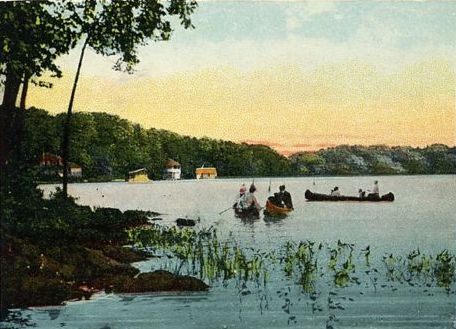
Independence Day in Mendon in 1882 was celebrated in a special way. Nipmuc Park, a family recreational resort, had its grand opening. There had been a renewed interest in Lake Nipmuc, the town’s most beautiful natural resource. It offered clean water surrounded by pure air. “Nature’s beauty spot” provided the setting for family festivities in celebrating the birth of our nation.
Opening day on the Fourth of July attracted hundreds of people who enjoyed many leisurely activities. There were opportunities for rides around the lake in row boats, sail boats, and a newly licensed steamboat. There was a clam bake at the grove near Nipmuc Hall. Swings, hammocks, and rocking chairs were available for visitors who wished to relax while listening to the spirited sounds of Brown’s orchestra. Picnic lunches were enhanced by summer treats that were for sale. After sundown, there was a fireworks display from John Guild’s cottage from the island. Nipmuc Park provided a Fourth of July to remember.
The celebration of our independence from Great Britain is a reminder of Mendon’s role in the early stages of the American Revolution. The town’s Fourth Meeting House at the north end of Old Cemetery was the site of fiery speeches and debate. The Sons of Liberty in Boston took note of Mendon’s nineteen resolves from a town meeting on March 1, 1773. Six scholarly residents, in response to a letter from Boston’s Committee of Correspondence, wrote wording that clearly defined the issues of the colonies. They included….that all men have naturally a right to life, liberty, and property, and that a just and lawful government must originate with the free consent of the people. Another resolve stated that quartering an army in a free country in times of peace without the consent of the people was a violation of rights of free men. The other resolves, similar in tone and eloquence, were debated and approved at that meeting. Colonial leaders, such as Samuel Adams, John Hancock, and Paul Revere, took notice.
The opening of Nipmuc Park on the Fourth of July in 1882 was a special celebration of our freedom. More than one hundred years earlier in 1773, the spirit of the American Revolution was exemplified at a Mendon town meeting, just down the street, near the corner of Providence Road and Blackstone Street. We celebrate the birth of our nation as July 4, 1776, and we credit Thomas Jefferson as the author of the Declaration of Independence. It was a proud day in our history, one to celebrate. Most certainly it could be said that the founding fathers of our nation were well aware of what took place at a Mendon town meeting three years earlier. Independence Day has a special meaning in our town, and it is with pride that we celebrate it.
Mendon Historical Society – June 11, 2015
(The Fourth Meeting House became obsolete by 1843. It was sold and dismantled. The wood was purchased by Holland Albee for a boarding house for the workers of his bakery. It currently exists as the home of Randy and Sharon Gebelein at 8 Hastings Street.)
For more information about Mendon in the American Revolution, see Dan Malloy’s website: hope1842.com.
Nipmuc Park and the Mendon Trolley
The establishment of Nipmuc Park in 1882 and the Milford – Uxbridge Electric Street Railway in 1901 created significant changes in how people lived their lives in Mendon. The park, on the western shore of Lake Nipmuc, offered clean water and air and a variety of recreational opportunities for weekend visitors. The resort and the new means of transportation led to changes in the town’s land use, occupations, and population. Mendon’s agricultural society and economy began a period of transformation that lasted through the 1940’s.
July 4,1882 marked the beginning of a new era for Lake Nipmuc. Nature’s beauty spot became the site of commercial entertainment. The dedication of Nipmuc Hall and the adjacent grove featured a clam bake and rowboat and sailboat rides. A special ride was a licensed steamboat tour around the lake. Swings, hammocks, and a bowling alley were available, and summer treats included ice cream, soda, and lemonade. Brown’s five-piece orchestra provided entertainment throughout the afternoon and evening. After sundown, there was a fireworks display from John Guild’s cottage on the island. The beautiful lake and recreational offerings attracted hundreds of visitors on opening day and on every weekend during the summer.
In December 1901, the electric street railway opened and purchased the park. New features were added such as electric lighting, a merry-go-round, a new theater, and a dancing pavilion. Vaudeville and burlesque shows were offered, and soon the park was the most popular resort in the region. The new attractions, plus the easy access by trolley, brought several hundred people from neighboring towns to Mendon every weekend.
Two Mendon residents, Tom and Bill Hackenson, recently reminisced about their days of working at the park as teenagers in the early 1940’s. Tom drove a launch, a tour boat holding fifty people, around the lake using a bullhorn to amplify his voice. He operated a variety of rides, including the merry-go-round. He also worked as a backstage prop man to set up and change decorations and equipment for burlesque shows. He recalled that several of the dancers were very talented, including Sally Keith, Sally Rand, Lili St. Cyr, and Ann Corio. Tom’s brother, Bill, worked at the roller skating rink and as a ground maintenance man. Both men felt that they were very fortunate to have had these jobs as adolescents in a time of economic difficulty at a place that had significance in the town’s history.
With the weekend use of the trolley focused on the park, it was the Monday through Friday use that created the biggest changes and opened new occupational opportunities for Mendon farmers. Factories and mills in Uxbridge, Hopedale, and Milford became easily accessible by trolley, and many young adults chose to give up the family business in agriculture in order to find employment out of town. As this trend continued for several years, many Mendon families decided that the new economic use of the land would be to sell it for housing development. As more houses were built, the town’s population grew. In 1890, 919 people lived in Mendon. By 1940, the population had grown to 1,315, and many residents were no longer involved in farming.
Nipmuc Park and the Milford-Uxbridge Electric Street Railway helped to create change in Mendon’s use of land, population, and economy. The popularity of the park was at its peak until the end of World War I, when an influx of automobile production greatly reduced the need of a regional trolley. The service ended in 1928. By the early stages of World War II, the trolley rails were pulled up throughout the country in order to use the steel for military equipment. The recreational use of the park had dwindled by the 1950’s. Mendon’s landscape of dairy farms, orchards, and pastures is in the past, but during the era of transition, the town had a special place on the shores of Lake Nipmuc that had been a stimulus of change. For the Hackenson brothers, they were pleased to have been a part of it.
Richard Grady
October 1, 2012
A History of Lake Nipmuc
The first people to enjoy the beauty and natural resources of Lake Nipmuc were the Nipmuc Indians. They lived at seasonal villages not far from the shoreline. Included were villages located at Pond Hill (northwest of Rte. 16), the Phipps property (off Park Street), and Wigwam Hill (off Millville Street). The Nipmucs, fresh water Indians, used the lake and the land surrounding it for hunting, fishing, and farming. Nipmugg Great Pond, as the natives called it, was mentioned as a point of reference in the Indian Deed of 1662. The deed authorized the sale of an eight mile square parcel called Squinshepauge to be sold as a new frontier settlement. The incorporation of the town of Mendon on May 15, 1667, and the King Philip War, 1675 – 1676, marked the end of the common use of the lake by the great Nipmuc people.
After the King Philip War, Lake Nipmuc was used for agricultural purposes by new families who moved into town during its resettlement. Robert and Sarah Taft built a new farmhouse about two hundred feet from the eastern shore in 1679. It was from this site that eventually evolved generations of farmers, town officials, philanthropists, and national leaders. The lake was known as Taft’s Pond, and a shoreline road leading to the residence was named Taft Avenue. The lake’s uses remained low key until after the Civil War.
It was in the late 1860’s that there was a new appreciation of the scenic natural beauty of the lake. It became popular for wealthy out-of-towners to board for the summer at Homer Darling’s home at 73 North Avenue, or the Adams House at 10 Hastings Street, or the Russell House at 1 Emerson Street.. Later, Sky Farm at 21 North Avenue became a summer residence. Lake Nipmuc had become known as a resort, with its healthy, cool air, its clear, pristine water, and its tree-lined shore.
The 1880’s were the beginning of the establishment of the lake as an extremely popular regional resort. John C. Wood was granted a license to operate a bowling alley at his building at Nipmuc Grove, and Charles E. Guild was granted permission to operate a steamboat for as many as twenty-five passengers at a time. Nipmuc Hall and Grove opened on July 4, 1882. It featured a clam dinner, lemonade, ice cream, and soda. It offered boat rides, swings, and hammocks. An orchestra played throughout the day, and there was a fireworks display at night. The new recreation site attracted hundreds of people every weekend throughout the summer.
The Milford-Uxbridge Electric Railway, also known as the Mendon trolley, began operation in December 1901. It purchased Nipmuc Park and provided easy transportation for visitors. A new theater was built that featured famous vaudeville stars (including Fred Allen). Electricity was installed, and more rides were offered. A restaurant and a new dancing pavilion were built. Nipmuc Park was the most popular resort in the area.
World War I and the growing popularity of automobiles changed the necessity of a trolley system and the operation of a lakeside amusement park. By the late 1950’s and early 1960’s, only the ballroom remained as the most popular feature. Bill Green offered Friday night record hops to area teenagers and a hall for wedding receptions and special occasions at Lakeview Ballroom. (Aerosmith) He also operated the Flame and Sword Restaurant. The Rouleau family purchased the property, renovated it, and changed the name to the Myriad Ballroom. It continues to serve as a popular hall for dining and dancing overlooking the scenic lake.
The town of Mendon purchased White’s Beach in 1964 for the purpose of a swimming facility for town residents. Allan Byrne was appointed as the recreation director. The Town Beach has served as a popular place for family summer entertainment ever since.
Lake Nipmuc has served generations of people in many ways over the centuries. It is more than an eighty-five acre spring-fed kettle hole. It is one of our natural resource treasures!
Richard Grady
Mendon, MA
Lake Nipmuc: Late 1940s – Late 1950s.
Judith Hattersley Oldfield, daughter of Stenson and Marjorie Hattersley, spent her summers there on Taft Avenue at her family’s cottage. The cottage was once owned by Marjorie Arnold Hattersley’s family.
George Murphy and his wife, who were both in vaudeville, used to spend their summers on Taft Avenue. They stayed in the green house to the right of White’s Beach (when facing beach).
Sally Rand spent a few summers on Taft Avenue when she was performing in burlesques at Lake Nipmuc Park. She stayed in the home later owned by the Newtons. This was next to the home of Police Chief Larson. A prominent judge from Providence would sometimes visit her.
31 Taft Avenue which is now (December 2012) for sale was once owned by the Cahill family. Jack Cahill was the police chief in Dedham, MA. He and his family spent many summers on Lake Nipmuc.
White’s Beach was owned at one time by Al and Marguerite White. They eventually sold it to the Boucher family, and Al and Marguerite bought a place on Old Taft Avenue close to Rte. 16.
One summer there was a group of gypsies living on the Rte. 16 side of the lake.
