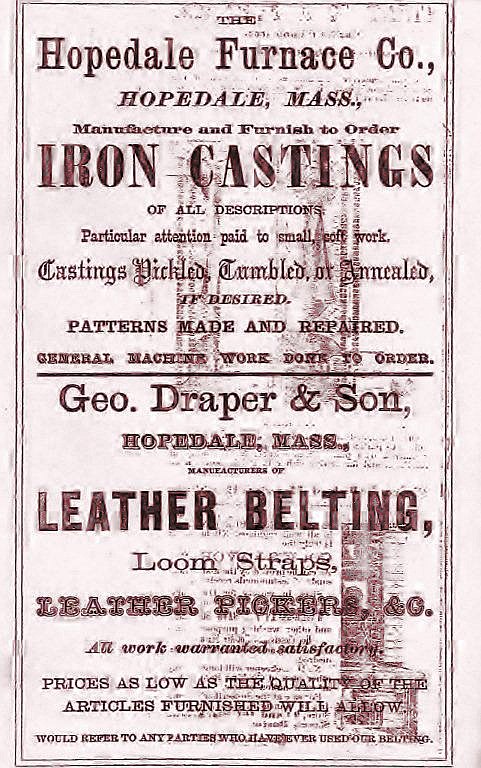
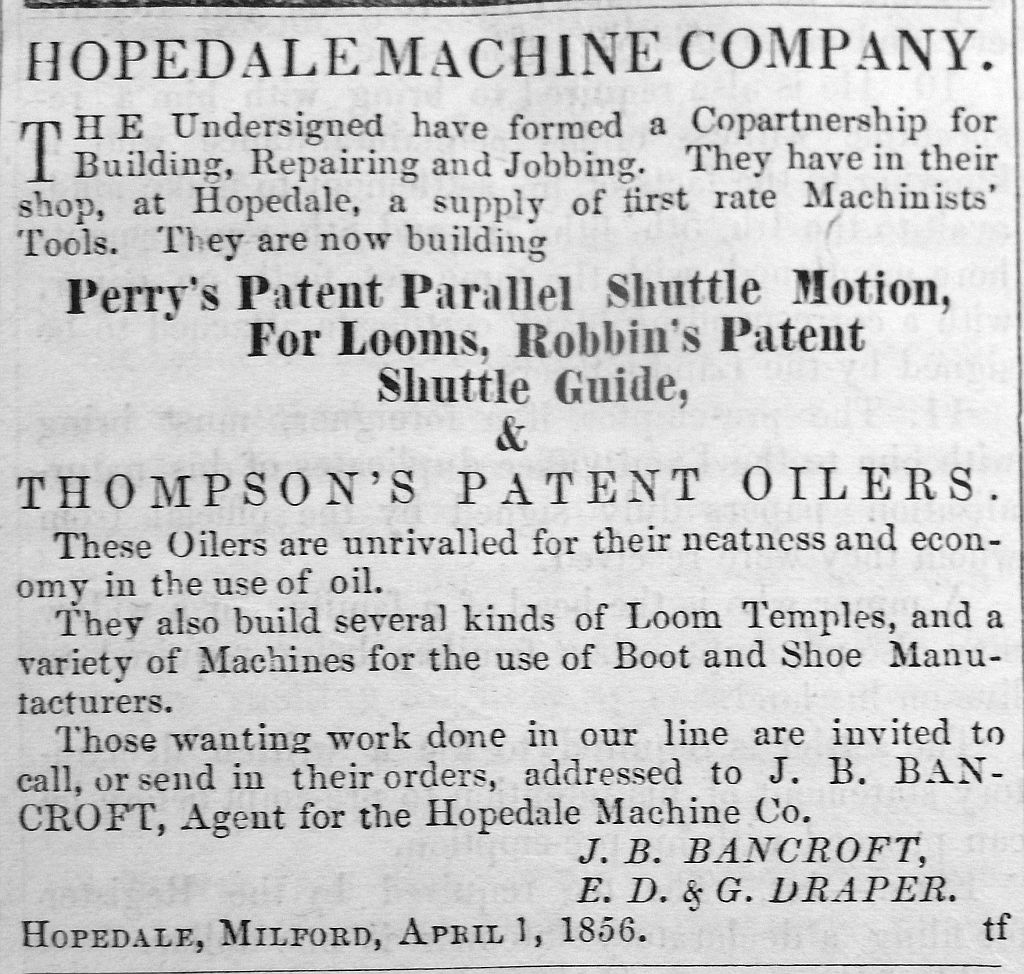
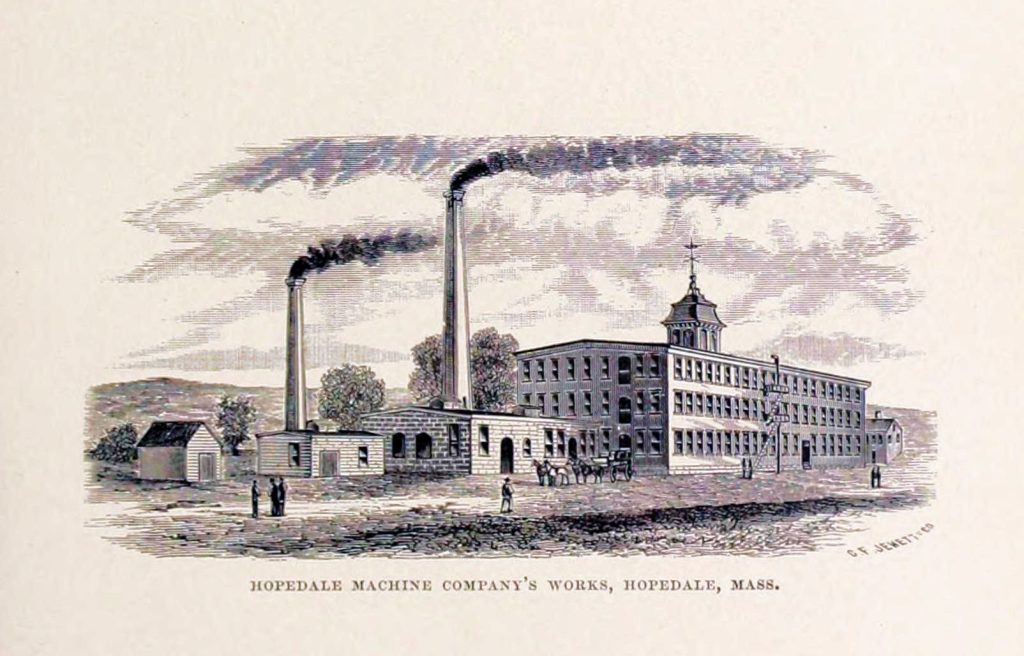
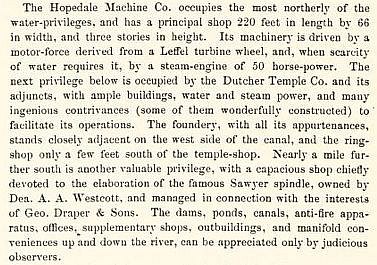
Before it became Draper Corporation, the business was operated as a number of somewhat separate companies, including the Hopedale Furnace Company (the foundry), George Draper & Son (later George Draper & Sons), Dutcher Temple Company, Sawyer Spindle Company, and the Hopedale Machine Company.
The Draper Business, 1856 – 1878
National Register Nomination
Kathleen Kelly Broomer, 2001
Ebenezer Draper and George Draper were entrepreneurial in spirit, and their business successes quickly transported them from the ranks of artisans and mechanics to industrialists whose financial resources did much to shape the appearance of Hopedale Village. Natives of Weston, Massachusetts, Ebenezer Draper and George Draper were the younger sons of Ira Draper, a farmer and machinery designer. In 1816, their father had patented a self-moving loom temple that enabled one weaver to run two looms instead of one.
The Draper brothers not only improved on their father’s invention, but also continually developed improvements for the weaving industry and acquired pertinent patents and businesses. In 1856, George Draper purchased an interest in Warren W. Dutcher’s innovative reciprocating loom temple and convinced Dutcher to move to Hopedale Village from North Bennington, Vermont. The Draper brothers became partners with Dutcher in the Dutcher Temple Company, located behind the Draper factory on Hopedale Street, where Social Street and Union Street once crossed Water Street. (This street configuration and the temple shop buildings were eliminated later in the 19th century with expansion of the Draper plant.) Dutcher had his Second Empire-style residence built at 14 Adin Street (ca. 1868). (His son, Frank Jerome Dutcher (1850-1930), was running the temple company in 1896 when it was consolidated into the Draper Company, at which point the younger Dutcher moved to a high-level position in the sales department of the Draper concern. Five years before becoming president of the Draper Company, Frank Dutcher had a house built at 34 Adin Street (1904), near his father’s house.
Other patents owned or acquired by the Draper brothers in the early years of the company included the parallel underpick shuttle motion, first patented by Warren W. Dutcher in 1846. The Snell & Bartlett let-off (1857) and Stearns parallel motion (1859) were original Draper patents, as was the frog with loose steel (1863). The Metcalf hand-threading shuttle (1868) was the first practical self-threading shuttle. Its development contributed to eliminating the industry practice of threading a shuttle by sucking the filling through a hole in its side, known as the “kiss of death.”
Ebenezer Draper retired in 1868, selling his interest in the company to his brother, George. George in turn sold it to his son, William Franklin (“The General”) Draper (1842 – 1910). Upon retiring, Ebenezer Draper left Hopedale; he died in 1887 in Boston.
Described as “a stereotype of the company-town entrepreneur,” George Draper is credited with having transformed Hopedale into a single-enterprise town and laying the foundation for its model image. (John Garner, Model Company Town, p. 167) Before joining the Hopedale Community in 1853, Draper had acquired varied experience on textile mills in Massachusetts and Rhode Island. At the age of fifteen, he worked as a weaver in a mill in North Uxbridge managed by his eldest brother. He moved on to positions as superintendent of a cotton sheeting mill in Walpole (starting 1834), spinner at Massachusetts Manufacturing Company in Lowell (1839-1843), and machinery designer (1843-1845) for Edward Harris in Woonsocket, Rhode Island, producer of fine woolens. Draper later managed the Harris mill in Ware, Massachusetts and immediately afterward superintended the entire Ware division. (Garner, 167) His keen business sense and strong management skills enabled his to synchronize production and employment at the Hopedale plant with the development of housing and recreation facilities, in addition to utilities, water resources, and fuel reserves. (Garner, 171) George Draper continued to expand the business after his older brother’s departure, reportedly acquiring a monopoly on spindles after buying the inventions of J. Herbert Sawyer of Lowell (1871) and F. J. Rabbeth of Pawtucket (1878). Draper brought Sawyer to Hopedale to set up and run his own department. (Garner, 132)
Both Ebenezer and George Draper died in 1887, and both are buried at Hopedale Village Cemetery. In that same year, a program began that led to the Draper Company’s most successful product, the automatic cotton loom.