Eben Sumner Draper, Jr.
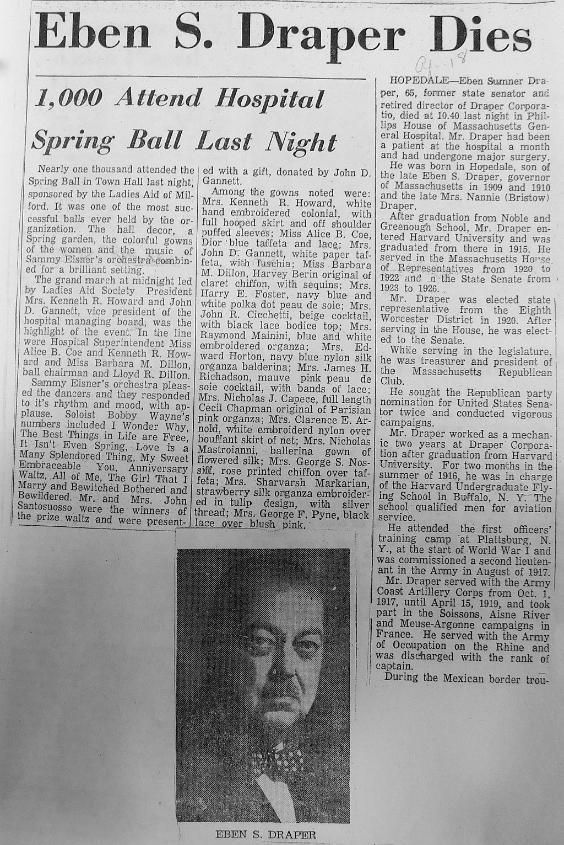
1893. After completing his prepatory education at the Noble and Greenough private school in Boston, he entered Harvard University, receiving the degree of A.B. in 1915. At the end of his sophomore term in college the young man took an extended trip to Alaska in which were combined exploration and hunting. He and four other hunters chartered a boat in Seattle. Two museum men accompanied them, a crew of twelve and Eskimos for whaling completed the compliment. The ship sailed to Nome through the Aleutian Islands to the Siberian coast and then to Point Barrow. When the ice pack broke, she ship rounded the Point and went eastward and was finally frozen in at a point forty miles west of the mouth of the Mackenzie. Winter quarters were built on the shore. The ship came out with its crew and men in October of 1913. Draper and three companions left the Arctic in November of 1913 and with the assistance of dog teams crossed the uncharted Endicott Range and arrived on the Yukon River, returning to Boston for Christmas. Having obtained his degree, Mr. Draper became associated with the Draper Company, but after a period of a year, in 1916, he became a student of aviation. As a preparedness measure he presented a plane to the state of Massachusetts, affording it the distinction of being the first state to own its own plane. For three months during the summer, he was in charge of the Harvard Flying School in Buffalo, New York. Out of the group of twenty-five students, eight were killed fighting in France during World War I. Entering the first Plattsburg training camp at the outbreak of World War I, Draper was commissioned provisional second lieutenant coast artillery corps of the regular army at Fortress Monroe, Virginia, August 15, 1917. Two weeks later he sailed for France where he attended the French artillery school at Abbeville, France. He was attached to the fifty-third artillery regiment of the United States Army, and on June 15, 1918 was assigned to the intelligence section of the third army corps as first lieutenant of the regular army. Soon after he saw active service in the offensive at Soissons, took part in the famous battle of the Marne, and was in the engagements at Aisne River and at Argonne. Finally Lieutenant Draper served with the Army of Occupation. In October 1918, he received his captain's commission, and on May 24, 1919 he was honorably discharged. Captain Draper had his initial military experience as a member of the First Corps Cadets of Massachusetts, where he served at first as a private and then as corporal from 1911 to 1913. During this period, he served at the Lawrence strike in Lawrence, Massachusetts. After World War I, he attained the rank of lieutenant-colonel in the National Guard, and was assistant chief of staff of the twenty-sixth division of that body from 1923 to 1927. In 1940 he became attached to the Massachusetts Intelligence Service at the State House and was a colonel during World War II. In 1921 and 1922 Mr. Draper was honored by election as representative in the General Court of Massachusetts. He was sent to the State Senate from 1923 to 1926. In Republican circles Mr. Draper was popular and prominent, and for four years he filled the position of treasurer in the Republican Club of Massachusetts. He was president of the club in 1925 and served in that capacity until 1928. In 1928 he was a candidate for the Republican nomination of United States Senator and was defeated in a hard contest. In 1930 he advocated the repeal of Prohibition and made that his principal issue in his campaign for the Republican nomination to the United States Senate and was defeated by less than 5,000 votes. Since then he has not been a candidate for public office himself but has assisted and managed various state-wide campaigns. Eben Sumner Draper is interested in many philanthropic enterprises, chief among them being the Milford Hospital, of which he is president. It was in connection with this institution that, in 1916, Mr. Draper, together with his brother, Benjamin Helm Bristow Draper, and his sister, Dorothy Draper Gannett, erected a nurses' home as a memorial to their parents. This hospital has grown greatly in size and he has been its president for many years. He also served as a trustee of the Massachusetts General Hospital for six years, being appointed by Governor Leverett Saltonstall. Mr. Draper has been director of the Milford National Bank since 1914, and president since 1936. He has served as a trustee of the Suffolk Savings Bank of Boston for twenty years and as a director of the Draper Corporation since 1934. Mr. Draper seeks relaxation in social life. He is a devotee of outdoor sports. He is a member of the Horticultural Society, being deeply interested in all phases of horticulture. His father's estate, The Ledges, has been his property since 1914 and he is greatly interested in the development of the land and gardens and the care of the gorgeous trees. He has traveled widely. He is a member of the Sons of the Revolution, the Somerset Club of Boston, the Country Club of Brookline, Massachusetts, Harvard clubs of Boston and New York, and the Brook Club of New York. Married first at Paul Smith's, New York, August 30, 1920, Ruth Lawrence Carroll. Married second, November 12, 1926, Hazel Marjory Archibald of Seattle, Washington. Issue by first wife: Nancy Carroll Draper, born August 28, 1922, at Boston, Massachusetts. The Drapers, Prestons and Allied Families, 1954. Eben Sumner Draper died on April 17, 1959 at age 65. He is buried in Hopedale Village Cemetery. In addition to Ebenezer Draper of the Hopedale Community, there have been three Eben Sumner Drapers in Hopedale. One was the governor, and another, the subject of this page, was his son. He's referred to here as a junior, in the hope that it will help to avoid confusing him with his father, but he didn't go by that for most of his life. The third was the son of Bristow and Queena Draper. Evidently at birth he was named Eben Sumner Draper, but at some point in his life he dropped his middle name. Mrs. Draper sails to England as a stowaway Draper Menu HOME . |


Cody. She was born in Boston, Mass., on Aug. 28, 1922, to Eben Sumner and Ruth Carroll Draper. Her grandfather, Eben Sumner Draper, Sr., served as Massachusetts lieutenant governor 1906-08 and governor 1909-11. She was raised and schooled in Charleston, S.C., and the family also had a home in Islip, Long Island, N.Y. In the early 1940s the family lived in Tucson, Ariz. Before purchasing her Wyoming ranch she also lived in Ridgefield, Conn. Her connection to Cody began as a child when she often visited Valley Ranch on the upper South Fork where she grew to love Wyoming’s mountains. She eventually purchased nearby property, including her Slide Mountain Ranch, where she raised cattle. She was the major benefactor of the Draper Museum of Natural History at the Buffalo Bill Historical Center, where she was a longtime trustee. Draper attended the Hewitt School, a K-12 girls school in New York City, graduated in 1940 with honors from Warrenton Country School in Virginia and attended Ashley Hall, a college prep school in Charleston. She also attended Goucher College in Baltimore, Md. She was one of six people appointed by the Admiral of the 6th Naval District to serve on the Headquarters Motor Corps. During World War II, at age 17, she was made the youngest supervisor on the East Coast of the Warning Center in Charleston. She later served four terms in the Connecticut Legislature. A breeder of Great Danes since 1945, she wrote “The Great Dane - Dogdom’s Apollo.” She was a recognized national and international judge of the breed and served as president of the Great Dane Club of America. She traveled extensively in Europe, Africa, Australia, New Zealand and Japan. She also authored a book of her photographs of African wildlife, “On Safari - Dogs are the Excuse.” She is survived by her sister Martha Crewe of California, nephew Sebastian Crewe of England, niece Sabrina Crewe and great-nephew Conrad Crewe of Cody, and numerous cousins and friends. Burial will be private. Cody Enterprise, January 2008 |


In the 1920s, Draper replaced his parents' home with the mansion shown above. |


Thanks to Milford historian Giancarlo BonTempo for finding, printing and delivering the article below. |
Comments on the paragraph at the top of page 99: The first whole sentence on the page say that Ira's sons and grandsons joined him. While his son James produced temples under the patent first owned by Ira, it's not certain that they were in business together. It may be that James bought the patent from his father. Later the patent went to James's brother Ebenezer, who produced temples in the Hopedale Community, starting in 1842. In 1853, Ebenezer's brother George joined the Community, and it appears bought a share of the temple business. Certainly by the time Ira's grandchildren were in the business, Ira was no longer living. He died in 1848. The first of his grandchildren to go into the business was William, (the general) son of George and Hannah (Thwing) Draper, who was born in 1842. Another impression left by reading the first paragraph on page 99 is that the Draper temple was the main part of the business. By 1856, George Draper became aware that a better temple had been invented by Warren Dutcher of Vermont. George convinced Dutcher to move to Hopedale and they went into business together. By the time the Draper Corporation was formed in 1916, their main product was an automatic cotton loom. They continued to sell temples (and of course they were part of the looms they manufactured) but it was the loom, not the temple, that made them the prominent company that they became. |


the crutches, and a number of other Eben S. Draper, Jr. items. Draper served in the Massachusetts House and Senate in the 1920s. In 1928 and 1930, he ran unsuccessfully for the U.S. Senate. One of his main campaign themes in the 1930 election was his opposition to Prohibition. The posters are about 38 inches wide and twice has high. At some point in his life, Eben was using crutches. He was really a big man, as you can see by the crutches leaning up against the inside of my front door. Click here to read more about Eben S. Draper, Jr. |

