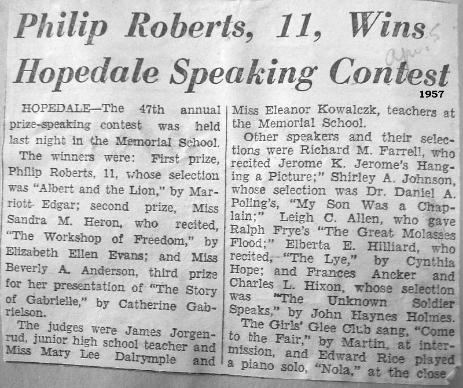
No, Phil wasn't 11 when he was a high school sophomore. That should have been Philip Roberts, II. |


March 15, 2015 No. 272 Draper Business, 1856-1878 Hopedale in March Worcester County Electric Company (now National Grid), 1960
were in an album that had been saved by Robert Biggs. I expect to add many more soon, but here's a start.
Friends of Adin Ballou peace essay contest During the past two weeks, additions have been made to the following pages: Princess Boncompagni (The princess files for divorce, 1922.) The Community House (1922 article on plans for the Community House and Milford News 1966 photo when there was a parking lot along the Hopedale Street side.) Tupper Lake (A 1948 Cotton Chats article about increased demand for bobbins, and how Draper was expanding their capacity to produce them up to a rate of 28 million per year. The Hopedale Community Historical Society (Clipping from a 1957 meeting.) Now and Then - Spindleville (2009 article on the opening of the bridge.) Hopedale Coal & Ice (Hopedale Ice Company ad, 1888.) Town Hall (Spa sold by the Dions to the DiVittorios.) Winter of 2015 (Yes, more pictures of snow.) Almon Thwing (Obituary) I've also added a clipping to the Now and Then, Chapel Street Block page, probably from the 1950s, titled Hopedale Home Being Razed Built Nearly 80 Years Ago. It quotes William Whitney who said that houses that had been along Hopedale Street where the Draper plant is now, were moved to Hopedale Street extension (south of Mendon Street, I presume) and to Prospect Street. Mr. Whitney was born in Hopedale and died here in 1963 at the age of 91, so it's safe to say that he knew a good deal about the early days of the town. <><><><><><><><><><> In a town like Hopedale, which has achieved unusual social, civic, and industrial success, the state of mind among the pupils and the conditions and problems in the schools are somewhat analogous to those of the well-to-do family. A child living in such an environment beholds prosperity on every side, but he does not perceive the years of effort, the vast amount of labor, nor the careful and intelligent planning which this prosperity has cost. He is pleased to believe that it has all come as a matter of good fortune, that he is entitled to a full share of it, and that all good things he sees will be his. The result of this state of mind is that the child develops a very large wishbone where his backbone ought to be. F. G. Atwell, Superintendent of Schools, 1910 <><><><><><><><><><> The Draper Business, 1856 - 1878 National Register Nomination Kathleen Kelly Broomer, 2001 Ebenezer Draper and George Draper were entrepreneurial in spirit, and their business successes quickly transported them from the ranks of artisans and mechanics to industrialists whose financial resources did much to shape the appearance of Hopedale Village. Natives of Weston, Massachusetts, Ebenezer Draper and George Draper were the younger sons of Ira Draper, a farmer and machinery designer. In 1816, their father had patented a self-moving loom temple that enabled one weaver to run two looms instead of one. The Draper brothers not only improved on their father's invention, but also continually developed improvements for the weaving industry and acquired pertinent patents and businesses. In 1856, George Draper purchased an interest in Warren W. Dutcher's innovative reciprocating loom temple and convinced Dutcher to move to Hopedale Village from North Bennington, Vermont. The Draper brothers became partners with Dutcher in the Dutcher Temple Company, located behind the Draper factory on Hopedale Street, where Social Street and Union Street once crossed Water Street. (This street configuration and the temple shop buildings were eliminated later in the 19th century with expansion of the Draper plant.) Dutcher had his Second Empire-style residence built at 14 Adin Street (ca. 1868). (HIs son, Frank Jerome Dutcher (1850-1930), was running the temple company in 1896 when it was consolidated into the Draper Company, at which point the younger Dutcher moved to a high-level position in the sales department of the Draper concern. Five years before becoming president of the Draper Company, Frank Dutcher had a house built at 34 Adin Street (1904), near his father's house. Other patents owned or acquired by the Draper brothers in the early years of the company included the parallel underpick shuttle motion, first patented by Warren W. Dutcher in 1846. The Snell & Bartlett let-off (1857) and Stearns parallel motion (1859) were original Draper patents, as was the frog with loose steel (1863). The Metcalf hand-threading shuttle (1868) was the first practical self-threading shuttle. Its development contributed to eliminating the industry practice of threading a shuttle by sucking the filling through a hole in its side, known as the "kiss of death." Ebenezer Draper retired in 1868, selling his interest in the company to his brother, George. George in turn sold it to his son, William Franklin ("The General") Draper (1842 - 1910). Upon retiring, Ebenezer Draper left Hopedale; he died in 1887 in Boston. Described as "a stereotype of the company-town entrepreneur," George Draper is credited with having transformed Hopedale into a single-enterprise town and laying the foundation for its model image. (John Garner, Model Company Town, p. 167) Before joining the Hopedale Community in 1853, Draper had acquired varied experience on textile mills in Massachusetts and Rhode Island. At the age of fifteen, he worked as a weaver in a mill in North Uxbridge managed by his eldest brother. He moved on to positions as superintendent of a cotton sheeting mill in Walpole (starting 1834), spinner at Massachusetts Manufacturing Company in Lowell (1839-1843), and machinery designer (1843-1845) for Edward Harris in Woonsocket, Rhode Island, producer of fine woolens. Draper later managed the Harris mill in Ware, Massachusetts and immediately afterward superintended the entire Ware division. (Garner, 167) HIs keen business sense and strong management skills enabled his to synchronize production and employment at the Hopedale plant with the development of housing and recreation facilities, in addition to utilities, water resources, and fuel reserves. (Garner, 171) George Draper continued to expand the business after his older brother's departure, reportedly acquiring a monopoly on spindles after buying the inventions of J. Herbert Sawyer of Lowell (1871) and F. J. Rabbeth of Pawtucket (1878). Draper brought Sawyer to Hopedale to set up and run his own department. (Garner, 132) Both Ebenezer and George Draper died in 1887, and both are buried at Hopedale Village Cemetery. In that same year, a program began that led to the Draper Company's most successful product, the automatic cotton loom. |

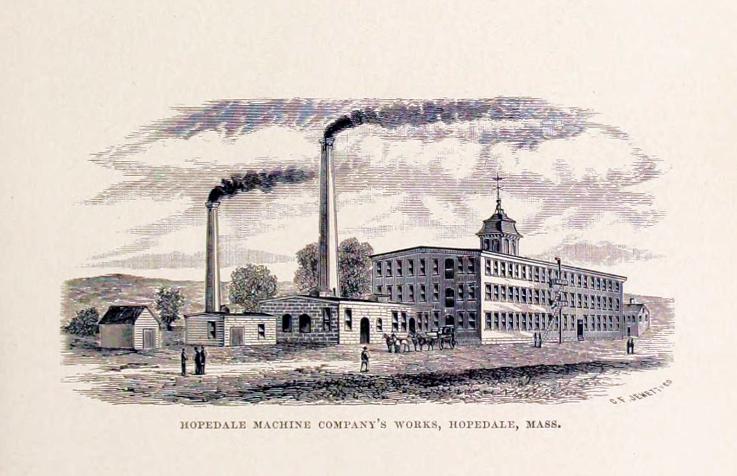
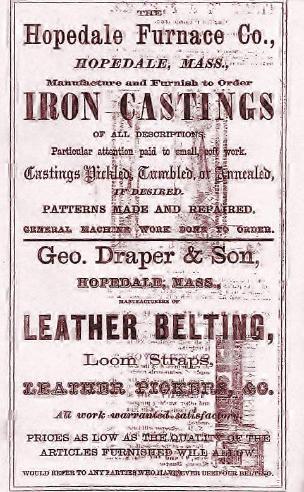
Before it became what we used to call "Drapers," the business was operated as a number of separate companies,including the Hopedale Furnace Company (the foundry), George Draper & Son (later George Draper & Sons), and the Hopedale Machine Company. |

