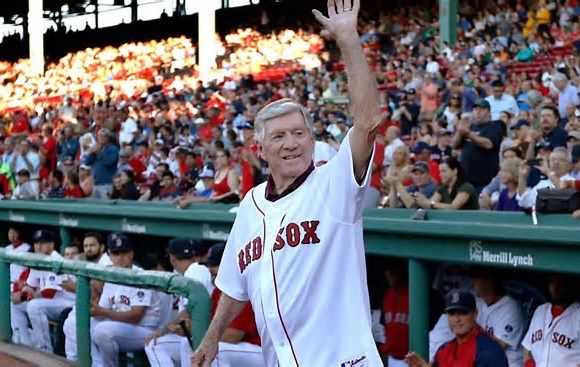
Joe Morgan – 1930 – 2026
Remembering the End of an Era
Telephone interview with Boston Red Sox manager Joe Morgan
By Doug Reynolds
December 16, 1990
The legacy of Blackstone Valley baseball endures even today in the major leagues. Boston Red Sox manager Joe Morgan played shortstop for the Draper Company team in Hopedale, Massachusetts, during the summers of 1949, 1950 and 1951. He recalls that an acquaintance, Johnny Turko, asked him to consider playing in the Blackstone Valley League when he was eighteen years old and preparing to start his college baseball career at Boston College. Morgan found the skill level of league players higher than any he had ever experienced. “You got a rude awakening in that league…college ball wasn’t as good as the Blackstone Valley League, no comparison.” Teams “had a ton of guys that played professional ball.”
Morgan credits three main factors for the high quality of play in the league. The first was the willingness of managers to pay for professional baseball services. In addition to average mill wages for a forty hour a week job as a ground’s keeper, Morgan received $25 for each baseball game – the payment rate for infielders and outfielders. “I worked two years for the mill and one year for the Larches. That was a bar just across the Hopedale town line. Hopedale was dry in those days.” (I’m sure most who were familiar with The Larches would object to Morgan’s description of it as a bar. It had been built as a Draper mansion. During Morgan’s time working there it was being used by Draper Corporation as an inn and restaurant. As Morgan said, Hopedale was a “dry town” in those days. It was said that the town line ran through the middle of the building and alcohol was served on the Milford side.) Pitchers and catchers on the Hopedale team received $35 per game and sometimes bonuses. Team officials also made sure players had housing and food. Morgan spent his first year in a Hopedale boarding house and succeeding seasons with a local family.
A second reason league teams were exceptionally good in the Morgan era was the age and maturity of a lot of the players. Many had “already been in the army for four or five years” where they found the opportunity to hone skills on semi-professional military teams during and after World War II. Nearby Fort Devens had a team “that was something” and regularly played Blackstone Valley League teams. Most players in the late 1940s under the G.I. bill continued baseball careers on college teams after leaving the service. The better industrial teams recruited players from the colleges. “It was tough,” Morgan explains, “on a high school kid. For a guy leaving home for the first time, it was quite an experience.”
A third reason for the quality of play in the league was the recruiting activity of mill officials. The Hayward–Schuster Mill in East Douglas drew southerners. Whitinsville had “some connection with the Phillies” organization. Hopedale was “mostly Holy Cross” when Holy Cross was still a national power in college athletics. “That was a good league in those days. There were an awful lot of really good players in it.”
Why did mills join the Blackstone Valley League and recruit the best players they could? “Entertainment. It definitely was entertainment. A real good crowd [in Hopedale] might have been 1,000 or 1,500,” and in a mill village of fewer than 6,000 people, that was something.
And why was the league discontinued? Morgan does not know. But his statements provide a clue. Draper Field, the ballpark his team played in, “…was a beauty. They made a parking lot out of it and sent the lights down south somewhere.” [Well, they didn’t make a parking lot out of it but they did send the lights south. I believe they went to Spartanburg where Drapers had a large plant.] Indeed, the prosperity of World War II and its aftermath did not continue in New England mills. With the migration of textile and related industries to less expensive labor markets, mill owners no longer had a reason to continue the league.
Park, Pond and Sports Menu Red Sox and Yankees play in Douglas