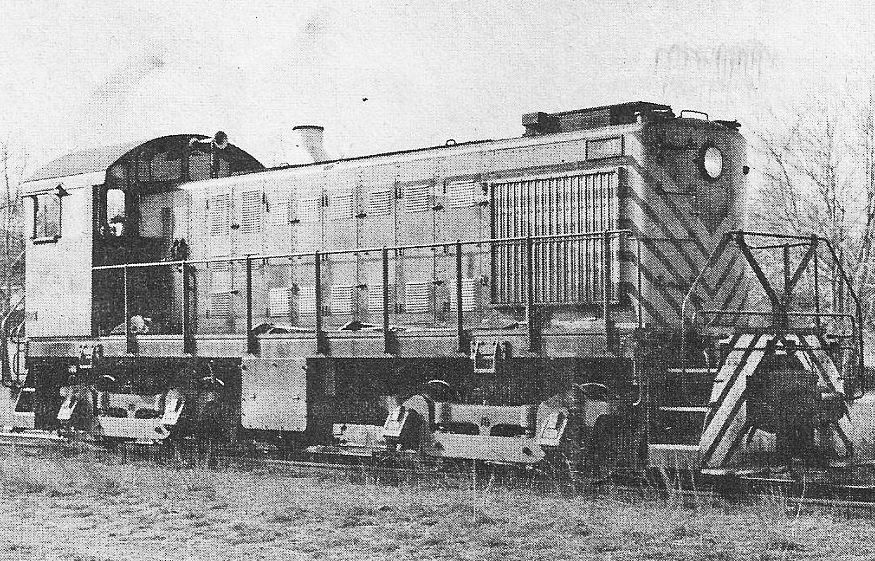
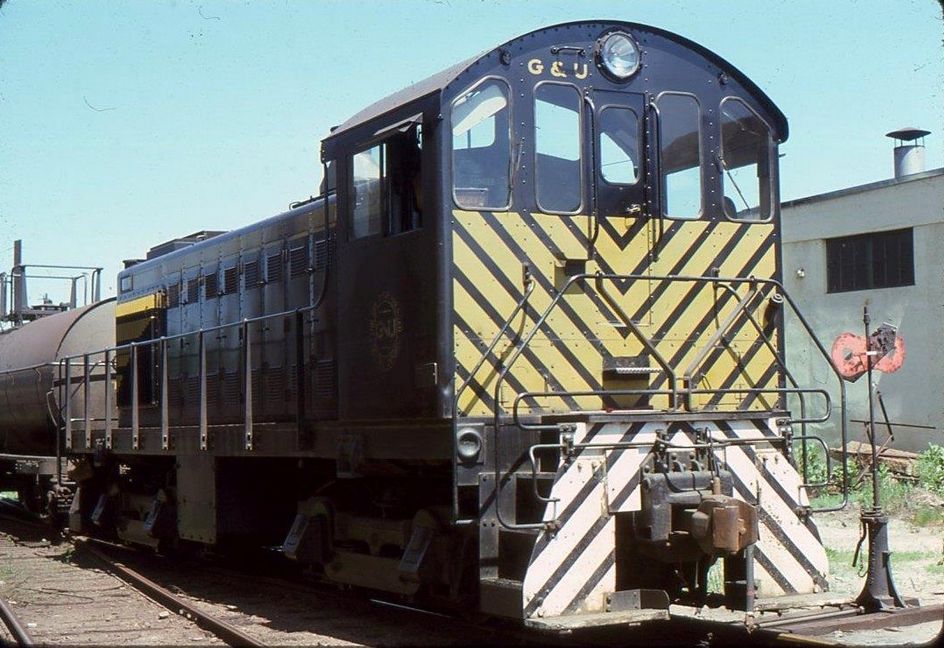
The locomotive on the trip described below must have been G&U No. 1001, shown above. Here’s what Gordon Hopper had to say about it in his History of the Grafton and Upton Railroad.
The company then purchased a 1,000 horsepower model S4 ALCO-GE locomotive for daily road service and it was put into use on July 1, 1952. The new locomotive weighed 121 tons, and it was identified as number 1001. When it was acquired, the cost was approximately $120,000 and it served as the road locomotive for more than 30 years.
Its original wheels were replaced during 1969, and on July 17, 1974 a set of two rebuilt trucks complete with traction motors were installed on the locomotive in the Hopedale yard by G&U personnel.
A Ride on the G&U Railroad
By Chester W. Walker
Worcester Gazette Staff Reporter
Despite trucks and airplanes, the railroads still have a place in this country. For many, it is a place in the heart. Just 75 years ago, rail service began between Milford and Hopedale, Upton, West Upton and North Grafton on the tiny Grafton & Upton Railroad.
On the anniversary of that beginning, May 17, 1890, Henry Billings II, treasurer and general freight agent of the 15-mile line, arranged for a group to take a ride.
Along with Fred Kardon of Athol, a photographer, and railroad buff Alfred Arnold of Holden and his son, Tad, we boarded the caboose and pulled out of the Hopedale depot at 11:35 am. Trainmaster F. Wilder Temple waved the signal and engineer Walter Beauchamp and conductor George Belcher started the daily run. Edward Aslanian, Robert Boudreau and Stanley Ferr completed the crew.
Behind the big locomotive rolled eight carloads of Draper Corp. looms, some headed for Mexico. Paul Roberts joined the passengers as the train rumbled past the new Draper Foundry.
There was no club car and certainly no diner, but the smooth, slow ride and the passing scene made our bagful of sandwiches a refreshing lunch. The trainmen knew every inch of the way (a few words missing here) deer and cattle crossings at Brook’s Farm, the green acres of Old Cemetery, then Brooks Street, where in 1927, and again in the early 1930s, flood waters from traversing streams washed out the tracks for more than 200 feet.
Then the train passed the Grove Street crossing and the site of the old Upton depot which no longer exists. Milk from local farms and hats from local factories were loaded years ago at this station.
Remarking on the fine condition of the roadbed, we asked Roberts what kink of timber they used for ties, since native chestnut is no longer available. He told us that native hardwoods, usually oak, had replaced the chestnut.
Picking up speed, we headed on. There were many crossings, and at each, bells and whistles signaled our approach. The Arnolds were taking full advantage of the unusual ride, each replacing the other at various vantage points. Al Arnold is a dyed-in-the-wool rail buff; no mistake about that, since he was making the trip on his vacation. He had recently returned from New Hampshire where he had ridden the rails of some long-forgotten railroad.
As the train climbed the gradual grade toward Grafton Center, Roberts told us that the line’s freight has changed a lot over the years. No longer is it milk, hats, grain and lumber. The main part is Draper supplies and manufactured goods, but Washington Emery Mills of North Grafton is still a good customer, and Jesse White’s Lake Nipmuc boats arrive in G&U cars.
Freight handling, too, has changed in Waterville, as Grafton’s north end is often called. Our diesel quickly dropped its eight-car load for New York Central pickup later, coupled up two cars of assorted hardware and our caboose, and started the homeward run. No turntable was required. The modern diesel-electric locomotives, unlike the old-time steamers, run just as well either way. Only 15 minutes was needed for the switch.
The return trip disclosed many places where curves had been straightened in the roadbed, the old bed still visible as an occasional cartpath. Dunn’s crossing in Grafton, we recalled, was cattle crossing even in the old trolley days.
Keeping the roadbed and right-of-way in good condition, we learned, is no easy task, even for a small line like the G&U. There is brush to be cut and burned, many culverts to be cleaned, warning signs to be repaired, and numbers of other tasks to keep a section hand busy.
Flocks of sheep and grazing cattle still populate the fields we passed, but cowcatchers are not standard equipment on modern locomotives.
Back in West Upton we stopped at the depot, not to take on mail or freight, but to take a few pictures. Then back into the caboose and on to Hopedale.
Seventy-five years ago Upton made quite a thing out of the opening of the new railroad. There were speeches and brass bands and girls carrying what was described as a “mammoth” garland of evergreen boughs. The citizenry paraded down to the now vanished Upton depot where two trains, one from Grafton and one from Milford, met in classic fashion. The next day the freight began pouring in, and the passengers also.
Divided into three gangs, a force of 300 men and 75 teams of horses toiled for months to cut through the rocky barrier that blocked the rails’ passage between the twin villages of West Upton and Upton Center, Hopedale on the south and Grafton to the west. (In Gordon Hopper’s history of the G&U, he wrote that the 300 men and 75 teams were used when the line was extended from West Upton to Hopedale and Milford.)
Agitation for a rail line had been in the air for several years, notably from 1879 when William Knowlton served as senator from the district at the State House in Boston. He became a director of the newly-formed line and a locomotive was named for him.
No longer does the G&U carry passengers as a regular thing, of course. Now there are swifter modes of transportation between Hopedale and North Grafton. None, we’ll vow, are more interesting than the “old reliable” G&U, still going strong after 75 years. Worcester Gazette, date unknown, but based on the first two paragraphs must have been in 1965.