Transportation in Hopedale in the Early 1900s
In the early days of the twentieth century, the best way to get from one part of the town to another was to walk. Traffic was almost none. A bicycle here and there, a horse-drawn wagon delivering produce, meat, coal or ice. In the hot days of summer, one had to watch out for a sprinkler, also horse-drawn, which would be out laying the dust in the unpaved streets. (With a close look near the center of the picture above, you can just about see the sprinkler wagon. Early town reports for here in Hopedale, Massachusetts show that the highway department had three of them back in the dirt road days.)
If one wanted to go to some other town, and walking was not feasible, there were available streetcars, powered by electricity, which could convey one, through connecting lines, to Worcester, Providence, or Boston.
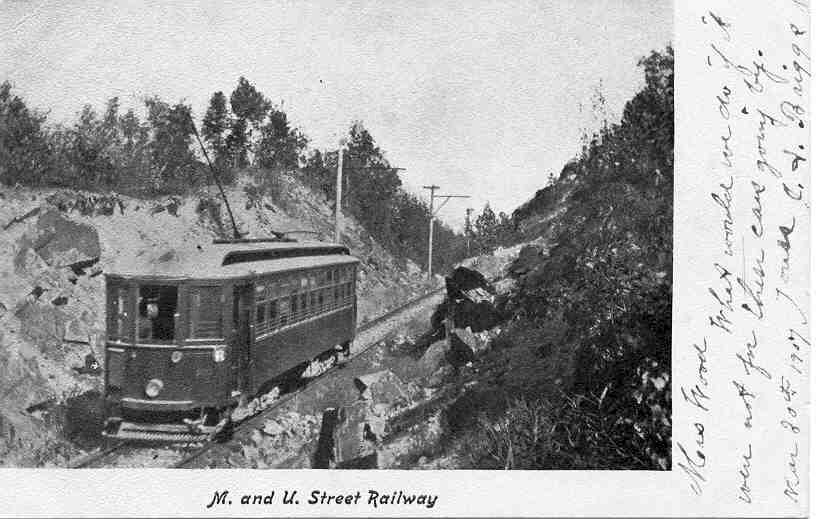
The electric cars, operated by the Milford and Uxbridge Street Railway Co., ran from Milford to Uxbridge, by way of Hopedale, Mendon and Nipmuc Park, where similar lines ran to other cities. The Milford connection ran through Caryville and Holliston to Framingham, where both electric and steam lines ran to Boston. The company also ran a car to Grafton, through Upton. A line at Grafton could convey one to Worcester.
In the summer months, the cars were open, with seats traversing the full width of the car, and running boards went the full length of the car on both sides. The seats had backrests which could be swung over, so that most of the passengers could ride facing front when the cars changed direction.
The power came from a wire running above the roadbed at a height of about fifteen feet. The contact was made by a pole secured to the car, with a free running brass grooved wheel, making contact with the live wire. Tension to keep the wheel in contact was done by a stiff spring, anchored to the roof of the car. The full length cars had one of these poles at each end of the car, and when the operator wished to reverse the direction, he would get out, and by means of a rope, which was fastened to the car, pull the pole down, and secure it by moving it to a position under a hook on the roof, and then go to the other end of the car, and make the connection, by reversing the process. If rain was falling, this was sometimes an interesting operation.
To control the car, the motorman had a handle which fit over the power plant outlet, with a contact point which touched the points on the system, which was like a rheostat, with more power coming as the handle moved from one contact to the next. Compressed air brakes were used to stop and hold the car. There was also a hand brake, similar to those found on freight cars, used to anchor the car when the operator left it. If the pole jumped the power wire, as sometimes happened, the motorman had to stop the car so the conductor could dismount and go to the rear. Using the rope connected to the pole the conductor had to replace the wheel on the power wire. At that point they were ready to proceed. The conductor had to move along the aisle to collect the fares. The fares were rung* up by pulling a cord which ran overhead the full length of the car and was connected to a digital counter at the end of the car. During the busy runs, when people may have been riding on the running boards as well as having the seats filled, collecting fares called for a considerable amount of dexterity. The conductor’s uniform had patch pockets in the jacket, lined with soft leather to protect the fabric. It has often been remarked that during these crowded car runs, it was very rare for a passenger to try to avoid payment of fare.
To make the run to Grafton, the conductor had to throw a switch at the end of Soward Street, let the car move onto the Grafton line, and throw the switch again to leave the Uxbridge line open. In zero weather, this could also be an adventure.
Soward Street had a double track, as did the part of Hopedale Street in front of the factory, as a great many employees came by the means to their work. The extra cars would go to Soward Street, manipulate the change of direction and return to the car barn, located on East Main Street in Milford, and wait to be called out for evening service.
At Nipmuc Park, a spur was located, which could accommodate several cars, which would remain there during a busy night, and take on passengers for the return trip. If you missed the last car at night, you made it home on foot or not at all.
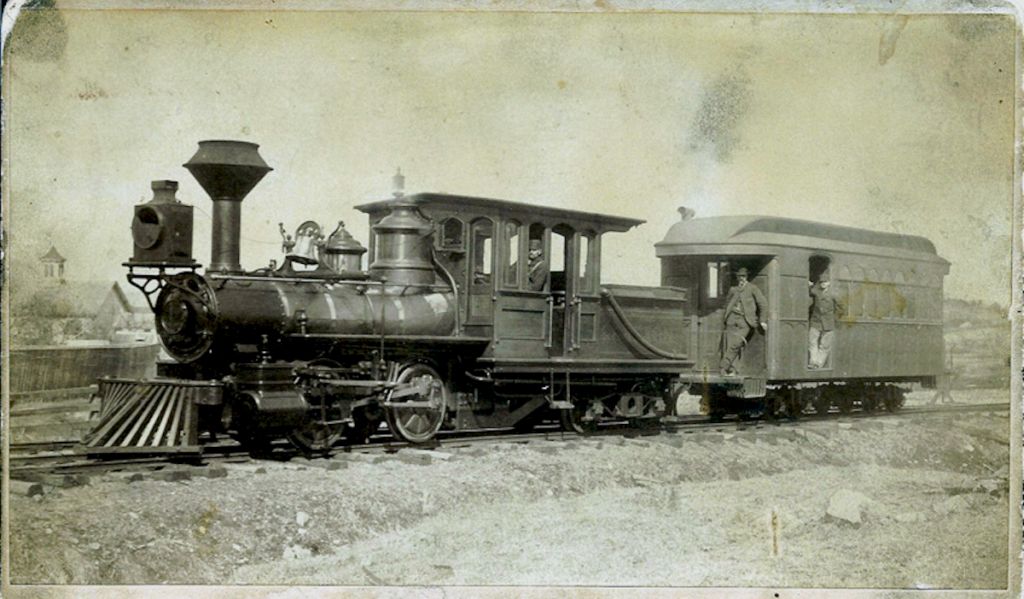
There were also small open cars, like those on the toonerville trolley, and when carrying a full load, they were rough riding and adventurous to ride. A steam operated train made a few round trips during the day between Milford and Boston. Anonymous. Found at Bancroft Library. Probably it was a paper given at a meeting of the Hopedale Community Historical Society.
* One line in the middle (it was at the bottom of the first page) was missing. Thanks to “trolley guy” Bob Heglund for filling in essentially what the author must have written.
In talking with kids about life in early America, I find that most seem to think that every family in those years had a horse. Actually, for people living in towns and cities, other than the wealthy, that would be very unusual. They were generally within walking distance of work, and had little time to travel anywhere, nor could they afford the expense of having a horse. On the few occasions when the need to travel beyond walking distance arose, where trains and trolleys weren’t available, they could generally rent a horse and buggy at the local livery stable. See further down on this page for more. DM
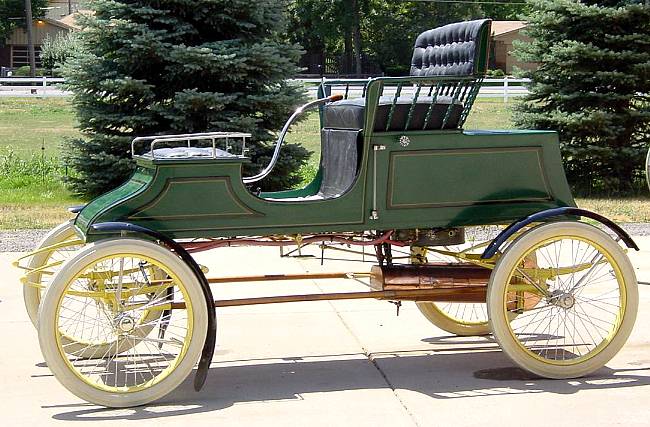
Auto Parade in Milford and Hopedale, 1904
Milford’s Early Transportation
By Gordon E. Hopper
MILFORD – Early transportation in the Milford area was supplied by railroads and stages which ran between Milford and Upton, Hopedale, Mendon and the Medways. These stages continued in use down to the time of the establishment of the trolley system.
The first impetus toward establishing connections with these towns, upon whom the local merchants depended much for their trade, came in 1887 when electric cars started to operate in Woonsocket, RI.
A great interest was evidenced in them and many Milford residents took a ride in their buggies to see them. All were excited and enthusiastic and during the following year, a streetcar company wanted the right to lay tracks on Central Street. A little later that same year, the Board of Selectmen granted the Milford & Hopedale Street Railway Company the right to lay such tracks.
Operations on Central Street started in 1891 and by 1896, electric cars were running from Milford to Framingham and Hopedale.
A special factory was built in 1892 for the manufacture of storage battery-operated cars but a fight over a patent right forced the discontinuance of these cars in Milford.
By this time, public sentiment was turning to the use of trolley cars and W.B. Ferguson, a man with a lot of money, interested himself in the establishment of trolley lines from Milford to the surrounding towns and in 1895, franchises were granted for rails to Framingham, Holliston, Medway, Hopkinton and Hopedale.
By 1896, a powerhouse which furnished electric current for the cars was completed and on May 15, 1896, service was started to Framingham. It is recorded that at this time, the fare to Boston by steam train was 75 cents, while the electric cars charged only 45 cents.
The Milford to Medway street car line was opened on September 27, 1897, and plans were underway for a Milford-Upton line at that time. This line was proposed to go through Central, Exchange and West streets to Upton. After much fighting among the selectmen, they heeded the choice of the people as registered at a public meeting and finally granted a franchise for this route. However, the towns of Grafton and Hopedale refused to grant the franchise and in 1902, it was decided to have the Upton cars run from Hopedale to Grafton on the Grafton and Upton Railroad tracks.
In another direction street railway development was more rapid. In 1899, the line called the Milford, Attleboro & Woonsocket was opened. Its Milford branch which opened on September 7, 1900, collapsed when the automobile made it a financial burden to its stockholders. The Milford-Hopkinton line became operational two years later.
The Milford & Uxbridge Street Railway opened on December 20, 1901 after absorbing the old Milford, Holliston and Framingham line. During 1901, this line carried 1,097,557 passengers and the Woonsocket lines carried 1,489,950 passengers.
Due to there being no railway connection between North Milford and the rest of the world, a trackless trolley company wanted a franchise to set up such a line to run to the isolated section.
These cars would have a trolley but no rails, thus making them cheaper to install and maintain. Over a period of several years, this company asked for franchises, got them and then lost them by not starting operations. They finally completely dropped out of the picture.
Trolley companies saw their doom approaching steadily with the influx of cars being purchased. Taxi services and private hauling by automobiles were digging into the passenger services of all the trolley lines in Milford.
The Woonsocket line was the first one to succumb. Their service had been unsteady and in 1925 it decided to quit. One the day of the discontinuance, the Johnson Bus Lines, Inc., started operating motor busses to Bellingham, Franklin and Wrentham.
The Milford & Uxbridge Street Railway stuck it out and in 1924 single fares were raised to 13 cents. In 1928, this line was purchased by the Citron-Byer Co. and trolley operations came to an end in Milford.
Research material used in the preparation of this feature story was supplied by Robin Philbin of Milford. Milford Daily News.
Auto Parade in Milford and Hopedale, 1904
Sylvester Roper and the Invention of the Mortocycle
Early Hopedale Highway Department vehicles HOME
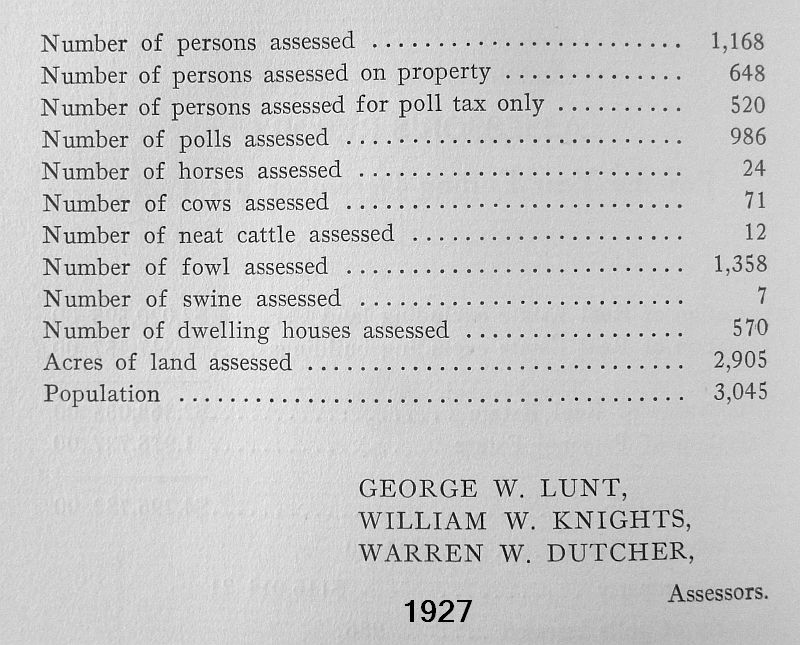
From the Hopedale town report for 1927, you can see a clue indicating that most people, at least those in manufacturing towns, and no doubt in cities also, in the early twentieth century, didn’t own horses. Hopedale in 1927 with a population of 3,045 had only 24 horses. Almost certainly they were owned by the few farmers in town, the Hopedale Stable, and the few wealthy folks. Factory workers weren’t going to be stabling and feeding a horse seven days a week for the few times a year they’d have an occasion to travel beyond walking distance. For the times when walking wouldn’t get them where they had to go, they’d take the trolley or rent a horse and wagon. In Hopedale, they’d rent from the Hopedale Stable.
The assessors’ report for 1892 shows fewer people, but more horses. The population was 1120 (living in 233 dwelling houses) and there were 126 horses. Just over one horse for every two houses, whereas by 1927 there was only one horse for about every 24 homes. Probably the arrival of trolley service and the automobile is the reason for this.
This site is mainly viewed by people familiar with Hopedale, Massachusetts, but this page is frequently viewed by people from all over the country and other countries. I presume that’s because a search for “transportation 1900s” usually brings up this page on the first page of results. Since those of you who are looking at this page may know nothing of Hopedale, here are a couple of sentences of introduction.
Hopedale is a tiny town of only five square miles with a population of about 6,000. It started asa Utopian commune in the 1840s, and later became the home of the Draper Corporation, at one time the world’s largest manufacturer of automatic cotton looms. It’s located in south- central Massachusetts, just a few miles north of the Rhode Island border and about six or seven miles southwest of the start of the Boston Marathon.