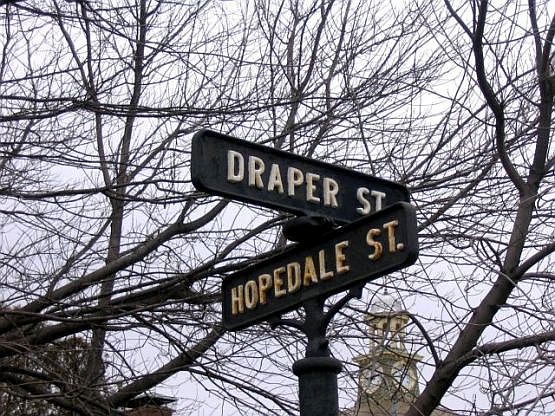
Street and Place Names in Hopedale
Below are the origins, as best as I’ve been able to determine them, for various street and place names in Hopedale. I haven’t included some of the more obvious ones such as the original Community names (Peace, Freedom, Hope, Progress, etc.)or others such as Lake Street, and Cemetery Street, except for cases where I have information beyond the obvious. Please email me (link on homepage) with additions, corrections and suggestions for this page.
If you’re looking for information on when the various neighborhoods of duplexes were built by the Draper Corporation, click here.
Here’s a paragraph written by Frank Dutcher in 1910, recalling Hopedale’s streets in pre-Civil War days. Our highways included the present Main Street (now Route 16/Mendon Street) running from Mendon to Milford past Mr. O.B. Young’s with Freedom Street at the northerly limit as the only other road to Milford. Freedom Street at that time went to Mendon, up the steep hill past the “Saltbox” place, now occuped by the Dillon family. Hopedale Street connected the roads through the center of the place. Dutcher Steet, then called High Street, only existed in the imagination, with the exception of the short section connecting Social and Union streets. There were no good sidewalks. Frank Dutcher, Hopedale Reminiscences
Here are a few sentences from Charles Merrill about Hopedale streets in 1910. The village streets were surfaced with finely crushed stone, which was easy on the horses’ feet. In hot, dry weather, they were wet down with a sprinkler cart drawn by a pair of horses, laying the dust and sending up a warm, humid smell as it passed by. The streets all had the same names that they do now, but no one but a well-informed citizen could know what they were. There were no street signs in 1910, and would not be until some time in the twenties when carrier delivery of mail came into being. Charles Merrill, Hopedale As I Found It.
I’ve heard that there were no street signs in Hopedale until the time when home delivery of mail began, because the Drapers felt they gave a cluttered appearance to the town. When home delivery began, however, they were put up because it was a postal system requirement. Evidently deciding that if they had to have them, they wouldn’t be flimsy little signs, Drapers made them in the company foundry. The Hopedale/Draper sign at the top of this page is an example of what they looked like.
Material followed by AB – HM is from Adin Ballou’s History of Milford. HHC is Ballou’s History of the Hopedale Community. Anything followed by DM you can blame on me, Dan Malloy.
Street and place names in blue text are links that will bring you to more information about them than you’ll find on this page.
Adin Street– Named for town founder, Adin Ballou. (And I just said I wasn’t doing the obvious ones. Well, I’ll leave Ballou Drive for you to figure out.)
Adin Ballou Park – On the original site of the Ballou home.
Bancroft Park / Bancroft Memorial Library – Joseph Bancroft, one of the Uxbridge group that was very important to the formation of the Community, moved to Hopedale in 1847. He married Sylvia Thwing, sister of the wives of Ebenezer and George Draper. As he rose through the ranks of the Draper Company he did very well financially. After the death of Sylvia in 1898, he decided to build a library and give it to the town in her name. Joseph served as president of Drapers from 1907 until his death in 1909. The house on the north side of the library was the home of the Bancrofts.
Billy Draper’s Store – Newspapers, tobacco products and other items sold there, but best remembered for selling candy.
Bridges of Hopedale Pond – Freedom Street, trolley bridge, Cutler’s bridge site, Rawson’s Bridge, Rustic Bridge.
Carpenter Road – Long-since discontinued, this road extended from Route 140 near the Upton town line and went from there to Mendon. The link will bring you to a Gordon Hopper’ article on the road, plus pictures.
Catherine Street – I’ve heard that the street was named for Katherine Kelley, mother of Gladys McVitty, whose husband developed the Dana Park, McVitty Road, Catherine Street neighborhood. How did it become Catherine Street if it was named for Katherine? My wild guess is that it was a mistake when the signs were ordered. (See Dana Park for more on the area.)
Centre Street – Centre St., in Hopedale Village, from Hopedale to Dutcher; on the recorded Plan of Hopedale site designated as Union St., accepted 1872. AB – HM It had seemed that Union Street was one of those names like Peace, Hope, Social, Freedom and Progress, that stood for the ideals of the Hopedale Community. However, based on what Ballou wrote in History of Milford, it was first named Centre Street and evidently was changed to Union later and had an origin other than Community ideals.
While the street was accepted in 1872, its name may have become Union before that. Possibly it was a Civil War era change, promoted by people who weren’t as anti-war as Ballou and the more faithful of the Community.
Chapel Street – The original chapel and school of the Community, was located in the block enclosed by Hopedale, Freedom, Dutcher and Chapel streets.
Chapel Street School – In addition to the chapel and school of the Hopedale Community mentioned above, there was another school on the same block. It was an elementary school, probably built in 1868. In reporting on the 1956 town meeting, the Milford Daily News stated that, “Residents voted to give selectmen permission to raze, sell or make other disposition of the abandoned Chapel Street School building and to sell the desks, chairs and other furnishings.” The building was razed, probably not long after the meeting.
Charlesgate Road – The “gate to the Charles;” a dead-end street off of Route 140, which ends near the Charles River.
Community House – And no, it’s not named the Community Center – it’s the Community House. Click on the link for more.
Cook Street – There were two gentlemen by the name of Cook in the original Community. For a while I thought that the street was named for William Walker Cook who had been one of the Uxbridge founders of the Hopedale Community. He sold seeds and nursery stock through a mail-order catalog. The other was Alonzo Cook. Originally a carpenter, he eventually became a paint dealer in Milford.
However, in History of the Hopedale Community, p. 129, Ballou tells of several purchases of land in 1844, ending with, “The third and most important tract was the Amos Cook farm of 108 acres lying directly south of and contiguous to our territory with an outlying wood lot of twenty three and a half acres, for which we paid $3,000.” This description places the Cook farm in the area where Cook Street is now located so it seems quite likely that that was the origin of the name. Further on in History of the Hopedale Community, Ballou has more to say about the purchase.
“During the year now under review, [1848] considerable addition was made to the Community Domain by the purchase of diverse lands contiguous to our previous estate, amounting in the aggregate to about 130 acres, thus increasing our territorial possessions to more than 500 acres.
The largest and by far the most important of these additions was that of the so-called “South Cook farm,’” containing with its outlying wood-lots some 65 acres. This lay directly south of our before acquired landed property, on the opposite side of the Mendon and Milford road and was divided by the highway leading to South Milford, Bellingham, etc., and hence conveniently located for agricultural and horticultural purposes, to which it was admirably adapted by the nature of the soil and by careful husbandry in later years.
We were now sole masters by legal title deeds of our little Mill River and nearly all the territory skirting it on both sides for about a mile in length, north and south, snugly ensconced between Magomiscock Hill in Milford on the east and Neck Hill along the border of Mendon on the west; as pleasant a location as could be reasonably desired for the purposes to which it was consecrated by us.” It appears as though more of the Cook farm that hadn’t been bought in 1844 was purchased in 1848.
Since I’ve already put so much down on one of the shortest streets in town, I might as well do a little more. From History of the Hopedale Community, pp. 171 – 2: “The year 1847 was one of general health on our Community domain, although one of our number, Mrs. Abigail Draper Cook, wife of Br. Wm. W. Cook, who had never been vigorous and strong, fell into a confirmed decline in the spring which resulted fatally on the 22d of July. She was but 27 years of age, a most estimable woman, of an admirable, devout, Christlike spirit, much beloved in life, and in death deeply lamented.” AB -HHC
Workmen from Rosenfeld’s Washed Sand & Stone Co. have completed bulldozing a new roadway off Hopedale Street in Hopedale. The new roadway is about 300 yards long and begins at a point near the G&U railroad bridge, goes along the old Moore property and comes out at a point further down Hopedale Street. James P. Hynes of Rutland, formerly a Milford resident, was responsible for the private roadway.
There are three street names designated on the plans. The short stretch near the bridge is to be called Cook Street; the long stretch in the rear running parallel to Hopedale Street will be Nelson Street and the short way coming out further down Hopedale Street is named Thwing Street. Land on this newly created way is owned by Mr. Hynes, who has been selling lots through an agent, William J. Donovan, 184 Hopedale Street. The lots, about 19 in number, are nearly all sold, and it appears that at least five houses will be erected there shortly. Milford Daily News, April 26, 1948 – See also Nelson Street
Country Club – Built on former Howard farm.
Cutler Bridge – A bridge across Hopedale Pond that has been gone for probably a century or more. Evidently it connected a farm on the east side of the pond to Salt Box Road which led to Mendon. The approach to the bridge still exists in the form of a peninsula that extends out into the water from the eastern shore. It appears to have been gone by the time the 1913 map of the Parklands was drawn, since it identifies it as “Site of Cutler Bridge.” See Bridges of Hopedale Pond. Also, see Cutler Street below.
Cutler Street – No. 30 [in Ballou’s list of abandoned home-sites] is the Cutler place, on an old discontinued “Drift-Way or Bridle-Road,” that led from what is now Freedom St., north-eastwardly, over the Cutler Bridge, towards the Dea. Rawson place. David Cutler was the most prominent early owner, and dwelt, in 1760, where the ruins now are. Then said “Drift-Way” was laid.
I have never been there to inspect the site but am told that it is situated on a north-easterly line from the Cutler Bridge, forty rods or more in the direction of the Rawson estate. I suppose the Cutler place descended to his heirs, was sold out to different purchasers, and ere long passed out of the family name. The house is said to have been tenanted last by one Pease, who had Indian blood in his veins. I have not been told the date of its final abandonment. AB – HM For more on this, see Cutler Bridge above, and use the link to see the map that shows the location of Rawson’s Bridge, and, evidently, the former location of Cutler’s Bridge.
Dana Park – This street was named for Dana Osgood. Osgood was the grandson of George and Hannah Draper and the son of Edward Louis Osgood and Hannah Thwing Draper Osgood. According to the town poll tax booklet for 1930, Osgood was 48, lived at 50 Greene Street (which later became the furniture business known as the Harel House) and gave his occupation as “manufacturer.”
Up into 1956, the street from the intersection of Hopedale and Greene streets to the other end at Greene Street near the Spindleville Pond was named McVitty Road. Louis McVitty was the man who developed the area. It its account of the March 1956 Hopedale town meeting, the Milford News reported that , “The name of McVitty Road was changed to Dana Park by the voters, with no discussion.” The southern end, however, kept the name, McVitty Road.
Daniels Street – Possibly named for Hastings Daniels or his family. In Hopedale Reminiscences, Sarah Daniels mentions that Hastings, owner of the farm which became the home of the Hopedale Community, died in 1839. The Community purchased the farm in 1841. In his History of the Hopedale Community, Ballou mentions it having been known as the Hastings Daniels place.
Darling Hill – The part of the Parklands along the Hopedale-Mendon town line. The name was used years ago but in recent decades it has become known as The Lookout; particularly the part of the hill where the stone shelter is located.
Dec Court – Named for mid-twentieth century selectman Zeny Dec.
Dennett Apartments – See Griffin-Dennett Apartments.
Dennett Auditorium – The auditorium at Hopedale High School was named for Winburn Dennett, principal of the school for many years. Dennett became a teacher at Hopedale High in 1919 and retired as principal in 1963.
Dennett Street – “As for Dennett Street, I don’t know which Dennett that is named for. My great-great grandfather, Winburn Dennett, [grandfather of the high school principal] came to Hopedale from Berwick, ME back around 1865. It may be named for him.” Charlie Dennett, e-mail, October 2003.
Depot Street – The street that goes from Hopedale Street to former location of the Grafton & Upton Railroad depot.
Draper duplexes – See page for a few pictures and a large amount of information on them.
Draper Field – Where the Draper team in the Blackstone Valley League played.
Draper Street – Why was one of the shortest streets in town named for Hopedale’s most prominent family? Very likely because George and Hannah Draper lived on the corner of what are now Hopedale and Draper streets. (The site of their house is now part of the Community House lawn.)
Driftway – Developed in the 1950s by Norman Henry who operated a farm at 200 Dutcher Street. A Milford News article at the time tells of the development. However, some sort of road existed there much earlier. For more on this, see Cutler Street.
Dutcher Street – Warren Dutcher of Vermont was persuaded to move to Hopedale by George Draper. Dutcher had invented an improved temple, an important loom part, and he and Draper formed a partnership. Originally Dutcher Street was named High Street. The name was changed sometime in the 1870s. On an 1870 map , it was still named High Street and it extended from Adin Street to Social Street.
On an 1886 map, by then named Dutcher Street, it ends at Freedom Street. On a map made in the 1890s, it extends a little beyond Dennett and there the map ends. A 1916 map shows it going beyond Lower Jones Road (still called Jones Road then). The upper end was called North Dutcher at that time.
Fireplaces – Years ago The Parklands fireplace/picnic areas were known as the First, Second and Third fireplaces. The First was the one two hundred yards or so after entering the wooded area north of the bathhouse. The Second was about two hundred yards south of the Rustic Bridge. The Third was the walk-in fireplace behind The Driftway. The area around the Third has long been known as Maroney’s Grove. In 1957,this naming system was complicated a bit when another picnic area was built between the First and the Second fireplaces. For more, start here.
Fisherman’s Island – An island about three-fourths of a mile up Hopedale Pond from Freedom Street. One of the three walk-in fireplaces in and around The Parklands is located there.
Fitzgerald Drive – Named for Frederick, Lloyd and Arthur Fitzgerald.
Freedom Street – From West, passing Dutcher and Hopedale, over Mill River, to Mendon line; in part a very old road, and in part new; having, as the matter now stands on record, two branches towards Mendon line, viz., the new North Mendon road, laid out by the county commissioners, 1870, and the old “Salt Box” road, as relaid by said commissioners, 1851.
The general course of this road was probably an early proprietors’ path, from the ancient Tyler neighborhood in North Mendon to now Milford Centre. It became first a legal town highway, 1748; alterations quite important in Hopedale, and sanctioned by the town, 1849; the old road west of Hopedale discontinued,1850, but re-opened by the county commissioners, 1851, with considerable improvements ordered, and finally the new road aforesaid laid by the county commissioners, 1870.
From West St. to the fork at the foot of Neck Hill the distance is about 425 rods, with a general width of 2 rods, made plus in some places for materials; the “Salt Box” branch is 158 1/3 rods long, and 2 wide; the new road branch is about 131 rods long, and 3 wide; entire length, 712 rods 10 links; the whole contents are about 10 acres 77 rods. Some extras for materials are included. AB – HM
Gannet Way – In the last several decades of the twentieth century and into the twenty-first, the only descendant of the Draper family of Draper Corporation fame living in Hopedale was Bill Gannett. Bill’s mother, Dorothy, was the daughter of Governor Eben and Nancy Bristow Draper. (There have been other Drapers living in Hopedale for many years, including recent times, but they weren’t related to the Draper Corporation Drapers.)
Garages – When the Draper Corporation owned most of the houses in Hopedale (most of the houses north of Route 16, anyway) they didn’t allow cars to be parked in yards, so areas with garages were established off of Bancroft Park, Jones Road, Lower Jones Road, Prospect Street, Hill Street, Cemetery Street and between Park Street and Inman Street
General Draper High School – The high school is on the site once occupied by General William Draper‘s mansion. According to the agreement when the land for the school was donated to the town by the general’s daughter, Princess Margaret Preston (Draper) Boncompagni, the school was to be known as the General Draper High School for a minimum of fifty years. (Or maybe forever.. Click here to read the legal paper and see if you can figure it out.)
Gen. Draper High School replaced the earlier high school on Hopedale Street. That building, in 1935, became the Sacred Heart Church. Eventually a new church was built and the old one was razed to expand the parking lot.
George Albert Draper Gymnasium – The gym was built in 1956, thanks to a $350,000 anonymous donation. It was named in honor of George A. Draper who, among other things, was the donor of the Community House. He was the son of George and Hannah (Thwing) Draper and the brother of Frances Eudora Draper, Hannah Thwing Draper, General William Franklin Draper and Governor Eben Sumner Draper.
“About 1910, when George A. Draper had become the general manager of the business, having taken over charge of manufacturing and loom development in addition to his duties as treasurer, the company broadened its work on improved mechanisms by directing part of its research to precision building of all old and new loom devices.” Five Generations of Loom Builders, p. 18. See also Boston Celtics Play at the Draper Gym.
Gleason’s Corner – A name used long ago for the intersection of South Main Street (Route 140) and Plain Street. One place where the term can be seen is in the report of fires in the 1926 town report. A chimney fire occurred at the home of a Mr. Varnum in April of that year with Gleason’s Corner given as the address. In town directories for that time, the only Varnum listed was George Varnum of 221 South Main Street. So far this is the only indication I’ve found as to where Gleason’s Corner was.
The Green Store – For many years a store, and later the Community Bible Chapel at the corner of Hartford Avenue and Route 140.As I update this in April 2023, the building has been for sale for more than a year. I expect that when the time comes to update again, it will have been razed.
Greene Street – Sometime around the 1940s or 1950s, the spelling was changed from Green Street to Greene Street. And now. as you follow Greene Street in Hopedale into Milford, it becomes Green Street. Harriet Greene was a very prominent member of the Hopedale Community. Did someone decide a century later to honor Harriet by adding the e? I have no idea.
Actually, it’s even more confusing than that, because in looking through old town records, prior to 1940, the final e comes and goes a few times. Here’s what Rev. Ballou wrote: “...from Main, near Fruit, passing Elm, Courtland, and Hopedale, to Mill; a small portion of the very oldest part (from the widow Sarah Clark’s to Ransom J. Clark’s) laid in connection with a now long-discontinued road to Mendon, 1723; a large section (from said widow Clark’s, northerly, to Cortland and Elm Sts.) [This reference is , of course, to Elm Street Milford, neither Hopedale as an independent town or Elm Street, Hopedale existing at the time this was written.] laid 1732; another section (from Ransom J. Clark’s to Mill St or thereabouts) laid 1773, in lieu of an older one further east; numerous straightenings, extensions, and improvements made, as follows: 1839, from Newell Nelson’s to the then widow Green’s (Not Harriet Greene evidently; no final e – could the widow Green, or perhaps the late Mr. Green be the source of the name? But if that’s the case, when did the e appear?) saw-mill, now Spindleville machine-shop; 1850 and 1851, the northerly new section added (from Main to Courtland and Elm; various other considerable improvements made at sundry times (mostly between the southerly end of the new section and the Newell Nelson place), all presenting a new respectable street about 490 rods long, with an average width which I shall call 3 rods.” AB – HM Click here for more about the name, Green/Greene Street.
Griffin-Dennett Apartments – The apartment buildings on Hopedale Street, near Route 16. Richard Griffin was the only Hopedale resident killed while serving in the Korean War. The apartments (not to be confused, as they often are, with Atria-Draper Place, the assisted living facility housed in the former Draper Main Office) are operated by the Hopedale Housing Authority. Mortimer Dennett was town clerk for many years in the mid-twentieth century.
Hammond Road – Built in 1946, Hammond Road was the last of the Draper housing neighborhoods. It was named in honor of Lowell Hammond, the first of fifteen Hopedale men killed in World War II. Hammond had enlisted in the Army Air Corps before the war and was killed on May 7, 1942 at Port Moresby, New Guinea. His brothers, Freeman and Robert (Zeke) also served in the war.
Harel House – Originally the home of Dana and Laird Osgood, it later became a well-known furniture (and more) store off of Greene Street.
Heron Lane – Named for Larry Heron who was severely wounded and left blind during combat in World War II.
Hope Street Bridge – The bridge once connected the section of Hope Street between Prospect and Dutcher streets with the part of Hope Street between Bancroft Park and Cemetery Street. it was built so traffic could pass not only over the Mill River, but also over the G&U Railroad tracks and sidings and various Draper facilities.
Howard Street – Up through the 1950s, a Howard family lived in this area and had a large greenhouse from which they operated their carnation business. The name Howard appears on Mill Street on an 1851 map. There once was a Howard Farm where the Hopedale Country Club is now.
Inman Street – When we first moved to Inman Street in 1970, we had a neighbor whose name was Lynwood Wrenn. His parents had lived on the street since the houses were first built, or shortly after. He told us that the street had been named for the Inman Farm that had been here before Drapers bought the land and built the houses. Fenner Inman was listed in the census of 1850 and also 1860. His occupation was given as laborer in 1850 and lumber dealer in 1860. DM
Jones Road/Lower Jones Road – These streets were probably named for the Jones Farm that was purchased by the Hopedale Community in 1841. According to a story I’ve heard many times over the years, the plan was to eventually connect the two Jones Roads, but either because of problems with ledge or because Drapers stopped building houses, it never happened. For many years, what is now called Lower Jones Road was called Jones Road, as was the street that is still known as Jones Road. Since the intention was to complete it, houses on the lower section were numbered from one to eight (and now to 12) and numbering in the upper section began at ninety-nine. Eventually it was decided that the two wouldn’t be joined and “Lower” was added to the name of the section of the street that connects to Dutcher. In recent years (the 1970s, I think) the formerly dead-ended Jones Road has been extended to Route 140. DM
Lake Street area – Draper duplexes built in 1910 – 1912. Soward and Progress street homes, and the Seven Sisters can also be seen on the page.
Lapworth Circle – I presume it was named for William Lapworth, founder of Hopedale Elastic Fabric Company.
The Larches – The mansion on the Hopedale-Milford town line on Williams Street. The first home thiere was built by George Otis Draper. Shortly after he sold it to his aunt, Hannah Draper Osgood, it burned. The home there now is what she had built after the fire. It later served as an inn for people from out of town doing business at Drapers. There was a restaurant there as well as an outdoor pool. There are still many larch trees on the property.
“George Otis Draper departed from the practice of building a large house on Adin Street and instead chose a site at 11 Williams Street, adjacent to the Milford town line and on a direct line with the plant via Freedom Street. His first home on the property, known as The Larches, had a castellated tower and burned in 1909. The present Colonial Revival and Craftsman-style house is one of the finest examples in Hopedale Village of the blending of these two popular styles.
A son of William F. Draper, president of Draper Corporation from 1887 to 1907, George Otis Draper was secretary of the company and represented his father’s interest in company matters.” Kathy Kelly Broomer, National Register Nomination.
Larkin Lane – Named for Judge Francis Larkin.
The Lookout – The location of one of three fieldstone walk-in fireplace/shelters in the Parklands. It was built in 1908 for $311.45. The area was originally called Darling Hill.The Lookout is located uphill from the railroad tracks, a short distance from Mendon town line. Access is from a dirt road beginning at the end of Overdale Parkway and also from a path up the hill from the Parklands road on the west side of the pond. This area was used regularly for camping by the Boy Scout troop in the mid-1960s and five well-constructed Adirondack shelters were built there. Unfortunately, before many years passed, they were all vandalized and burned to the ground.
Lower Jones Road – See Jones Road/Lower Jones Road.
Magomiscock Hill – The hill that has one end more or less along Highland Street in Milford and continues down toward Route 140 and then along the Hopedale-Milford town line toward Adin Street.
Edward Malloy Recreation Center – In March 2005, the hall at the Griffin-Dennet Apartments was named the Edward Malloy Recreation Center in honor of Ed’s 43 years of service on the Hopedale Housing Authority.
Malquin Drive – When the electric company bought land to put in the line that crosses Hopedale Street next to the present location of Malquin Drive, the owner of one parcel insisted on selling his entire lot, which was more than the company needed. My father, Ed Malloy, an employee of the company, and fellow employee Jim Quinn, purchased the land the company didn’t need, put in a road and sold about fifteen house lots.
The plan was to name it Malloy Street, and do another in Uxbridge where Qunin lived, to be called Quinn Street. However, highway supervisor, Freddie Evers thought combining the names into Malquin Drive sounded better and since he was the one who ordered and erected the signs, that’s what it was named. The first houses were built in 1957-58. DM
Maroney’s Grove – The enclosed fieldstone fireplace and surrounding area in The Parklands behind The Drftway, also known as the Third Fireplace. It seems that the name is more commonly spelled Moroney, but old maps show it spelled with an “a.”
McVitty Road – Named for developer Lewis McVitty. For more, see Dana Park.
Mellen Street – from Plain, passing Newton and Warfield, crossing South Main, passing Howard, crossing Charles River, to Bellingham line; a part of the ancient way to “the Great Meadow; named in honor of Henry Mellen, who dwelt on it much of his lifetime. AB – HM
Mill Street – From Plain, a little north of So. Milford cemetery, passing Greene, through Spindleville, over Mill River, to Mendon line; mostly an ancient road, partly laid in 1734, and partly in 1744; straightened, widened, and improved, 1792 and 1832. AB – HM
Nelson’s Grove – A grove where antislavery meetings were held in the 1840s and 1850s. It was described as being along the Mill River a half mile south of the village. It was probably on or very near to the present site of Nelson Street. Some references to it just refer to it as a grove or a pine grove.
The name, “Nelson’s Grove” was used by Nellie Gifford in Hopedale Reminiscences (p. 52), who wrote, “The Community was strongly Anti-Slavery in sentiment, and the celebrations of Emancipation in the West Indies, held in ‘Nelson’s Grove,’ were enthusiastic events, enjoyed too by the children.” This was written in 1910, and I don’t know if the area was known as Nelson’s Grove at the time of the abolitionist meetings or if that name came later. DM
Nelson Street – April 26 [1948] – Workmen from Rosenfeld’s Washed Sand & Stone Co. have completed bulldozing a new roadway off Hopedale Street in Hopedale. The new street is about 300 yards long and begins at a point near the G & U railroad bridge, goes along the old Moore property and comes out at a point further down Hopedale Street.
James P. Hynes of Rutland, formerly a Milford resident, was responsible for the private roadway. There are three street names designated on the plans. The short stretch near the bridge is to be called Cook Street; the long stretch in the rear running parallel to Hopedale Street will be Nelson Street, and the short way coming out further down Hopedale Street is named Thwing Street.
Land on the newly created roadway is owned by Mr. Haynes, who has been selling lots there through an agent, William J. Donovan, 184 Hopedale Street. The lots, about 19 in number, are nearly all sold, and it appears that at least five houses will be erected there shortly. Milford Daily News
In April 1722 Gershom Nelson purchased of Josiah Wood his large farm of some 200 acres, lying mainly just south of the Eld. John Jones est, in now Hopedale, though extending farther both east and west. Thither he immediately removed his family, and commenced the management of his new purchase.
Josiah Wood bought the bulk of this real estate of Capt. Seth Chapin, the original settler, in 1715, but had made some additions to it, and in partnership with certain neighbors erected a sawmill on its southerly skirt. The scant remains of the old dam are still discernible on the river, about half-way down from the Mendon-road stone bridge towards the new mill now in possession of Saml. Walker. But Mr. Nelson did not live long to enjoy his farm. He d. Sept. 14, 1727. AB – HM.
Newton Street – A short piece of road in South Milford, just south of the dwelling-house, once a schoolhouse, from Plain to Mellen St.; laid first, I am inclined to think, in connection with a piece adjacent to the cemetery in 1791, but afterwards ignored; laid anew, 1857. AB – HM
Northrop Street – At one time I assumed that Northorp Street had been named for James Northrop, the principal inventor of the Northrop loom. However, now I think it’s much more likely that it was named for his brother, Jonas. James had lived on Hopedale Street, near the center of town.
Article 4 – To see if the town will vote to accept and allow the laying out of a town way to be called Northrop Street, extending from the present Northrop Street, so called, easterly to William Street, as reported by the board of road commissioners, or take any other action in relation to the layout of said way. Town Report, 1907
Originally, Northop Street just went up the hill about as far as the Northrop house at the corner of Park Street. This article refers to the extension of it to where it meets Freedom Street. At that time, What is now called Williams Street was then known as William Street.
Octagon houses – There were once three of them in Hopedale. Go to the page for pictures and information about them.
Overdale Parkway – “Darling Hill Roadway cut in off Freedom Street. 1800′ of roadway completed – today known as Overdale Parkway. 1917“ Park Department History
The Parklands – “The Parklands covers the area surrounding Hopedale Pond, extending roughly from the Grafton & Upton Railroad right-of-way to the rear property line of houses on Dutcher Street. Landscape architect [Warren Henry] Manning designed the park, which encompasses approximately 273 acres, about thirty-six of which constitute the pond and islands.
The park includes a bathing beach (1899) and bathhouse (1904) near Hopedale Street. The Craftsman-style bathhouse is one story on a T-shaped plan, about five bays by two bays, with wood shingle siding and an asphalt shingle cross-gable roof. The building has overhanging eaves, exposed rafters, decorative bargeboards, and irregular fenestration with six-pane sash. On the pond side of the building are three doors, only one of which is currently operable.
An intact trail system (designed 1907) leads to scenic views and rock outcroppings and has outlets to Hopedale, Dutcher, Freedom and Hazel Streets. Tree stands of maple, ash, birch, hickory, and pine are native to the park. The following species were introduced: hemlock, tulip, mountain ash, Carolina poplar, black alder, striped maple, willows, Japanese barberry, red-osier dogwood, bittersweet, and cedars.
Within the mowed area immediately north of the bathing beach are two additions to the landscape: a one-story, hip-roofed garage facing Dutcher Street to the east, and, in a clearing overlooking the pond, a 1996 monument for the Hopedale Parklands nature Trail, dedicated to Willard W. Taft. The monument is a granite boulder with an attached brass plaque.” Kathy Kelly Broomer, National Register Nomination.
Patrick’s Corner – Delano Patrick was a member of the Hopedale Community. His son, Henry operated two grocery and dry goods stores. One was where the parking lot in front of the medical building beside the library is now and the other was at the intersection of Hopedale Street and Route 16 where Stone Furniture was. That intersection was known for many years as Patrick’s Corner.
Patrick Road – My guess is that it was named for Henry Patrick.
Pest House – The house at 366 West Street (Route 140) which was used in 1901 to quarantine Heman Hersey, an employee of Henry Partick’s Store, when he contracted smallpox. Hersey survived and lived for many years after his bout with the pox.
The town bought the house, I’ve been told, because it was off by itself and it seemed a good idea to get Hersey as far away from other people as possible. The town kept ownership of the house for a couple of decades or so before eventually selling it. As far as I know, it was never used as a quarantine house for anyone other than Hersey. My information on Hersey and the house came from Hester Chilson and from the 1901 town report. DM
Pete’s Meadow – The area that became the Draper dump, which was also for all practical purposes the town dump, near, and quite possibly including, Draper Field. This was mentioned to me by Arnold Nealley as a name he remembered from when he was young. He had no idea who Pete was.
Plain Street – From South Main, near the old Bowker place, passing Mill, South Milford cemetery, Newton, and Mellen, to Mendon line at the old “Country Road,” once so called; originally an ancient voluntary path of the first settlers; portions of it laid out at different times, — 1721,1723, 1791, and finally 1848, when it was widened and much improved. AB – HM
Ponds (very little ones)- There were several little ponds in Hopedale that were used for skating years ago because they froze long before Hopedale Pond did. One, called Frog Pond (there must be thousands by that name), was located in the woods behind Prospect Street. It couldn’t have been more than twenty by forty feet but many a hockey game was played on it by kids from the Prospect Street and Freedom, Oak, Jones Road neighborhoods.
There was another up behind the dump off of Freedom Street that was used by kids from the Overdale Parkway area. Water from it would get onto the street and freeze in the winter so it was drained many years ago.
Frog Pond filled in naturally over the years and no longer exists. I believe there was a small pond off of Mill Street and another near the cemetery. If you know anything of these, please let me know.
Brooks and swampy areas were also favorite places for kids to play. There was a brook that came down from the Oak Street area to Park Street and then went underground to the pond. There was a swampy area near Northrop Street just about where Tammy Road comes out. Neither are there now, having been eliminated by the building of Tammie Road, Gale Road and the extension of Jones Road. DM
Progress Street – See Lake Street page.
Rawson’s Bridge – A bridge that once crossed the upper end of Hopedale Pond, where the Rustic Bridge is now located. See Cutler Street. For both, see Bridges of Hopedale Pond.
Richard Road – I received the following from Todd M. Gleason: Richard Road in Hopedale was named after my late father, Richard N. Gleason, who purchased the first home on the street, 1 Richard Road, which was developed in 1985.
The Rustic Bridge – “The Rustic” is the fieldstone bridge over Hopedale Pond just about a mile up from Freedom Street. An earlier bridge there was made of wood. The link goes to a page about Hopedale Pond bridges a four different locations. The Rustic is at the bottom of the page.
Saltbox Road – An old road that ran to the north of and more or less parallel t Freedom Street in Hopedale and Hopedale Street in Mendon. In Mendon it ended at North Avenue and in Hopedale it came to somewhere near the railroad tracks at the bottom of the hill.
Most of it has long since been abandoned for vehicle use, but the area is part of the Parklands and the road is a good place for a walk in the woods. A short piece of it, west of the north end of Overdale Parkway can be found in the annual town street listings as Old Saltbox Road. There is one house with that address.
Here’s what Frank Dutcher, writing for Hopedale Reminiscences, had to say about what became Saltbox Road. “Freedom Street at that time went to Mendon up the steep hill past the “Saltbox” place, now occupied by the Dillon family “ For many years, the section of Freedom Street from near the bottom of the hill behind the old town dump, to the top of the hill near the intersection with Overdale Parkway was also referred to as Saltbox Road.
The Seven Sisters – The seven very similar duplexes on Freedom Street between the shop and the railroad tracks. From what I’ve heard, they were moved to Freedom Street during one of the periods of expansion of the Draper shop. They were originally on a part of Union Street that no longer exists – it was west of Hopedale Street. There was an expansion of the foundry in 1902, due to the success of the Northrop loom, and that’s likely when the houses were moved. (Memories of John Cembruch, who was born in one of the Seven Sisters houses.)
The Shop – Draper Corporation. In recent years you often hear it referred to as the mill. Back when business was booming there I don’t recall ever hearing that term used. It was always “the shop,“ or “Drapers.” More DM
Soward Street – Soward Street was named for Edmund Soward who joined the Hopedale Community in 1843. He was a mechanic and was also the Community expert on agriculture. Originally from England, he died in 1854. For more about the street, see the Lake Street page.
Spindleville – The area of Hopedale around Spindleville Pond and MC Machine Company, now also including the golf course and Laurelwood. For more on Spindleville, go to the Memories of Hopedale Menu and then to the stories of Frances Rae, Reggie Sweet and Roberta Simmons.
The Statue of Hope – The statue next to the Bancroft Memorial Library.
Steel Road – Named in memory of John Steel who was one of two Hopedale men who were killed in the Vietnam War. The other was Douglas D’Orsay.
Taylor’s Marsh – The millpond/marsh by the town line near Route 140. The town line passes through the middle of it. Half of it is in Milford and half in Hopedale. A Taylor family lived in the nearby house for many years. At least two of the Taylors worked for Hopedale Coal & Ice, and there’s some evidence that ice was cut on that pond. Possibly HC&I owned the pond and the house.
Thayer Street – The Thayers were a prominent family in the southern part of Hopedale for many years.
Thwing Street – The Thwings, originally from Uxbridge, were a very prominent family in the early Hopedale Community. Anna was the wife of Ebenezer Draper, Hannah was the wife of George Draper and Sylvia was the wife of Joseph Bancroft. Their brother, Almon, also lived in Hopedale. A grist mill, known as the Thwing Mill, was located about two hundred yards downstream from the bridge over the Mill river on Thwing Street.
Tillotson Road – Named for Walter Tillotson, who was killed in World War I. The American Legion post, whose home used to be at the corner of Hopedale and Depot streets (where the police station is now), was also named for Tillotson.
Trolley – The Milford & Uxbridge Street Railway came into Hopedale on what is now Route 16, turned onto Hopedale Street, and for some years ended at the intersection of Hopedale and Freedom streets. In 1900 it was extended across Hopedale Pond, along Soward Street and through the woods to Mendon. There it went along North Avenue to the center of Mendon, and then to Route 16 and into the center of Uxbridge. the link on the word Trolley at the beginning of this section will bring you to a menu for articles on the G&U Railroad and the trolleys of the area. Click here to go to a page on the remains of the trolley path from Milford to Uxbridge.
Warfield Street – From Mellen, southerly, to South Main; an ancient proprietors’ way, probably dating back, as a laid-out road, to 1718, though there is some uncertainty about the date; named with respectful reference to the Warfield families who for several generations have dwelt in its vicinity. AB – HM
Water Street – One of the earliest streets, dating to the Hopedale Community days, Water Street ran near to the Mill River. It can be seen in the Hopedale maps for 1854 1870 1885 Eventually it was built over as the Draper business expanded and more shops were built. It was discontinued in 1915. While it wasn’t discontinued until 1915, it disappeared from the maps well before that.
Article 2. Voted: Unanimously, that the highway known as Water Street, which extends northerly from land of Henry L. Patrick across the westerly end of Depot Street to land of the Grafton & Upton Railroad Company be and is hereby discontinued. Town Report, 1915, p. 22.
West[‘s] Cove – The cove on Hopedale Pond that comes within a few feet of Freedom Street. Is it West or West’s? I don’t know. It’s on the west side of the pond, but it’s also right by where the Tom West family lived for many years. Tom West was the president of Draper Corporation in the mid-twentieth century. The home was later occupied by Bill and Nancy Gannett. The Hopedale Coal & Ice Company icehouse once stood where the house is now.
West Foundry – The big green building near Fitzgerald Drive. It was named for Thomas West, president of Drapers for many years during the mid-twentieth century.
Westcott Mill – Also known as the Spindleville Mill, it was located on Spindleville Pond and produced, yes! you guessed it, spindles. There had once been a gristmill on the site (and another, the Thwing Mill about a quarter mile upstream) but the Westcotts produced spindles there. The Westcott family owned it for three generations. The building now houses the MC Machine Co. For more on the mill, go to the memories of Reggie Sweet.
Westcott Road – Named for the Westcott family that operated the Westcott Mill. (See Westcott Mill above.)
West Street Mill Pond – From what I can tell, the mill pond is just named Mill Pond. The town line between Hopedale and Milford meanders up through it.
White City – The neighborhood off of Route 16 near the Mendon line consisting of Hill Street and Cross Street. Until Drapers sold the houses, they were all painted white. John Chute’s White City memories. Hermina Marcus’s White City memories.
Williams Street – Town directories up until about 1930 list this street as William Street. At some point after that, it became Williams Street. This caused me to think that it had been named for General William F. Draper. There was already a Draper Street in town and the general’s son, George Otis Draper lived on William (or Williams) Street. However, while looking though the minutes of the Highway Commissioners, I found the following for March 17, 1893:
Petition received signed by G.O. Draper and others to lay out and grade Williams St and Freedom St from Williams St to Hopedale St.
Voted to lay out and grade as petitioned and the following abutters were notified to meet Thursday March 30th.
H.M.Co. [Hopedale Machine Company]
H.E.G.Co [Hopedale Elastic Goods Company]
F.J. Dutcher
Harriet Thompson
C.F. Roper
E.A. Darling
H.L. Patrick
Geo. Williams
D.L. Patrick
Gen. Draper
G.D. & Sons [George Draper & Sons Company]
Felix Kearney
Geo O. Draper
So it appears that the road was originally named Williams Street, later listed as William Street for some years, and is back to Williams again. Seeing the name Geo. Williams on this list of abutters. I suppose that it’s possible that the street was named for him and/or his family (However, I asked Hester Chilson about this once and she didn’t think so. Hester’s foster mother was the daughter of Mr. and Mrs. George Williams.) An early map shows what is now Williams Street listed as Northrop Street. DM
Do you have information on the origin of other street and/or place names in Hopedale? Send them in (e-mail link on homepage) and I’ll add them.
Hopedale Maps and Aerial Views Menu